
Scientists Find a Quadruple Star System in Our Cosmic Backyard
Two of the objects in the arrangement are cold brown dwarfs, which will serve as a benchmark for others throughout the Milky Way.

Zenghua Zhang, an astronomer at Nanjing University in China, and his colleagues were combing through catalogs of stars in search of cold brown dwarfs, interstellar objects that fall somewhere between planets and stars.
They found something odd, and rare, in the Milky Way.
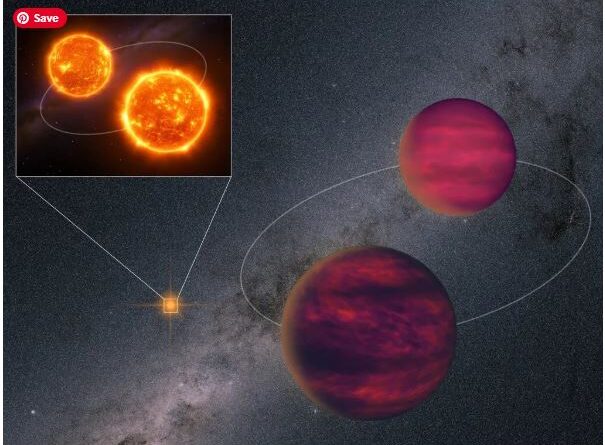
First, the astronomers identified what they believed was a lone brown dwarf orbiting a bright single star. Further investigation revealed that the brown dwarf was actually two. After submitting a paper about the discovery, Dr. Zhang said, they realized that the bright companion was a pair of stars, too.
“I like to call this a double-double,” said Adam Burgasser, an astrophysicist who leads the Cool Star Lab at the University of California, San Diego, and was involved in the discovery.
A study describing the quadruple star system — a brown dwarf dancing around another, locked in an orbit with two brighter stars also circling each other — was published by the Monthly Notices of Royal Astronomical Society this summer.
The discovery will help scientists untangle the properties of brown dwarfs. These objects form like stars but have too little mass to consistently fuse hydrogen, a process that heats a star and makes it shine. Brown dwarfs have atmospheres similar to gas giant planets, like Jupiter or Saturn.
But because they are cold and faint, brown dwarfs can be difficult to study. Astronomers typically search for brown dwarfs orbiting companion stars, which often burn brighter and are easier to measure.
According to Dr. Burgasser, these binaries of brown dwarfs and brighter stars often formed out of the same material, at the same place and time. Measuring the brighter stars, then, can be useful for estimating the properties of the fainter brown dwarfs, like their age, temperature and composition.
Such systems become benchmarks for understanding lone brown dwarfs across the galaxy, and the formation and evolution of the least massive stars. Finding two brown dwarfs around two brighter stars “helps twice as much,” Dr. Burgasser said. “It becomes kind of like a super benchmark.”
To hunt for brown dwarfs orbiting companion stars, Dr. Zhang and his team scanned stellar databases made with data from two retired space missions, NASA’s Wide-field Infrared Survey Explorer and the European Space Agency’s Gaia telescope.