
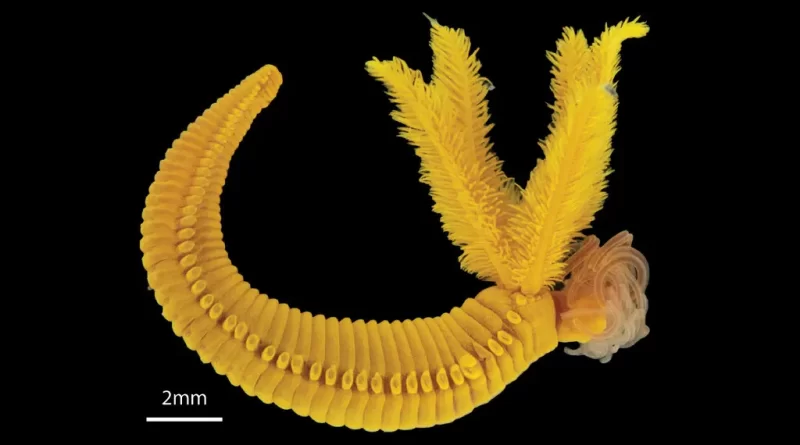
Trilobites : This Golden Worm Fights Poison With Poison

Arsenic is a toxic metal, and exposure to it has been linked with serious health issues like cancer and neurological disorders in humans. However, high levels of arsenic don’t faze Paralvinella hessleri, a golden deep-sea polychaete worm with featherlike gills and a mouthful of tentacles. In some of these worms, which reside along hydrothermal vents in the Pacific Ocean, arsenic accounts for 1 percent of their total body weight.
It’s not an organism that relies on arsenic to live. Instead scientists have uncovered how these worms survive deadly amounts of arsenic. In a paper published Tuesday in the journal PLOS Biology, researchers describe a novel process within the worms’ cells where accumulated arsenic combines with toxic sulfide from the surrounding water to create a less hazardous mineral.
Hao Wang, a biologist at the Institute of Oceanology in the Chinese Academy of Sciences and an author of the new study, likens the strategy to “fighting poison with poison.”
Paralvinella hessleri belongs to the family Alvinellidae, a group of small worms that thrive in extreme environments. Many reside near hydrothermal vents, a hellish environment where superheated water laced with toxic chemicals billows from fissures along the seafloor.
P. hessleri lives along the chimney-like vents themselves, an area largely avoided by other locals like squat lobsters and mussels. In addition to arsenic, these waters contain high concentrations of sulfides, a compound that can be more poisonous to animals than cyanide.
Dr. Wang was initially struck by the worms’ bright yellow coloration, which stands out in a ghostly environment awash in grays and whites. “For creatures that live in total darkness, producing vivid pigments doesn’t seem to make much sense,” he said. Other creatures that do have color, like giant tubeworms, are often dark red thanks to tissues flush with hemoglobin.

To learn more about these gold-hued worms, Dr. Wang and his colleagues examined several P. Hessleri specimens collected by a remotely operated vehicle near the Okinawa trough off Japan.
The scientists examined the cells lining the worms’ skin and organs and discovered yellow granules throughout their anatomies that resembled champagne bubbles.
While the granules were easy to find, their purpose was difficult to deduce. Initially, the scientists posited that they were symbiotic bacteria living inside the worms’ cells. However, closer analyses revealed that the structures were not living.
Puzzled, the scientists kept experimenting. One day, Dr. Wang added an alkaline solution to one of the specimens and was surprised to discover that the yellow granules dissolved and disappeared. This revealed that the granules were minerals. The granules’ yellow color, solubility and structure pointed to an arsenic sulfide mineral known as orpiment.
Orpiment is no new discovery. Humans have utilized it for millenniums as an insect repellent and a medicine. Medieval alchemists even believed orpiment could be used to make gold. The mineral was also prized as a pigment. Ancient Egyptian artists mixed orpiment with indigo to create deep greens. Renaissance painters like Titian and Raphael used the golden color to give their paintings a heavenly glow.
“Realizing that the same substance that once enriched human art also occurs inside the cells of a deep-sea worm made me smile,” Dr. Wang said. “In a way, nature had discovered how to use this pigment millions of years before we did.”

Humans largely stopped using orpiment because of its toxic nature. But the mineral is still in vogue in deep-sea worms. Dr. Wang and his colleagues posit that the worms form the mineral as the arsenic in their cells interacts with the sulfide bubbling up from the vents. Combining the toxic substances creates a less toxic byproduct.
The researchers speculate that this process also produces the worm’s striking coloration. It’s also a new example of biomineralization. Most organisms produce minerals to form hard structures like shells and teeth, but P. hessleri reveals that this process can also detoxify environmental hazards.
Peter Girguis, an evolutionary biologist at Harvard University who was not involved in the study, said the finding represented the first time that arsenic sulfides have been discovered within the cells of an animal.
He hopes the new findings will inspire researchers to search the animal world for other novel solutions to environmental hazards.
“This discovery reminds us that we are still learning about the myriad of ways in which life has evolved solutions to difficult problems,” Dr. Girguis said.