
NASA Launches Mission to Map the Bubble Around Our Solar System

A NASA mission, IMAP, and two more spacecraft that will study space weather are traveling through space atop a single SpaceX rocket

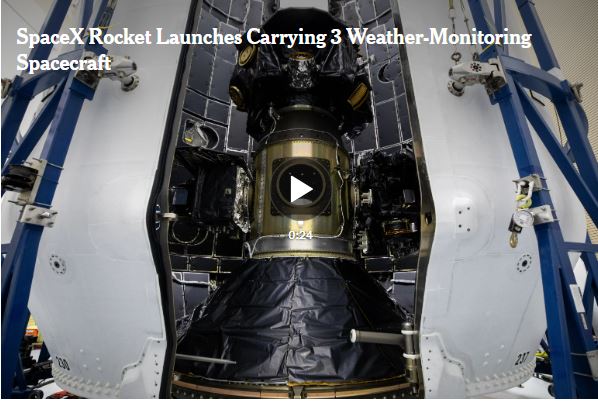
A SpaceX rocket launched on Wednesday morning carrying two spacecraft for NASA and one for the National Oceanic and Atmospheric Administration.
The two NASA missions are the Interstellar Mapping and Acceleration Probe, or IMAP, and the Carruthers Geocorona Observatory. The NOAA mission is known as the Space Weather Follow On-Lagrange 1, or SWFO-L1.
The missions will all study the solar wind — a stream of charged particles from the sun — and its effects on Earth and interstellar space. The flow of electrical charge creates the heliosphere, a giant magnetic bubble that surrounds the solar system and protects us from powerful and dangerous cosmic rays that crisscross the universe.
The NOAA spacecraft will provide crucial warnings when the sun belches a fusillade of high-energy particles at Earth. Such solar storms can disable satellites in orbit and crash electrical power networks on the ground.
The Falcon 9 rocket launched at 7:30 a.m. from NASA’s Kennedy Space Center in Florida, shortly after sunrise. About an hour and a half later, the three spacecraft separated from the rocket’s second stage.
They are all headed to the same part of the solar system — a region between the Earth and the sun known as Lagrange 1 where gravitational forces between the two are in balance. They are to arrive at their destination, close to a million miles away, in January.
“Having them fly together as one provides such an immense value for our American taxpayer,” Joe Westlake, director of the heliophysics division at NASA, said Sunday during a news conference.
IMAP’s cost, which includes $109 million for the launch, is $782 million. Carruthers will cost $97 million, and SWFO-L1 will cost $692 million.
Ten instruments on IMAP will measure various aspects of the solar wind, the particles streaming from the sun outward through the solar system. They will also study the magnetic bubble of the heliosphere, which is generated by the solar wind.
That protective bubble deflects much of the high-energy radiation from outside the solar system.
Without the protection of the heliosphere, life might not have arisen on Earth.
“Understanding that shielding, why it works, how it works, how much it can vary over time is obviously very important for human exploration beyond the near-Earth environment,” said David McComas, a professor of astrophysics at Princeton University who serves as the principal investigator for IMAP, including places like Mars.
One process that IMAP will study is charge exchange, when positively charged protons in the solar wind occasionally pick up an electron as they reach the outer part of the heliosphere. That changes them into electrically neutral hydrogen atoms, which can then fall back toward the inner solar system a few years later, where they can be detected by IMAP.
Such events are highly improbable — Dr. McComas calls it a 10 billion-mile hole in one — but there are so many solar wind particles that the rate will be high enough for IMAP to measure.
IMAP will also detect neutral particles entering the heliosphere from outside the solar system.
In some respects, SWFO-L1 is a replacement for Deep Space Climate Observatory, or DSCVR, which was launched in 2015 to serve as an early warning system for solar storms. DSCVR, however, has suffered repeated technical glitches, the latest glitch occurred in July. DSCVR has been offline since then with no timeline for a fix.
NOAA is currently relying on two older NASA spacecraft, the Advanced Composition Explorer, or ACE, which launched in 1997, and the Solar and Heliospheric Observatory, or SOHO, which launched in 1995, for its data on solar wind and the explosions on the sun that create solar storms.
SWFO-L1 includes more modern versions of the ACE and SOHO instruments.
The Carruthers Geocorona Observatory was originally named GLIDE, short for Global Lyman-alpha Imager of the Dynamic Exosphere. It will study the exosphere, a faint layer of Earth’s atmosphere that extends at least halfway to the orbit of the moon. Recording images of the exosphere will help scientists to understand how that part of the atmosphere interacts with the solar wind.
In 1972 an ultraviolet camera deployed on the moon by astronauts during Apollo 16 revealed that the exosphere glows.
When sunlight hits hydrogen atoms in the exosphere, it often pushes electrons in the atoms into a higher-energy state. When the electrons fall back into their lowest-energy state, the hydrogen atoms emit a specific wavelength of ultraviolet light known as the Lyman-alpha line.
The Apollo ultraviolet camera, designed by a scientist named George Carruthers, was the first to capture a global view of the glow known as the geocorona — Latin for “Earth’s crown.”
After Dr. Carruthers died in 2020, Paul Hertz, then the director of NASA’s astrophysics program, saw a connection between the Apollo 16 images and what GLIDE would study. Early in his career, Dr. Hertz had worked with Dr. Carruthers, one of the few Black scientists who worked on space missions during the Apollo era.
In 2022, NASA renamed GLIDE after Dr. Carruthers.
Lara Waldrop, the principal investigator for the Carruthers observatory, said her instrument employs essentially the same process that Dr. Carruthers had invented to shift light from ultraviolet wavelengths to visible ones. (The last step of recording the visible light photographs has been modernized from the film used by the Apollo astronauts to digital sensors.)
The exosphere is almost empty. The densest part, about 300 miles above the surface, contains 30,000 to 100,000 atoms per cubic centimeter, Dr. Waldrop said. That may seem like a lot, but many satellites, including the International Space Station, slip through these wisps of atmosphere at lower altitudes.
At an altitude of 50,000 miles, the density drops to about 25 atoms per cubic centimeter, said Dr. Waldrop, a professor of electrical and computer engineering at the University of Illinois at Urbana-Champaign.
Even with so few atoms, the exosphere appears to play a key role in how Earth’s atmosphere recovers from a solar storm. Electrons in the exosphere’s hydrogen atoms occasionally jump to high-speed protons in the solar wind, dissipating the powerful electrical currents that can disable satellites in orbit and power grids on the ground.
“This was underappreciated for a long time,” Dr. Waldrop said.
————————————————————————-
Kenneth Chang, a science reporter at The Times, covers NASA and the solar system, and research closer to Earth.