
WHEN THE CROWD TURNS FROM DEVOTION TO CHAOS

- Jay Singh Rawat
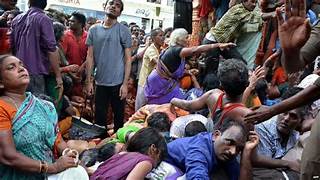
Someone once defined a stampede as a “terrible crime committed by a group of almost innocent people.” Unfortunately, India is increasingly becoming the stage for this “crime.” Every stampede news leaves a new stain on our society and governance system. The recent stampede at the Venkateswara Swami Temple in Tirupati, Andhra Pradesh, which claimed nine lives, has once again reminded us that crowd management in India still relies on luck. The administration, police, and organizing committees chant the tune of investigations and compensation every time, but the reality is that no one is punished, and no lessons are learned. Someone rightly said that a stampede is a terrible crime committed by a group of innocent people. This crime is repeated because our administrative system does not even consider it a crime. It dismisses it as an accident and moves on. Just look at one year, and the picture is horrifying.
Tragedies in a Single Year
In September, a stampede in Chengalpattu district of Tamil Nadu killed about 40 people; in August, four devotees died in Shivpuri, Madhya Pradesh; in July, two in Hathras, Uttar Pradesh, and six in Haridwar, Uttarakhand; in June, three in Puri, Odisha, and 11 devotees in Belagavi, Karnataka. The year began with a stampede in Tirupati, Andhra Pradesh. After that, incidents occurred at the Kumbh Mela, Delhi railway stations, and in Nashik, Maharashtra. Despite all this, no system has been put in place to ensure that the next crowd tragedy does not happen.
International Comparison: Result of Negligence, Not Fate
It is often said that in a country with a huge population like India, such incidents cannot be avoided. But this argument is not true. In countries like America and China, millions participate in religious, political, or sports events. Yet, stampedes there are now rare. The last major stampede in America was in 2023, killing only two people, and before that in 2021. In China, after 62 deaths during the New Year’s celebration in Shanghai in 2014, the government implemented strict security protocols for crowd control. Since then, such incidents have almost stopped there. This proves that stampedes are not fate but the result of negligence. In India, the Bureau of Police Research and Development has detailed guidelines on ‘Crowd Control and Crowd Management.’ These cover the width of entry and exit routes, crowd flow, barricading, emergency evacuations, communication systems, and the role of trained volunteers in detail. But how many events follow these guidelines? Almost none.
The Tirupati Incident and Historical Stampedes
In the recent Tirupati incident, the police washed their hands of it by saying they were not informed about the event. The question is: when 20,000 devotees were involved in preparing for this program, how did the police not know? This is not just incompetence but a case of administrative dishonesty. India’s history of stampedes is decades old. In 1988, 50 devotees died at the Dwarkadhish Temple in Mathura. In 2008, a stampede at the Naina Devi Temple in Himachal Pradesh claimed 162 lives. In 2013, 115 deaths occurred on a bridge near a temple in Ratlam, Madhya Pradesh. In 2016, 25 people died during a religious procession on the Malviya Bridge in Varanasi, and in 2022, 12 devotees were killed in a stampede at the Mata Vaishno Devi Temple in Jammu.
Ignoring Causes and Solutions
The police and administration claim every time that the arrangements were satisfactory, while the deaths prove that everything was only on paper. The main reasons behind stampedes are the same—wrong estimation of the crowd, inadequate exit routes, inaction by local administration, and the short memory of the public and media. Organizers assume that devotees will maintain discipline themselves. Most temples, fairs, and railway platforms have only one narrow lane or gate. The police and administration limit themselves to photo sessions before and after the event. A few days later, no one even remembers the names of the deceased. If China learned from its experiences and took concrete steps, why can’t India? For every major event, it can be assessed in advance how many people are likely to come. Modern technology and ‘crowd simulation’ software can be used for this. The central and state governments should make crowd management protocols legally binding. Police and volunteers should be trained on crowd behavior and psychology. With the help of drones and cameras, crowd movement, stagnation, and pressure points can be monitored in real time. The most important thing is to fix accountability—after every incident, move beyond investigations into “unknown causes” and take action against responsible officials.
Warning and the Need for Change
In a diverse and faith-filled country like India, crowds gathering is inevitable, but crowds being crushed is not. A new stampede every month only shows that we have learned neither from technology nor from administrative honesty. In the crowds at temples, fairs, and railway stations, the same fear, the same chaos, the same life-threatening mistake is repeated every time. Stampedes do not come like natural disasters; they are symbols of our society’s disorder, administrative indifference, and lack of responsibility. If we do not wake up now, the next tragedy will only leave the question of ‘when’ and ‘where’.
ABOUT AUTHOR : The author Jay Singh Rawat is a distinguished senior journalist with an illustrious career spanning 47 years, marked by his profound contributions to Indian media and literature. He has authored eight research-oriented books exploring diverse themes, including history, culture, journalism, tribal communities, and pressing Himalayan issues, reflecting his deep insight into socio-cultural narratives. A recipient of several prestigious awards, Rawat’s work continues to inspire through its blend of rigorous research and journalistic integrity, shedding light on underrepresented stories from India’s heartland. He is also an honorary member od editorial borad of this news porta…Admin