
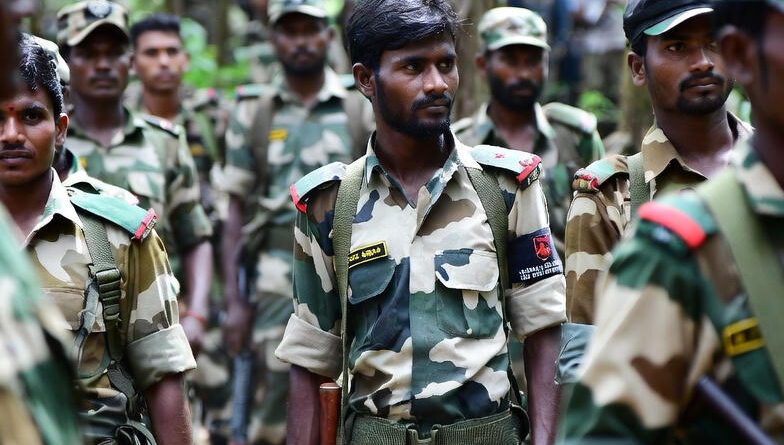
Beyond Bullets: Why Maoism’s Defeat in India Hinges on Healing the Red Corridor’s Wounds


-By Jay Singh Rawat-
November 20, 2025
As India’s security forces notch victory after victory against the Maoist insurgency—eliminating top commanders and coaxing thousands into surrender—the specter of Naxalism, that enduring emblem of left-wing extremism, seems poised for extinction. But in the dense forests and forgotten hamlets of the Red Corridor, a sobering truth emerges: true eradication isn’t forged in firefights alone. It demands a deeper reckoning with the grievances that birthed the rebellion half a century ago. Without bridging the chasms of inequality and neglect, this “zombie insurgency” could lurch back from the brink, no matter how many leaders fall.
The battlefield ledger for 2025 reads like a requiem for the Communist Party of India (Maoist). May brought the death of general secretary Nambala Keshava Rao (alias Basavaraju) in Chhattisgarh, alongside 27 cadres—a blow that shattered the group’s command spine. By November, the neutralization of Madvi Hidma, the elusive architect of the Maoists’ military wing, in a cross-border clash between Andhra Pradesh and Chhattisgarh, amplified the rout. These strikes, coupled with over 1,225 surrenders by October—including pivotal women commanders in Chhattisgarh and Madhya Pradesh—have shrunk the once-vast Red Corridor from 76 districts to beleaguered enclaves in Chhattisgarh, Jharkhand, and Odisha.
In Andhra Pradesh and Telangana, the Maoist footprint is already spectral, their operations deemed “finished” by seasoned observers. Operations like “Kagar” have felled around 270 insurgents this year, inching toward Home Minister Amit Shah’s March 2026 deadline for total eradication. Arrests—50 in a single Andhra Pradesh sweep last week, arms caches seized—paint a picture of a fractured foe: riven by infighting, starved of funds, and cornered by unremitting pursuit. “Their ability to wage war is crumbling,” confides a counter-terrorism veteran. Yet, for every tactical win, the insurgency’s ideological embers glow on, fed by the very soil it scorches.
The Roots Run Deeper Than the Guns
Naxalism didn’t erupt from ideology alone; it sprouted from the fertile ground of despair in 1967’s Naxalbari uprising. Adivasi communities, displaced by mines and dams, stripped of land rights, and sidelined by a development model that bypassed them, found in Maoism a voice—and a weapon. Today’s violence, though diminished, exacts a grim toll: 255 lives snuffed out in clashes this year, a reminder that the beast, while wounded, still bites. Human rights watchdogs decry the collateral cost—innocent deaths in crossfire—that sows seeds of fresh alienation.
History whispers warnings. The 2000s’ iron-fisted campaigns pared Naxalism from a pan-Indian peril to a regional whisper, but without uprooting its socio-economic anchors, it persisted. Splinter groups, urban recruits, or even digital echoes could revive it if the state falters on follow-through. “Bullets buy time,” says Ajai Sahni, a leading expert on internal security. “But only justice builds permanence.”
Mending the Last Mile: The True Path to Victory
Herein lies the pivot: eternal elimination demands more than bullets. It calls for robust development in the Red Corridor’s “last mile”—those remote trails where schools stand half-built, roads dissolve into mud, jobs remain mirages, and justice is a courtroom a hundred kilometers away. Initiatives like the Aspirational Districts Programme show promise, channeling funds into education, healthcare, and skill-building for the marginalized. Yet, implementation lags; corruption nibbles at edges, and bureaucratic inertia stalls progress. Imagine, instead, Adivasi youth wielding laptops, not rifles—cooperatives thriving on sustainable mining, not sabotage.
Fail here, and this zombie insurgency might just shamble back from the grave, cloaked in new guises of grievance. As India eyes a Maoist-free horizon, the real victory lies not in silencing guns, but in mending the divides that loaded them. The forests of Chhattisgarh may yet bloom with hope—or harbor embers of unrest. The choice is ours: a nation that conquers rebellion through compassion, or one that merely postpones the storm. The hour demands the former.
( The author is a senior journalist having experience of almost 5 decades in the field. He has authored 9 research books and edited several other publications. But Views expressed in the article are authors own-Admin)