
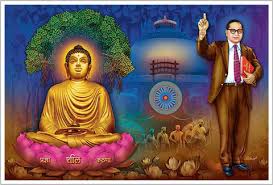
Educate, Agitate, Organise, Liberate: Babasaheb Ambedkar and the Dhamma Revolution

-BY- JAY SINGH RAWAT
Today, on the 69th Mahaparinirvan Diwas, we bow our heads in eternal gratitude to the architect of modern India, Bharat Ratna Dr. Bhimrao Ramji Ambedkar — the scholar, jurist, economist, social revolutionary, and above all, the chief draftsman of the Indian Constitution.On this very day in 1956, Babasaheb attained Mahaparinirvana in Delhi, leaving behind a nation he had tirelessly reshaped with the fire of justice and the light of knowledge. His departure was not an end, but the ultimate sacrifice of a Bodhisattva who lived and died for the liberation of the most crushed sections of humanity.
He was born into unimaginable humiliation as a Mahar in British India, yet rose to become one of the most educated Indians of his time — M.A., Ph.D., M.Sc., D.Sc., Bar-at-Law, L.L.D., D.Litt. — earning degrees from Columbia, London School of Economics, and Gray’s Inn, when even basic schooling was denied to his community. Every degree he earned was a slap on the face of caste oppression.
Babasaheb showed the world that caste is not just social evil; it is the annihilation of human personality. Through the Mahad Satyagraha (1927), the Kalaram Temple entry movement (1930), and the burning of the Manusmriti (1927), he declared war on Brahmanical hierarchy. He taught the untouchables that liberty, equality, and fraternity are not gifts to be begged for — they are rights to be seized.
As Chairman of the Drafting Committee, he gifted India the longest written constitution in the world — a document that is not merely legal, but profoundly moral. It abolished untouchability (Article 17), guaranteed equality before law (Article 14), reserved seats for the oppressed, and enshrined fundamental rights that even the most powerful cannot trample. He warned us: “However good a Constitution may be, if those who are implementing it are not good, it will prove to be bad.” That warning echoes louder today than ever.
Why and How Babasaheb Embraced Buddhism
For 35 long years (1921–1956), Dr. Ambedkar searched for a religion that could give his people dignity, equality, and self-respect without compromising on reason and morality.
He rejected Hinduism outright because, in his words, “Hinduism is a veritable chamber of horrors” for the Dalits — a religion that sanctified chaturvarnya, upheld untouchability through its scriptures, and graded human beings as high and low by birth. He famously said in Yeola in 1935: “I was born a Hindu, but I solemnly assure you that I will not die a Hindu.” That was not a casual remark — it was a death sentence to caste.
He studied Islam, Christianity, and Sikhism deeply, but found problems in each:
- Islam and Christianity demanded blind faith and conversion under foreign banners.
- Sikhism, though egalitarian in principle, was gradually being absorbed back into the Hindu fold and losing its revolutionary edge.
Then he turned to Buddhism — the religion born on Indian soil, founded by an Indian prince who himself rebelled against the Vedic caste order. Buddha rejected the authority of the Vedas, denied the existence of soul (atman) as a permanent entity, demolished the idea of birth-based superiority, and preached radical equality. In the Vajrasuchi Upanishad (which Ambedkar often quoted), Buddha had already shattered the Brahmin claim to superiority 2,500 years ago.
Babasaheb saw in Buddhism the perfect synthesis:
- Liberty (from caste and superstition)
- Equality (no one is high or low by birth)
- Fraternity (metta and karuna as social ethics)
- Reason (no dogma, no blind belief — “Be your own light”)
From 1950 onwards, he intensively studied Pali, translated Buddhist texts, and wrote The Buddha and His Dhamma — his magnum opus on religion. He reinterpreted Buddhism not as a monastic escape, but as Navayana (“New Vehicle”) — a revolutionary social gospel for the modern age that placed social and economic justice at its centre.
On 14 October 1956, just 52 days before his death, in a historic ceremony at Deekshabhoomi, Nagpur, Dr. Ambedkar took Diksha into Buddhism along with his wife Dr. Savita Ambedkar and nearly 600,000 followers — the largest religious conversion in recorded history. He administered the 22 vows himself, which included:
- I shall have no faith in Brahma, Vishnu and Maheshwara, nor shall I worship them.
- I shall have no faith in Rama and Krishna…
- I do not and shall not believe that I am a Hindu.
- I believe that Buddhism is the only true religion that can liberate humanity.
This was not just a change of religion — it was the greatest anti-caste revolution in Indian history. With one stroke, he freed millions from the mental slavery of birth-based inferiority.
Babasaheb lived by three guiding principles he gave us:
- Educate
- Agitate
- Organise
And his immortal mantra: “Life should be great rather than long.”
On this Mahaparinirvan Diwas, let us pledge once again:
We will protect the Constitution he wrote with his blood and sweat. We will carry forward his caravan of equality and self-respect. We will never allow the annihilation of the oppressed to happen again.