
Waterfalls and Wildflowers: Hiking South Africa’s Highest Mountains

About 200 miles from Johannesburg, the Drakensberg region offers a breathtaking landscape of stark ridges and green valleys.
The stress of rush-hour chaos on unfamiliar highways faded the farther I drove from Johannesburg, until all that remained was an empty straightaway and the hum of my rented Renault. Waves of farmland rolled into the occasional ranch house surrounded by a shelterbelt of trees. If I ignored the eucalyptus, I could envision the Midwest.
I was on my way to the Drakensberg, South Africa’s highest mountain range. Rising to more than 11,400 feet in spots, the Drakensberg erupts out of the border region between South Africa and Lesotho as a spine of basalt ridges and sandstone valleys. These are the most dramatic portions of the Great Escarpment, a 3,000-mile-long continental rim that runs from Angola in the west to Zambia in the east.

There, about 200 miles south of Johannesburg — a relatively easy three-and-a-half-hour drive — you’ll find Royal Natal National Park and some of South Africa’s most impressive geology: craggy gorges, cloud-piercing peaks and “the Amphitheater,” a cirque of sheer cliffs that looms like a massive rampart some 4,000 vertical feet over the bottomlands. The Zulu call this area uKhahlamba, the barrier of spears. Dutch settlers called it Drakensberg (Dragon Mountains).
Trekkers know it as a hiking heaven with endless miles of single-track trails that push past waterfalls, through wildflower meadows and along ancient rock art sites. For as rugged as this area is, it is also accessible, with lodges sprinkled among the folds. You could spend days exploring, fishing, biking or horseback riding. Your company will be baboons and the large, corkscrew-horned antelope known as eland.

I booked four nights at the Cavern, a family-run, 55-room retreat beneath sandstone cliffs in the newly formed Northern Drakensberg Nature Reserve. Founded in the 1940s by Ruth and Bill Carte and still operated by their descendants, the lodge has grown into a complex of gardens, dining rooms and lounges. It looked perfect: Tea at 11 a.m., dinners with fellow guests, at least 50 miles of trails right out the door. You could play tennis in the morning and take afternoon strolls. There were evening socials and spa treatments. Rooms with three meals a day, teatime and most activities cost about 3,030 South African rand per person per day, or about $185.
The Renault whined as flat-topped buttes appeared in the windshield and the land heaved up around me. By evening I’d settled into my thatched-roof room. Over the next three days, I’d tackle progressively harder hikes, led by a guide from the Cavern.
Hiking With a Zulu Guide
A heavy morning fog hung over a canopy of sagewood and ash, making the forest appear soft and saturated through the large windows of my double room. I lit a fire and made coffee. Outside, ibises offered a cranky reveille.
My guide, Sandile Shelembe, was waiting in the Cavern’s main lodge, with its overstuffed chairs, timber beams and dining room painted bold blue. He was in his 20s and athletic, with a big, toothy smile. The forecast called for drizzle and a high of 44 degrees. Sandile was prepared with a fleece, a pair of gloves and a pack with hot tea and homemade granola “crunchies.” We set out on a five-mile hike to Jackal Hill, a high point to the north at about 5,200 feet.

The trail wound under a steep hillside and through candelabra-shaped protea trees, where prescribed burns had cleared much of the sourveld, a nutrient-poor grassland, and had given the trees the fire they need to germinate. Across the valley, a string of hikers inched along some trails.
Sandile needed to gauge my hiking chops first, so we walked slowly and paused often. He pointed out eland scat and then the eland themselves. A baboon watched us.
Sandile graciously let me ask about his life as a young Zulu growing up on the outskirts of AmaZizi, a cluster of villages south of the Tugela River. “My whole life has prepared me to be a guide,” he said. He foraged for wild berries. He swam in swift rivers and hiked with livestock to highland pastures. He learned to identify birds.

Now he had a fiancée and steady work that would help him pay lobola, a dowry. So far he’d offered his future in-laws four cows and four goats — a gesture meant to show both respect and commitment. “Five cows and no goats would be insulting,” he explained. “Like a five-finger slap to the face.”
We passed a cluster of vacation rondavels — conical-shaped huts — popular with families on holiday from Johannesburg. An endemic bird, a cape white-eye, flitted past. At the top of the hill, Sandile offered tea and snacks. A small antelope called a red duiker bolted from behind a boulder. By the time we returned to the Cavern, dusk was falling and the jackals howled.
Deep into the Gorge


The next morning, fog obscured the mountains once again as Sandile and I piled into the Renault. I skirted potholes along a narrow road toward Royal Natal National Park, about 16 miles away. Today would be tougher: a nine-mile round trip into the canyons of the Tugela Gorge where the Tugela Falls, one of the world’s highest waterfalls, tumbles more than 3,200 feet.
Boxy mud-brick homes dribbled toward the base of a flattop mountain called Umdlankomo. This was AmaZizi, Sandile’s hometown. Many houses had rondavels out back. “The Zulu place chairs and blankets inside them to give ancestors a place to rest,” he explained. Houseguests could stay in them, too.

The park’s visitor center was inside a brown wood-and-rock building that also sold maps and bags of mealie meal, the finely ground maize used to make pap, a dense porridge. I paid the $7 entrance fee, and then drove to the trailhead near Tendele. A man in a winter jacket sat beside a smoldering campfire; he’d watch my car for a tip.
Sandile and I set off. The trail contoured above the dry Tugela River. Red-winged starlings zipped along cliffs while baboons foraged in the grass. Clouds hung low, obscuring the Amphitheater and the Policeman’s Helmet, a top-heavy outcropping. I wondered if I’d ever see the Drakensberg in full.
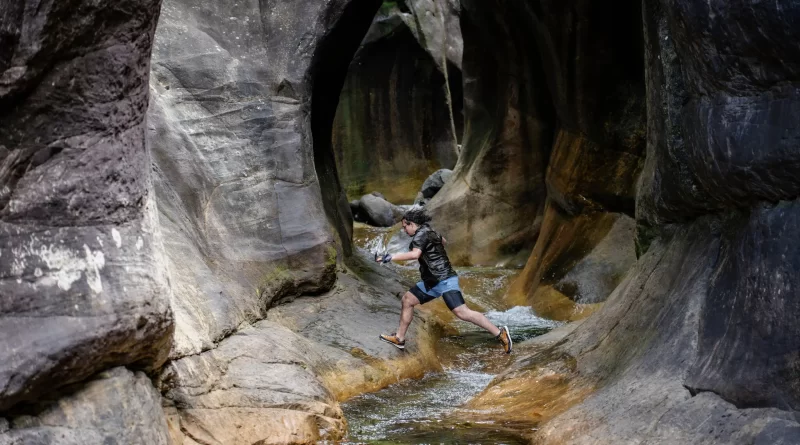
After about four miles, we entered a canyon of sculpted gray sandstone no wider than a driveway. Sandile and I pushed on, jumping puddles that become a river in summer. We found a spot to eat chicken sandwiches and cheese wedges. For him, this 50-degree weather was freezing; he struggled to unscrew a thermos of rooibos tea. “So cold!” he said. The Tugela Falls were a faint trickle this late in the dry season, feeding a series of clear pools that stopped us from going farther. It hardly mattered. Sitting there felt as if we’d found a secret corridor into an African version of Utah’s slot canyons.
On the way back, we took a different route through the Rugged Glen Nature Reserve, a protected expanse of grasses and trout streams with Stone Age and Iron Age sites. That night’s ostrich sosatie — a curry-marinated kebab — was outstanding, but I didn’t linger. The most demanding hike was yet to come.
Off to the Amphitheater

Morning arrived purple and soft with a whiff of clouds. The mountaintops that had been hidden for days now stood in full view: Hlolela, Battleship, the Camel’s Hump. One of the most popular hikes from the Cavern links five of these summits in an 11-mile push. We, however, were headed for something grander.
Sandile met me with Lawrence Mlambo, the Cavern’s guest relations manager, and Thokozane Ndaba, a guide in training. We drove by roadside goat sellers and women fetching water in yellow jugs. In Phuthaditjhaba, a bustling town with a university and a soccer stadium, Lawrence pointed toward the windshield. “There it is!” he boomed.
The Amphitheater reared up, a wall of basalt and sandstone splashed in golden light. Even from a distance, the cirque felt cosmic in scale and impossible to hike up. Instead, you must approach the Amphitheater rim from the back and hike about eight miles round-trip across the Maluti highlands. There, patches of snow clung to the shadows.
I paid the $4.50 entrance fee, and soon we were wandering along a trail that threaded its way under dizzying basalt walls and along ridges punctuated by rock features like “Witches” and “Devil’s Tooth.” At one point the trail went vertical, and we had to scale a 50-foot cable ladder bolted into the rock. It wiggled and swayed. As a climber, I’m comfortable with heights, but even I couldn’t look down.
Before long, the trail eased off and we worked across a relatively flat expanse of tussock grasses until there was nothing at all. We’d reached the lip of the Amphitheater, and it felt more like a point in the sky than the end of a trail. The land fell away so sharply, I didn’t trust myself to get close. I could see where Sandile and I had hiked the day before. The perspective made me reel.

We lingered, then began the long hike back across the high plateau, the mountains stacked purple in the distance. In the morning, back at the Cavern, I’d have time for one more hike before driving back to Johannesburg. For now, Sandile and the others pushed ahead while I took pictures that could not capture the scale of it all. Then I chased after them, those three fragile dots making their way back from the vast, airy edge of the continent.