
A Winter Lull in the Fighting? Not in the Age of Drone Warfare.
Shifts in tactics and technology in Ukraine mean that the pace of fighting is no longer decided by whether tanks can navigate frozen fields.
The two Russian soldiers, trudging through an expanse of knee-deep snow, came into view once the sun was up. Separated from his mate by about two car lengths, the first was trying to quicken his pace. But the soldier behind him kept falling over in his attempts to step in the fresh footprints, losing his rifle and getting stuck.
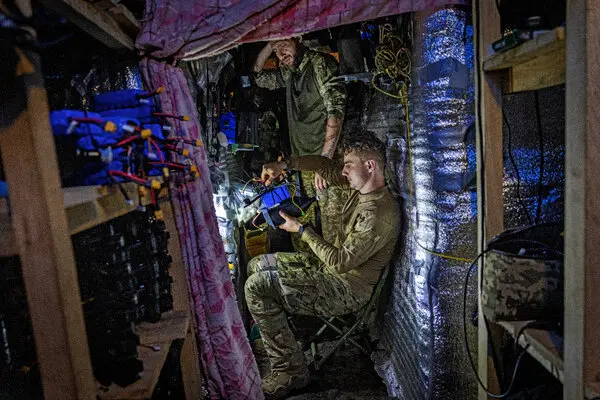
Ukrainian officers were closely watching each step and misstep in real time, a hovering drone transmitting video to a bank of screens in their warm command post. Spotted at 7:09 a.m., the two Russian soldiers were presumed dead 15 minutes later, after a Ukrainian strike.
The episode served as a grim illustration of the evolution of winter warfare in Ukraine.
Earlier in the conflict, which began in February 2022, tanks and other heavy armor dominated the battlefield. While the hulking equipment could move when a deep freeze hardened the ground, fighting slowed overall in the winter, as snow and mud made it more difficult to get around.
Now, as omnipresent drones watch and attack from the skies, heavy armor struggles to move in any season. Tactics have changed: Russia sends small groups of soldiers on motorcycles or on foot to try to infiltrate Ukrainian lines, hoping they are less noticeable to drones.

For these small groups, the mission is largely the same no matter the time of year. So the fighting mostly keeps the same pace — a plodding one — from season to season.
“Nothing really changes, summer or winter,” said a Ukrainian infantry platoon commander who, according to military protocol, went by his call sign, Salo. “The only difference is the cold.”
With the fighting now dominated by drones, weather variations during the winter have become “exponentially more consequential than in previous years,” said Franz-Stefan Gady, a Vienna-based military analyst. Some aspects of winter weather make it easier for troops to advance in the drone age. Some make it harder.
A drone officer one recent afternoon was counting on snowfall in the Dnipro region of eastern Ukraine. While the sky was blue outside his command post, a light snow was falling closer to the front line.
“We can clearly see tracks in the snow, where they lead, and identify positions where the enemy is hiding,” said the officer, who goes by the call sign Shirley.
Any further deterioration in the weather, however, would pose a problem, the officer warned.
“Once the snowfall intensifies, we lose visibility,” he said. “For us, that is the most dangerous time.”
Russian forces use overcast weather, fog and heavy snow as cover for infiltration attempts, according to analysts and soldiers.
“A higher percentage will make it past the front line when the weather’s bad,” said Rob Lee, a military expert at the Philadelphia-based Foreign Policy Research Institute.

Extreme cold, as Ukraine has been experiencing in recent weeks, can also cut both ways. Frigid temperatures pose age-old difficulties for soldiers on the front lines, degrading their abilities to move and fight. “These guys are outdoors for days at a time,” Mr. Lee said.
But it is also hard on drones. Low temperatures can degrade battery life. If it is snowing, certain drones can become inoperable. That risks enemy advances.
“Weather and tech are not friends,” a drone sergeant using the call sign Sol acknowledged, saying that snow was affecting his teams “a lot.”
Sitting on a futon in a small apartment, with drones and model cars decorating the walls, he explained how the propellers on some drones were prone to freezing.
To cope, he said, some crews try to warm their drones near gas stoves. Others have tested expensive de-icing sprays. But of all things, he said, rubbing simple meat fat on the propellers has proved most effective, providing a layer of protection.
Sol’s teams fly first-person-view drones, which are piloted through a live video feed. Those drones, along with smaller hobbyist models adapted for the battlefield, are most affected by weather.
When those cannot fly, Ukraine’s military often turns to large bomber drones, known as Vampires. Teams flying those drones had far less work in the summer, said a platoon sergeant with the call sign Black, but “now we fly around the clock.”
Cartoonishly large snowflakes fell around him as he loaded up a truck bearing supplies for his drone pilots on the front line. A few times he stopped to check his watch. Icy roads would force the truck to drive slowly, making it a tempting target for Russian drones.
Down the road about 15 miles toward the front line, Daryna, a medic, sat inside her small field hospital. The beds had electric warmers going, and two stretchers stood ready with silver thermal blankets. But there were no patients that day.
The weather, she said, was partly to blame. Snow was making it tricky to move the wounded off the front line without coming under attack by drones. Fatalities increase, she said, when medical care is delayed.
“A year ago, we were receiving guys wounded two-three hours ago,” said Daryna, who asked that her surname be withheld for her safety. “Now, we’re getting guys who were wounded a week ago.”

Bunkers have also changed. They must be dug deeper because of the threat of drones, which is harder to do when the ground is frozen.
He acknowledged that drones do “an enormous amount of work.” But he said that infantry remained critical, and not only because bad weather could ground drones or reduce visibility.
“The human factor still has to be present,” he said, because “infantry holds the line.”
Analysts said it was unclear whether Russia or Ukraine would benefit more from the winter weather. Much depends on the severity of the cold and snow.
“Drone warfare’s weather dependency has created a paradox: Both sides depend on unmanned systems for situational awareness and precision strikes, yet both face constrained operational windows,” said Mr. Gady, the military analyst.
Still, he noted that winter tended to favor defenders, a view echoed by several Ukrainian soldiers interviewed in the Dnipro region. Russian troops are looking to advance, they say, while Kyiv’s forces must simply stay in place and hold the line, limiting their exposure.
“Winter,” said Black, the platoon sergeant, clapping his hands together for warmth, “just has to be endured and waited out.”
