
A City Where Every Step Outside Risks Death by Drone

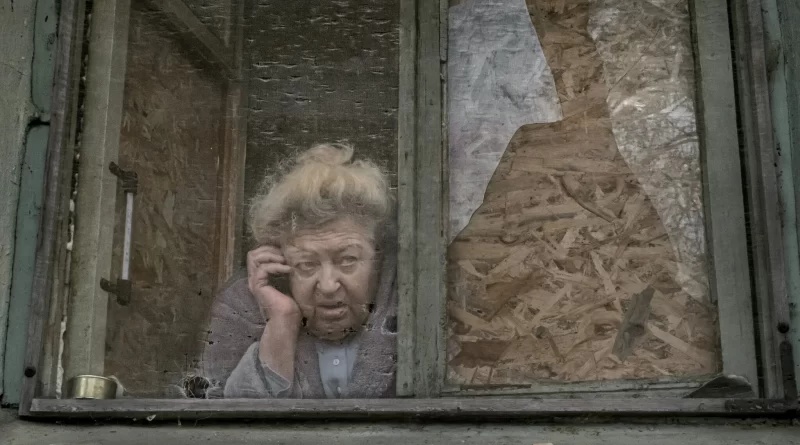
Russian attacks on civilians in Kherson, in southern Ukraine, have forced important aspects of life to go underground, offering a vision of a postapocalyptic future.


- Reporting from Kherson, Ukraine
It was pickup time at the day care. As other children and parents milled about, Tanya Leshchenko sat on a bench in a hallway and bundled her 5-year-old daughter into a purple winter coat. But before stepping outside, one more task remained.
Ms. Leshchenko checked an online chat group for warnings of incoming attack drones. The group posts crowdsourced alerts in the city of Kherson, in southern Ukraine, where the daily risk of death from flying robots offers a vision of an eerie, postapocalyptic future.
One warning last fall simply said, “I hear a drone!” — an ominous buzzing that has become a grim, intermittent soundtrack in the city. On the day when Ms. Leshchenko, 36, was picking up her daughter, however, the sky was calm. They walked out and headed toward the bus stop.
“You cannot outrun a drone,” Ms. Leshchenko said, before adding: “It’s scary.”
In Kherson, a city of broad tree-lined boulevards and stately czarist-era mansions, residents fear the open sky. The entire city lies within range of cheap Russian quadcopter drones, which Moscow’s forces launch from territory they occupy just across the Dnipro River.

A worker removing leaves from anti-drone netting over a thoroughfare. The city is experimenting with myriad drone defenses, including dozens of miles of nets intended to catch drones before they reach an object and explode.
About 200 civilians have been killed and 2,000 wounded in drone strikes over the past year, the authorities say. Ukrainians call the attacks a “human safari.” Russian drone operators drop grenades on people working in their gardens or ambling down sidewalks.
Kherson, whose population has fallen to about 65,000 after three-quarters of residents fled, has become the site of the most intensive use of drones in targeting civilians anywhere in the world, rights groups say. The United Nations has called the attacks war crimes.
Life is moving below ground. Hospitals, a maternity ward, government offices, a theater and dozens of other institutions have been relocated to underground sites. Basement activity rooms have replaced outdoor playgrounds. All schools are online only.
The city is experimenting with myriad drone defenses, though none are wholly effective. The military has built a wall of jamming antennas along a riverbank. Dozens of miles of nets intended to catch drones before they reach an object and explode have been strung over thoroughfares. On sidewalks, 250 concrete escape chambers have been set up.
Municipal workers carry hand-held drone detectors as they labor outside repairing bomb damage or mending drone nets. The devices work by intercepting feeds from drones’ cameras, showing what the Russian drone operator sees when zeroing in on a target. Seeing yourself or your car on the detector’s screen is terrible news.

“You need to reach maximum speed and maneuver” to get out of sight, Yaroslav Shanko, Kherson’s military-civilian administrator, said of evading a drone once detected.
Municipal workers carry hand-held drone detectors as they labor outside repairing bomb damage.
It happened once to Yaroslav Shanko, the city’s military-civilian administrator, a position akin to mayor. How did he respond? “You need to reach maximum speed and maneuver” to get out of the drone’s view, Mr. Shanko said. Screeching around corners and plowing down alleys at more than 80 miles per hour, Mr. Shanko’s driver escaped the drone.
Rights groups say that other war-torn or crime-afflicted cities around the world are likely to look like Kherson in the future.
Small quadcopter drones, some adapted from hobbyist models, have democratized precision-guided munitions that previously cost tens or hundreds of thousands of dollars. They have been used to target civilians in the Sudanese civil war and in Mexican gang conflicts, said Belkis Wille, an associate director at Human Rights Watch.
“Kherson is the clearest example of a campaign to target civilians with quadcopter drones, but this is really just the start of what we fear will become a reality for civilians in conflict areas” across the globe, Ms. Wille said. “The cost of targeting civilians has come way down.”
Kherson has never caught a break through four years of war. Russian forces occupied the city for nine months at the start of the full-scale invasion, before retreating. An 18th-century Russian aristocrat and lover of Catherine the Great, Prince Grigory Potemkin, is considered the founder of the modern city and was buried in a local church. When they retreated, Russian soldiers took his bones with them.
After Ukrainian troops liberated Kherson in November 2022, Russian forces took to firing artillery into the city from across the river. Once small drones evolved into effective weapons the following year, a new scourge began.


Drone injuries are now so common, said Oleh Pinchuk, a surgeon, that, “We forgot about car accidents here.” Sometimes, the wounded watch wide-eyed in a hospital bed, several days into their recovery, when Russian forces post video online from the camera of the drone that attacked them. They see themselves on the screen, getting bigger and bigger as the drone draws nearer.
Once drones close in, they are all but impossible to evade.
Mykola Hyadamaka, 67, a retired driver, recalled hearing a drone chasing his car. He raced home and tried to dash in his front door but fumbled with the gate to his yard. He was hit by shrapnel from a grenade.
“There is no escape,” he said in an interview in his hospital bed.
Serhiy Schevchenko, 36, a plumber, was chased by a drone around a tree before it blew up nearby.
“There was nowhere to hide,” he said.
Volodymyr Oleinichuk, 52, a parking lot attendant, dived under a shed after hearing a drone. It circled overhead, waiting for him to crawl out, he said. When he did not, it dropped a grenade near the foundation, spraying shrapnel under the shed and wounding him.
A particularly frightening aspect of drone attacks, Mr. Oleinichuk noted, is the sense of intelligence driving the machine as a pilot searches and maneuvers.
“There is somebody behind it, controlling it,” Mr. Oleinichuk said. “I heard how he was looking for me.”


With schools closed, underground activity areas are among the few places for children to socialize. They offer dance, art and other classes, and screen movies. A dance class at one center was called “United by Love.” Organizers put sandboxes in the subterranean play areas on the theory that children needed a substitute for touching soil in playgrounds.
Outside, danger lurks. When drones come, “You need to hide in a shelter, or just anywhere where you cannot see the sky,” said Daria, an 11-year-old who over the summer hid under trees in a park when a drone flew over.
Although so many have fled Kherson, Ms. Leshchenko, the woman who picked up her daughter, Alyona, at day care recently, said that she did not plan to leave. Her family has nowhere to go, she added.
Once she got to the bus stop, a concrete shelter would provide protection. She would check the online chat group again. Then she would walk home quickly, holding Alyona’s hand.

Yurii Shyvala contributed reporting.
Andrew E. Kramer is the Kyiv bureau chief for The Times, who has been covering the war in Ukraine since 2014.