
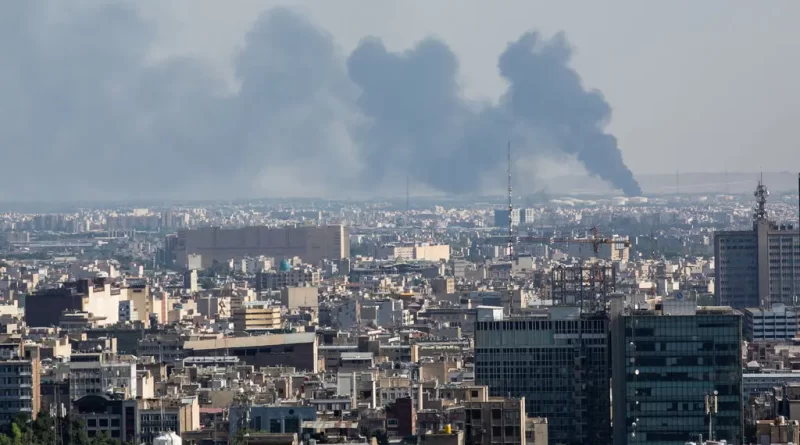
Trump Warns Iran With Military Muscle, but Risks a Regional War
Iran’s Islamic Republic, weakened by airstrikes in June and huge popular unrest, warns that it will strike back hard if attacked by the United States. This time, Iran may mean it.

Steven Erlanger covers diplomacy and security in Europe and the Middle East.
President Trump is turning his attention back to Iran, which he is threatening with more military strikes “with great power, enthusiasm and purpose.”
He suggested that the strikes would come if Iran did not agree to various demands, including a deal to end its nuclear enrichment program. “Time is running out” for Iran to negotiate such a deal, Mr. Trump warned on Wednesday.
Mr. Trump — and Israel — may be tempted to strike now with the larger aim of bringing down the faltering Iranian regime and perhaps changing the balance of power in the Middle East, experts and analysts say. But given the stakes for the regime in Iran, the risks of a regional conflagration are real, they say.
In the June strikes against Iran and in this month’s quick incursion into Venezuela to kidnap President Nicolás Maduro, Mr. Trump has shown that he likes military action to be short and limited. In both cases he avoided long military involvement or occupation, which would be anathema for his MAGA base.
“Trump likes low-cost, high-impact operations,” said Ali Vaez, Iran project director for the International Crisis Group. “On Iran, he could do high impact, but not at a low cost.” Mr. Trump, he suggested, is hesitating.
“He’s trying to use threats to coerce Iran into submission, but I don’t think this will work,” Mr. Vaez said. “This is a regime that is cornered and bound to act recklessly, whether against its own people or its enemies in the region.”

The Islamic Republic is at a weak but dangerous moment after suppressing widespread protests. It vows, if attacked, to respond with great force against the United States, Israel and American allies in the region. Iran said the death toll in the protests was 3,117, but human rights groups say that figure is vastly underestimated. They say that once internet blackouts are lifted, the numbers will most likely rise significantly.
Even after the June strikes, Iran is considered capable of hitting American and allied targets across the region, including in Israel, Saudi Arabia and the United Arab Emirates.
Iran’s armed forces are ready “with their fingers on the trigger” to “immediately and powerfully respond” to any aggression by land or sea, said Iran’s foreign minister, Abbas Araghchi. He called on Wednesday again for a renewal of stalled negotiations on the nuclear issue with the United States.
Iranian officials have sought help in recent days from diplomats in Saudi Arabia, Qatar and Egypt, trying to reopen talks with the United States and avoid military action. Arab states were influential in persuading Mr. Trump to hold off on military action three weeks ago, but after Venezuela, Mr. Trump now has more forces in the region and more military options.
Iran’s threats should be taken seriously, said Suzanne Maloney, an Iran expert who directs the foreign policy program at the Brookings Institution. “No one can assume Iran won’t respond and probably respond as they did on their own streets, and make it as ugly and violent as possible,” she said. Mr. Trump, she added, “does not want to get into a protracted conflict with Iran.”
At the same time, she said, Mr. Trump has created a dilemma for himself. By vowing to act in support of the Iranian protesters against the regime, he has created expectations and put his credibility on the line.

“With his social media incitement to the Iranian protesters and his sending of the armada into the region, there is almost an obligation to act,” Ms. Maloney said, referring to a recent buildup of American forces in the region.
Mr. Trump “is certainly under pressure to do something, especially when Iran, the age-old adversary, is weak,” agreed Sanam Vakil, director of the Middle East and North Africa program for Chatham House in London. “Many around Trump are hungry for this moment and think it would be strategically shortsighted to let it go, this chance to change the balance of power in the Mideast.”
Mr. Trump “smells weakness” in the regime, Ms. Vakil said, “and some fear that if he doesn’t go in now, through pressure or a military strike, he’ll miss a key moment.”
U.S. demands of Iran have, if anything, expanded. Washington is pressing for a permanent end to all enrichment of uranium and disposal of all of Iran’s current stockpiles; limits on the range and number of Iran’s ballistic missiles; and an end to all support for proxy groups in the Middle East, including Hamas, Hezbollah and the Houthis operating in Yemen.
The totality of these demands is likely to prove unacceptable, Mr. Vaez said: “I think Iran is more willing to show flexibility on the nuclear front, but if the U.S. wants to humiliate them by dismantling the entire nuclear program, that will prove a poison pill, as in the past.”
Demands for Iran to end its support for allies in the region “would be seen as capitulation, which the regime thinks is more perilous than a military confrontation with the U.S.,” he added.

A war with America would at least bring about more popular patriotic cohesion, even if the government itself is reviled.
Hakan Fidan, foreign minister of Turkey, has urged Washington to divorce the nuclear issue from the other demands, which he believes Iran could not accept.
Ms. Vakil expects Mr. Trump to take action. She suggested there could be various scenarios — to try to kill the leadership of the regime; to kill the leadership and its power structure, including hard hits at the Islamic Revolutionary Guards Corps, which defends the regime; strikes that also try to hit Iran’s energy infrastructure, to further strangle the government economically.
Any strike, she suggested, would include significant efforts to destroy Iran’s weakened air defenses, ballistic missile production facilities and launchers to try to prevent a large retaliation.
Mr. Trump might be able to get Iran to agree to a quick deal on the nuclear program alone and then de-escalate without a major military operation. As every analyst pointed out, Iran has not been able to enrich uranium since the June airstrikes, so it might be possible to come to a simpler deal on stopping enrichment altogether. That would embarrass the Iranian leadership but keep it in place, much as the Maduro regime remains in place in Venezuela.
If the regime fell, what would happen in Iran is a serious question, the analysts agree. There is no guarantee the result will be a peaceful democracy, they say, but there is a strong chance of a fiercer, younger leadership taking charge with the intent of going for a nuclear weapon as the ultimate deterrent against another strike.
Secretary of State Marco Rubio on Wednesday told lawmakers that the buildup around Iran was largely defensive because tens of thousands of American troops in the region were “within the reach of Iranian one-way drones and ballistic missiles.” He said it was “wise and prudent” to increase the U.S. presence but that the American force could also “pre-emptively act” against Iran.
What would happen if the regime did fall, Mr. Rubio said, was “an open question.”
“I mean, no one knows who would take over,” he said.
Steven Erlanger is the chief diplomatic correspondent in Europe and is based in Berlin. He has reported from over 120 countries, including Thailand, France, Israel, Germany and the former Soviet Union.