
Elephant Bone in Spain May Be Proof of Hannibal’s Tanks With Trunks
Archaeologists say a 2,200-year-old specimen is the first direct evidence of how the Carthaginian war machine used the giant mammals in the Punic Wars.
A 2,200-year-old bone unearthed near Córdoba, Spain, may provide the first direct archaeological evidence of the formidable battle elephants employed by the Carthaginian general Hannibal.
Tucked away in a bed of rubble alongside Carthaginian coins from the third century B.C., the baseball-size ankle bone serves as a bridge between colorful historical narratives about the Second Punic War and hardened archaeological fact. The fossil wasn’t from the 37 elephants that famously crossed the Alps in 218 B.C., but it offers what Fernando Quesada Sanz, an archaeologist at the Autonomous University of Madrid, calls a “landmark” connection to Hannibal’s military campaigns, as well as his tactical errors.
Traces of combat — specifically, catapult ammunition found with the specimen — suggest the elephant died in battle, according to Dr. Quesada, an author of a study published last month in The Journal of Archaeological Science: Reports.
During the closing decades of the third century B.C., the Mediterranean was dominated by two superpowers: the emergent Roman Republic and Carthage, a North African city-state in what is now Tunisia. Still reeling from a humiliating defeat in the First Punic War — which cost them the strategic islands of Sardinia and Corsica — the debt-stricken Carthaginians pivoted to Spain, carving out a prosperous new empire from its silver mines.
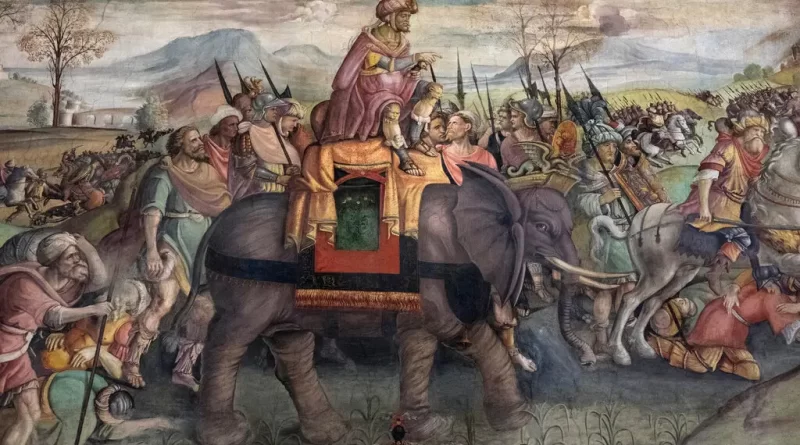
Leading this expansion was Hannibal of the Barca family, whose brother Mago is credited with bringing elephants to the Iberian peninsula around 228 B.C. Hannibal then revolutionized warfare by deploying armored pachyderms against local tribes. This terrifying shock force broke battle lines and provided elevated, commanding positions for his archers.
“It is quite possible that the bone uncovered around Cordoba belonged to one of the elephants that Hannibal used to crush the Carpetani tribe in central Spain,” Dr. Quesada said.
The Second Punic War was ignited in 219 B.C. by Hannibal’s brutal, eight-month siege of Saguntum, a strategic Spanish stronghold allied with Rome. Believing the siege to be a rogue act, Rome demanded that Hannibal be handed over. When Carthage refused, the two powers declared war, setting the stage for a colossal 17-year conflict.
Before his invasion of Italy, Hannibal left 21 war elephants in Spain under the authority of his brother Hasdrubal. Those so-called tanks of antiquity were distributed among Mago and other generals. Dr. Quesada said the bones in his team’s archaeological find might be linked to those elephants.
The four-inch bone fragment was dug up six years ago, ahead of construction work at the Iron Age site Colina de los Quemados. The excavation revealed a violent past for the fortified village. Sealed beneath a collapsed adobe wall, the remnant was found with 12 large stone catapult projectiles, suggesting that a fierce clash had taken place on the grounds of the settlement.
The artifact was found in isolation, with the rest of the animal’s remains lost. This anomaly has led researchers to a curious possibility: The relic might have been intentionally spared, salvaged by someone who found its small size ideal for a souvenir.
Researchers identified the specimen as the third carpal bone from an elephant’s right foreleg by comparing it with anatomical collections at the University of Valladolid in Spain and the Leiden University in the Netherlands. The anatomical match for the bone was confirmed through measurements against Asian elephant and steppe mammoth samples.
Eve MacDonald, a historian at Cardiff University and the author of “Carthage: A New History,” who was not involved in the new study, said that while a single ankle bone limits interpretation, “the association alone adds to the understanding of the significance of the elephant in the Carthaginian war machine.”
The fate of the Córdoba elephant was undoubtedly grim, but it was probably a swifter mercy than the marathon of misery endured by Hannibal’s herd. Over five grueling months, the elephants caravaned from Catalonia across the Pyrenees and the Rhone, ultimately scaling the snow-slicked Alps. Their thousand-mile journey was less a military feat and more a slow-motion catastrophe.
While accounts vary, many historians believe a significant number of the elephants — perhaps nearly all 37 — initially survived the passage. But by the spring of 217 B.C., Hannibal’s grand trunk show had been reduced to a lone survivor: a tusk-shorn animal named Surus, meaning the Syrian. The others had died following the Battle of Trebia because of exhaustion, wounds and a severe winter ice storm.
Hannibal is said to have ridden Surus across the treacherous Arno marshes after losing an eye to an infection. The chilling admission of the Roman playwright Plautus — that Surus “set my heart a-freezing” — endures as the ultimate testimonial to a creature that commanded absolute, frosty respect.