
They Did Deals With Trump to Get Lower Tariffs. Now They Are Stuck.

Countries that under the threat of tariffs made commitments like enormous investment pledges face the reality that they might have been better off waiting.


Alexandra Stevenson and River Akira Davis
Reporting from Hong Kong and Tokyo
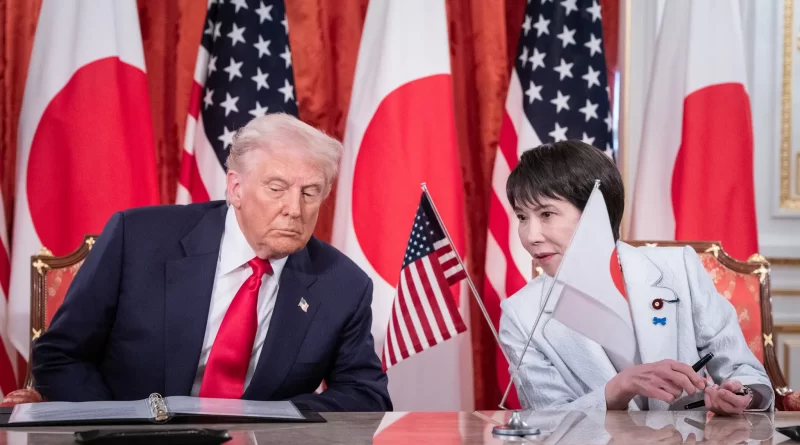
It started as a week of trade wins for President Trump. On Tuesday, Japan committed $36 billion in investments in the United States, and on Thursday, the president of Indonesia signed a deal in Washington to open up critical sectors of the country’s economy to American companies.
The moves were part of trade deals both countries had signed under the threat of huge tariffs, unlike anything they had faced in modern times — up to 35 percent in Japan’s case and 32 percent for Indonesia. Mr. Trump hailed the developments as signs that the United States was “WINNING again.”
But by the end of the week, it was no longer clear who, if anyone, was winning. On Friday, the Supreme Court struck down the legal premise of Mr. Trump’s punitive tariffs. After the ruling, he insisted that many of the deals would stand, although even he acknowledged that some might not. The court’s decision has left the fate of the deals highly uncertain.
In Asia, where most of the world’s goods are made, governments had raced to do deals with Mr. Trump. The goal was to negotiate lower tariffs for their export-dependent industries. Many government leaders who brokered deals and made significant pledges faced political recrimination at home, accused of giving away too much and, at times, even sacrificing national sovereignty.
With damaging tariffs hanging over them, countries like Japan and Indonesia — not to mention South Korea, Taiwan, Malaysia, Cambodia and India — made difficult concessions like lifting many of their tariffs on imports from the United States.
Some even promised to align with Washington on sanctions, issues of national security and sourcing critical minerals, major undertakings that have irked constituencies at home as well as trading partners like China.
For the Asian countries that struck deals with Mr. Trump, China looms large. In nearly every country, it is the most important regional economic and geopolitical partner or rival. Mr. Trump came into office promising to push back against China’s strong pull over global supply chains and, through his trade deals, rope in neighboring Asian nations in the effort.
So far, China has kept Mr. Trump at a standstill in trade negotiations and could end up with a better deal than its neighbors and American allies.

Now, after the court decision constraining Mr. Trump’s trade cudgel, countries throughout Asia were left wondering if they had made a mistake in quickly finalizing deals with Mr. Trump and whether existing agreements would stand.
“Countries which signed deals with the U.S. and agreed to a tariff above 15 percent are now disadvantaged,” said Steven Okun, chief executive of APAC Advisors, a geopolitical consulting firm.
“Do you renegotiate and drive a harder bargain since Trump’s leverage is diminished? Or keep what you have to avoid retaliation?” he said.
The fact that the actual tariff rates keep shifting is adding to the uncertainty. Hours after the court’s ruling, Mr. Trump said he would impose a global tariff of 10 percent, invoking a different legal grounding than the one the court had rejected. Then on Saturday, he said he would increase that to 15 percent.
In recent months, Japan, South Korea and Taiwan secured 15 percent tariffs in return for hundreds of billions of dollars in investments. For them, little has changed.
Indonesia, Malaysia and Cambodia agreed to 19 percent tariffs in exchange for large purchases of American goods and the opening up of certain sectors, putting them at a relative disadvantage to rival Asian economies.
There’s another complication for countries that secured the earliest deals: Very few of the agreements have been ratified. While Mr. Trump was acting unilaterally, officials on the other side of the negotiations often need to secure legislative approval at home.
Malaysia and Indonesia were quick to publicly note they had not ratified their deals with Washington. Johari Abdul Ghani, Malaysia’s minister for investment, trade and industry, said his country would act in its own best interests and continue to “diversify its trade relationship.” Its deal with the U.S. has caused domestic political instability.

South Korea, speaking before Mr. Trump changed his mind on his new global rate, said the ruling on Friday “nullifies the 15 percent reciprocal tariff,” even as it was careful not to disown the deal.
Across Asia, some countries are still hammering out deals, their governments trying to thread a needle on an issue that has caused turmoil at home and volatility in financial markets.
Take Vietnam. The country’s leader, To Lam, was among the first to call Mr. Trump after Mr. Trump’s April “Liberation Day” announcement of tariffs. It faced a 46 percent rate after becoming one of the world’s export powerhouses, as well as an intermediary for goods made in China that get shipped on to the United States, a practice Mr. Trump vowed to stop.
“The partner’s demands are very high,” Nguyen Sinh Nhat Tan, a Vietnamese trade negotiator, told state media in Hanoi this month. “Some requests go beyond reasonable levels and create difficulties for the talks, but we will continue to explain and persistently persuade them.”

Vietnam reached a framework agreement with the United States in July, agreeing to a 20 percent tariff, but it has yet to finalize the deal. The sixth round of talks, the most recent, ended this month without an official announcement, and there were no signs that the two sides were close to an immediate deal.
For now, it appeared that Vietnam would be subject to the same 15 percent tariff as every other country, though it was not clear whether Mr. Trump would try to stick to the earlier preliminary 20 percent tariff.
Countries that chose to conclude deals with Washington, knowing that the Supreme Court could overturn the tariffs, negotiated with the assumption that Mr. Trump would find another way to impose import duties to achieve his goal of more balanced trading relationships.
In particular, Japan and South Korea faced much higher tariffs on their automobile and steel sectors. The Supreme Court ruling did not touch on the Trump administration’s use of those and other tariffs.
Japan was one of the first countries to go to Washington to begin negotiations. After eight rounds of back-and-forth talks, Tokyo struck an agreement last year that secured lower rates.
Most importantly, the trade agreement implemented in September lowered tariffs on its largest export to the United States — autos and auto parts — from 27.5 percent to 15 percent. This blanket rate has been applied to all Japanese exports since late last year. In exchange, Japan pledged to provide $550 billion in financing for projects in the United States.
Local media in Japan, citing unidentified officials, have reported that the government is still planning to proceed with its first round of investment pledges. Of greater uncertainty is the next round of financing announcements that Japanese officials were considering rolling out around the time of the prime minister’s visit to Washington in March. A representative for the Japanese Cabinet Office did not respond to requests for comment.
South Korean aluminum, steel and automakers faced steep tariffs until a deal between the United States and South Korea in October that lowered overall country tariffs to 15 percent in exchange for a $350 billion investment commitment from Seoul.

Last month, Mr. Trump threatened to raise the tariff back to 25 percent, accusing South Korea of delaying its promised investment because its legislature had not ratified the agreement. South Korea has called for patience, saying it is working with various political parties to enact a new bill that would create and manage an investment fund in consultation with Washington. But Mr. Trump’s threat has lost some of its bite after the Supreme Court’s decision.
Taiwan’s trade deal called for a $250 billion investment in the United States. But since the agreement was finalized earlier this year, no major commitments have been announced.
“The winner countries are the ones that haven’t actually negotiated a trade deal or, like Japan, committed a lot of money,” said Paul Nadeau, a Tokyo-based adjunct fellow at the Center for Strategic and International Studies, a think tank.
While Mr. Nadeau expects tariffs to persist in some form, he said that the Supreme Court decision could change the dynamic of future talks. “Trump may be more constrained in ways that change his leverage at the negotiating table,” he said. “He comes to the table with less of a strong bat.”
Tung Ngo contributed reporting from Hanoi, Vietnam; Choe Sang-Hun from Seoul, Meaghan Tobin from Taipei, Taiwan; Hasya Nindita from Jakarta, Indonesia; and Zunaira Saieed from Kuala Lumpur, Malaysia.