
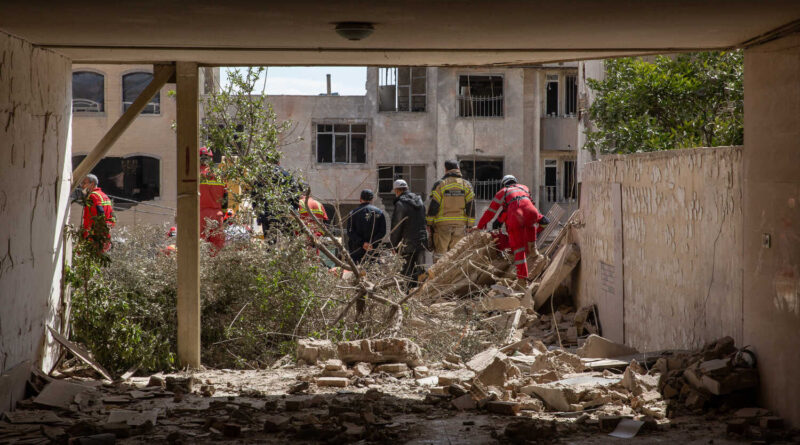
Iran War Live Updates: B-52s Start Flying Missions Over Iran, Pentagon Says
U.S. bombers have free rein for the first time in the war, even though Defense Secretary Pete Hegseth said that Iran still retains the ability to launch missiles after a month of U.S.-Israeli attacks.

The U.S. military has begun flying B-52 bombers over Iranian territory for the first time since the war began, the chairman of the Joint Chiefs of Staff said on Tuesday, suggesting that Iran’s air defenses have been significantly degraded.
But despite a monthlong U.S.-Israeli bombing campaign, Tehran still retained the ability to retaliate, Defense Secretary Pete Hegseth told reporters.
“They will shoot some missiles; we will shoot them down,” Mr. Hegseth said at the Pentagon alongside Gen. Dan Caine, the Joint Chiefs’ chairman. It was their first public briefing on the war in nearly two weeks, when they took questions from reporters on March 11.
General Caine said that U.S. warplanes were now focused on destroying supply chains that fed Iran’s missile, drone and naval ship building facilities, choking off the country’s ability to replace munitions destroyed in thousands of American bombing runs.
Mr. Hegseth also revealed he had made an unannounced trip to the Middle East over the weekend to visit troops at bases around the region. He again said that the United States was “closer than ever before to winning.” President Trump has offered conflicting messages about his objectives in the war and has struggled to contain its economic fallout.
Mr. Trump has tried to pressure Iran to end its de facto blockade of the Strait of Hormuz — normally a conduit for one-fifth of the world’s oil supplies — by alternating threats of destruction with unverified claims of diplomatic progress. Iran has denied holding substantive talks with the United States and has rejected the Trump administration’s conditions to end the war as unreasonable.
Mr. Trump has repeatedly complained about a lack of support from U.S. allies in the war, even as he has insisted that he does not need it. On Tuesday, he criticized countries that “refused to get involved in the decapitation of Iran,” saying on social media, “You’ll have to start learning how to fight for yourself.”
“The U.S.A. won’t be there to help you anymore, just like you weren’t there for us,” he added. “Iran has been, essentially, decimated. The hard part is done. Go get your own oil!”
Here’s what else we’re covering:
-
Gas prices: Gasoline in the United States crossed an average of $4 a gallon on Tuesday, a threshold it hadn’t reached since August 2022. The average cost of gas has jumped 35 percent since the war began on Feb. 28, according to data from the AAA motor club, becoming a political burden for Mr. Trump. Oil and gas prices also rose again.
-
Persian Gulf: Gulf countries reported more missile and drone attacks on Tuesday. A Kuwaiti oil tanker erupted in flames at a Dubai port in a drone attack that its owner, the Kuwait Petroleum Corporation, attributed to Iran. The authorities in Dubai and Saudi Arabia reported that debris from interceptions had injured several people. In the United Arab Emirates, remote learning will continue at all schools until mid-April, the education ministry said.
-
Lebanon: Israel’s defense minister, Israel Katz, on Tuesday outlined more explicitly plans for the mass displacement of hundreds of thousands of Lebanese people and the destruction of Lebanese villages along Israel’s northern border. Israeli forces have taken control of more territory in southern Lebanon as they have battled Hezbollah, the Iranian-backed militant group. He said that the Israeli military would maintain control over all of southern Lebanon up to the Litani River, which is about 20 miles from the Israeli border at its farthest point.
-
Casualties: The Human Rights Activists News Agency said at least 1,574 civilians had been killed, including 236 children, in Iran since the war began. Lebanon’s health ministry said that more than 1,260 Lebanese had been killed as of Tuesday, with more than 3,750 others wounded, since the latest fighting between Israel and Hezbollah began. In Iran’s attacks across the Middle East, at least 50 people have been killed in Gulf nations. In Israel, at least 17 had been killed as of Friday. The American death toll stands at 13 service members, with hundreds of others wounded.
-
Regional economy: One month of the war could plunge four million more people across the Arab world into poverty and shave off up to 6 percent of the region’s economic output during that time, according to projections by the United Nations Development Program.
One month of the American-Israeli war with Iran could plunge four million more people across the Arab world into poverty and shave off up to 6 percent of the region’s economic output during that time, according to projections by the United Nations Development Program.
The report, released on Tuesday, uses an economic simulation to project the effects of an ongoing conflict, and warns of “profound and widespread socio-economic impacts across the Arab region.”
Abdallah Al Dardari, the director of the U.N.D.P.’s regional bureau for Arab states, told The New York Times that the projections were based on just four weeks of war, which the current conflict has already exceeded.
He said that the agency had used such a simulation to predict the economic impact of the war in Gaza and Israel’s last offensive against the Iran-backed Hezbollah militia in Lebanon in 2024. According to the models, he said, the economic damage of the current war gets exponentially worse as the conflict drags on.
“Every week we add to the destruction, the structural weaknesses sink in and that will make the recovery more difficult and more costly,” he said.
One month of war, Mr. Al Dardari said, is projected to cost the Arab region $194 billion in lost economic output, a downturn he described as “unprecedented.”
As the war inflicts economic pain across the world, Arab nations in the Middle East are particularly vulnerable. Gaza and Lebanon were already facing huge reconstruction needs after the most recent Israeli military offensives. Syria is also in dire need of investment as it tries to recover from a 13-year civil war.

Now, regional officials warn that the current war could tip more countries, including Iraq, Jordan and Egypt, into severe economic crises. Egypt, the most populous Arab country, at around 120 million people, is already facing the strain of rising fuel prices and is struggling to finance its heavy debt. Like many countries in the region, it is also reliant on investments from oil-producing Gulf countries whose energy production has come under attack during the war.
Dependency on Gulf investments is a dilemma that the region must grapple with in the years to come. Even after the war ends, Mr. Al Dardari said, the Gulf nations that have often bankrolled postwar rebuilding efforts in the Middle East will be consumed with funding their own economic reconstruction.
“There isn’t enough surplus revenue in the Gulf to invest in the recovery of those countries,” he said. “That’s a structural challenge we never faced before.”