
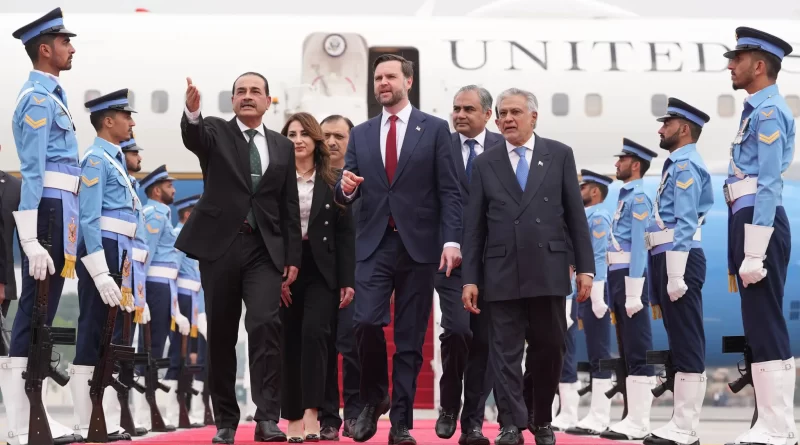
Iran War Live Updates: U.S. and Iran Begin Peace Talks, Iranian Media Says
The talks were taking place with the “mediation” of Pakistan, a state news agency reported, but the exact format was unclear. The White House declined to comment about Vice President JD Vance’s potential meetings with the Iranians.
 -Tyler PagerAaron BoxermanYeganeh Torbati and Elian Peltier-
(Tyler Pager and Elian Peltier reported from Islamabad, Pakistan.)
Peace talks between Iran and the United States began in Pakistan on Saturday, according to Iranian state media, as negotiators from both countries tried to reach an agreement to end more than a month of war in the Middle East.
The format of the talks was unclear, and the White House declined to comment as to whether Mr. Vance had met with Iranian officials. If direct talks were taking place, it would be the highest-level face-to-face meeting between U.S. and Iranian officials since Iran’s 1979 Islamic Revolution set the two countries against each other for nearly half a century.
Earlier on Saturday, both the American delegation — led by Vice President JD Vance — and the Iranian negotiators met separately with mediators from Pakistan.
The negotiations are taking place as a cease-fire between the United States, Israel, and Iran looked increasingly brittle, amid disagreements over the Israeli assault in Lebanon and Iran’s grip on the Strait of Hormuz.
The stakes are high: the five-week war brought chaos across the Middle East, and the temporary truce remains fragile. In a Friday address, Prime Minister Shehbaz Sharif of Pakistan called it a “make or break” moment.
Israel and the United States attacked Iran in late February, killing many of Iran’s top leaders and calling for the ouster of its government. Iranian retaliatory attacks have since drawn in much of the Middle East and battered the world economy. Iran also began blockading the Strait of Hormuz, sending global energy prices skyrocketing.
The full reopening of the Persian Gulf waterway, a vital passage for oil and gas, will be among the priorities for Mr. Vance during the negotiations. Iran’s military signaled in a statement on Friday that it would maintain control of the strait.
Israel’s military campaign in Lebanon against Hezbollah, an Iran-backed militant group, has also threatened to derail the truce. Iran had accused Israel of breaking the cease-fire by continuing to attack in Lebanon, leading Mr. Trump to ask Israel to rein in its assault.
Israeli fighter jets have not attacked the Lebanese capital of Beirut since Wednesday. But Israel has kept up its airstrikes in southern Lebanon, including on Saturday morning, according to Lebanon’s state media.
Both the United States and Iran have claimed that the other side was desperate to make a deal. Hours before the Iranians arrived in Pakistan, Mohammad Bagher Ghalibaf, the speaker of Iran’s Parliament, cast doubt that the talks would even take place and made further demands. Analysts said he may have been posturing for his base rather than presenting the actual Iranian negotiating position.
Mr. Trump suggested on social media that Iran was overplaying its hand. “The Iranians don’t seem to realize they have no cards, other than a short term extortion of the World by using International Waterways,” he wrote, referring to Iran’s continued control of the Strait of Hormuz.
Here’s what else we’re covering:
-
Negotiating team: Mr. Vance was joined in Islamabad by President Trump’s special envoy, Steve Witkoff, and son-in-law, Jared Kushner. The Iranian delegation, which includes Foreign Minister Abbas Araghchi and Mr. Ghalibaf, the speaker of Iran’s Parliament, arrived earlier in the Pakistani capital. Read more about them here.
-
Strait of Hormuz: Only two ships passed through the Strait of Hormuz on Friday. U.S. officials said one reason Iran had been unable to get more ships through was that it could not locate all of the mines it laid in the waterway and lacked the capability to remove them.
-
Israel and Lebanon: The countries’ ambassadors to the United States are expected to meet in Washington next week for direct talks, but a settlement to end the war in Lebanon is not expected imminently. More than a million people — roughly a fifth of the population — have been forced from their homes since the renewed war erupted last month between Israel and Hezbollah. Take a closer look in photos and video here.
-
Death tolls: The Human Rights Activists News Agency said at least 1,701 civilians, including 254 children, had been killed in Iran as of Wednesday. Lebanon’s health ministry on Friday said that at least 1,953 people had been killed in the latest fighting between Israel and Hezbollah, including 357 in a wave of Israeli strikes on Wednesday. In attacks attributed to Iran, at least 32 people have been killed in Gulf nations. In Israel, at least 20 people had been killed as of Monday. The American death toll stands at 13 service members.