
Cosmic Detective Work: Tracing the Phantom Flash

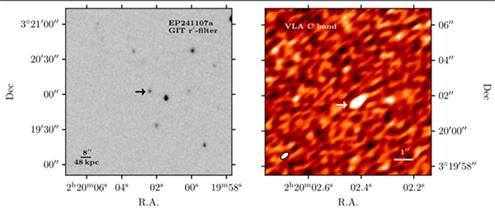
An international team led by Indian astronomers has decoded EP241107a, a fleeting cosmic flash called a Fast X-ray Transient (FXT) detected on November 7, 2024. Using a global multi-wavelength network—including India’s Hanle telescopes and Pune’s uGMRT—researchers tracked the rapidly fading explosion across optical and radio spectrums. Triggered by a massive star’s collapse or a neutron star merger, the blast unleashed an energy jet equivalent to all Milky Way stars shining for months. Uniquely, it lacked direct gamma-rays, representing a rare “orphan afterglow” that helps scientists unlock how extreme physics operates during stellar deaths.

By- Usha Rawat–
Astronomers have successfully solved the mystery behind a fleeting, high-energy cosmic explosion detected on November 7, 2024. This mysterious flash belongs to a rare class of celestial events known as Fast X-ray Transients (FXTs). First discovered about a decade ago, FXTs act like cosmic phantoms—bursting into view with a sudden glow of low-energy X-rays that lasts anywhere from a few minutes to several hours, only to vanish rapidly into the dark canvas of space. Because they disappear so quickly, mapping their origins has been a massive challenge for scientists worldwide.
A Global Hunt Led from India
The breakthrough came when a Chinese space mission called the Einstein Probe flagged a new FXT event, cataloged as EP241107a. Seizing the moment, a team of researchers led by Deepak Eappachen and Arvind Balasubramanian, postdoctoral fellows at the Indian Institute of Astrophysics (IIA), mobilized a powerful global network of telescopes. To capture the fading remnants of the flash, the team adopted a multi-wavelength approach, looking at the event through different types of light.
In India, researchers utilized the pristine, high-altitude skies of Hanle, Ladakh, where the Himalayan Chandra Telescope and the GROWTH India Telescope monitored the event in visible light. Simultaneously, the Upgraded Giant Metrewave Radio Telescope near Pune, India, and the Karl G. Jansky Very Large Array in New Mexico, USA, scanned the skies to capture the event’s radio signature. Giant telescopes in Hawaii and Chile were also brought in to complete this massive cosmic jigsaw puzzle.
The Power of Milky Way’s Stars Combined
By studying the host galaxy and comparing the data, the international team concluded that the flash was born from a cataclysmic, gamma-ray-burst-like explosion. This violent event was triggered either by the death and collapse of a massive star or the high-speed smashup of two ultra-dense neutron stars. The aftermath of this collapse unleashed a highly focused, roaring jet of energy. To put its sheer power into perspective, the kinetic energy of this jet was comparable to the total energy emitted by all the billions of stars in our entire Milky Way galaxy combined over several months.
The Mystery of the “Orphan” Afterglow
What makes EP241107a exceptionally rare is that it was a bit of a cosmic hide-and-seek. While its behavior perfectly matched a terrifying gamma-ray burst, satellites never actually detected the initial high-energy gamma rays themselves. Instead, scientists only caught the glowing “smoke” left behind by the explosion. This phenomenon, known as an “orphan afterglow,” suggests the event might belong to a lower-energy, harder-to-detect population of these cosmic explosions. Published in the Monthly Notices of the Royal Astronomical Society, this collaborative study between IIA, IIT Bombay, Caltech, and Harvard marks a major leap forward in understanding how extreme physics operates when giant stars die.