
A Citizen of Tomorrow Lost in Childhood
By- Jay Singh Rawat-

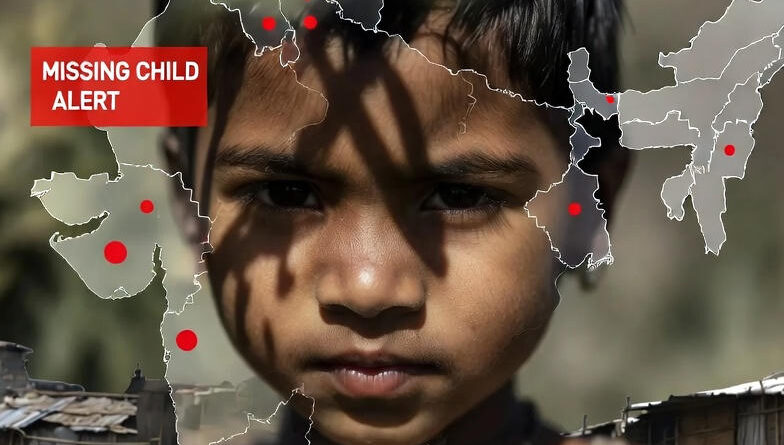
The Supreme Court has expressed deep concern over the fact that a child goes missing every 8 minutes in India and has sought an immediate solution to this serious problem. The country’s top court expressed this concern during the hearing of a public interest litigation filed by an NGO. The Supreme Court’s concern is such a warning that ignoring it would be akin to compromising with the future of the nation. A missing child is not just one case but an entire future that is snatched away from us. This concern is not only of the court, but also emerges from the latest report of the National Crime Records Bureau (NCRB) and various international and national surveys, which portray child disappearances in India as an epidemic-like problem.
In reality, the disappearance of children not only breaks families but also opens the door to social evils like human trafficking, child labour, sexual exploitation and forced marriage. According to the NCRB’s “Crime in India 2023” report, 91,296 complaints of children going missing were registered in the country in 2023, which is 9.5 percent more than the 83,350 cases in 2022. This figure shows that on average more than 10 children are going missing every hour, which matches the Supreme Court’s claim of “every eight minutes”. The report also revealed that 71.4 percent of these are girls, underlining gender-based inequality and the danger of sexual exploitation. Missing children not only become victims of physical exploitation, but their families also fall apart. The NCPCR dashboard shows that 60 percent of children need mental health treatment after rehabilitation. At the societal level, this increases gender imbalance; the higher number of girls leads to increased child marriage and trafficking.
If we analyse NCRB data state-wise, Uttar Pradesh appears at the top, where more than 25,000 cases were registered in 2023. It is followed by Bihar (18,000), West Bengal (15,000) and Maharashtra. In urban centres like Delhi-NCR, the percentage of untraced cases is more than 50 percent, where slums and migrant labour populations become easy targets for traffickers. According to the report, about 74 percent of the total missing children are recovered, but the remaining 26 percent, i.e. around 24,000 children, remain missing. These children often get trapped in human trafficking networks, where they are pushed into child labour, domestic slavery or prostitution.
NCRB’s ‘Track-Child’ portal proved helpful in 80 percent of cases in 2023, but delay in data entry and indifference of local police remained major obstacles. This problem deepened further after the Covid-19 pandemic, because economic crisis forced poor families to migrate. In the context of total crimes, crimes against children increased by 9.2 percent to 1,77,335, in which missing cases were considered a major component. Apart from these figures, various other surveys also highlight the multidimensional nature of this problem. UNICEF India’s 2024 annual report “The State of the World’s Children” mentions the displacement of 48.8 million children globally, in which India has a large share. According to the report, more than 52 million children in conflict- and violence-affected areas are out of school, which becomes a primary reason for disappearance. In India, due to poverty and lack of education in rural areas, 40 percent of missing children become victims of human trafficking, especially on the Nepal and Bangladesh borders. UNICEF has estimated that 1.5 to 2 lakh children went missing in 2024, of which 30 percent are linked to cross-border trafficking. The organisation has recommended digital tracking apps and school-based alert systems so that the early warning system is strengthened.
Bachpan Bachao Andolan (BBA)’s 2025 survey (based on more than 5,000 cases in 10 states) presents even more shocking figures. According to the organisation, 70 percent of missing children are pushed into child labour or forced marriage, and there has been a 20 percent increase in cases in 2024-25. BBA’s old study (2008-2010) mentioned the disappearance of 1,17,480 children, but the latest data points to online grooming as a new threat. Similarly, Save the Children India’s 2024 report “Stolen Futures” has termed disappearance as “stolen future”. According to the report, out of 91,296 missing children in 2023, 25 percent were linked to sexual exploitation. After Covid, cases from online platforms increased by 15 percent, where children become victims of virtual grooming. The organisation has advocated strengthening the POCSO Act and NGO-government partnership.
The National Commission for Protection of Child Rights (NCPCR)’s 2025 dashboard provides real-time tracking. Even now, more than 50,000 active untraced cases are registered on the ‘Khoya-Paya’ and ‘Track the Missing Child’ portals. According to the dashboard, 60 percent of children found missing suffer from post-traumatic stress disorder (PTSD) upon recovery, which creates a mental health crisis. NCPCR has launched the ‘Vatsalya’ portal, which maintains a database of missing and vulnerable children, but lack of awareness at the local level remains an obstacle.
Economic inequality, migration, lack of education and digital dangers are considered the main reasons behind disappearances. Poverty in rural India forces families, while urbanisation gives opportunities to traffickers. If we analyse the reasons, human trafficking is the biggest threat. According to NCRB, 45,000 cases are related to trafficking. UNICEF’s report highlights the Nepal-Bangladesh route in border areas. BBA’s survey gives a new dimension to online platforms, where children are lured through fake profiles. Save the Children has linked displacement in conflict-affected areas (such as Manipur, Kashmir).
In line with the directions of the Supreme Court, the Centre should launch a “Child Safety Portal” which is based on AI-based tracking. On UNICEF’s advice, alert systems should be implemented in schools. BBA has emphasised police training, while Save the Children has demanded strict implementation of POCSO. NCPCR’s ‘e-Baal Nidan’ platform should make complaint registration easier. State governments should make ‘Track-Child’ mandatory and increase partnership with NGOs.
ABOUT AUTHOR: Jay Singh Rawat is a distinguished senior journalist based in Dehradun, Uttarakhand, with over 47 years of experience in full-time and freelance journalism. He has contributed extensively to prominent publications, covering critical issues like environmental disasters, natural calamities in the Himalayas, and political dynamics in the region. An alumnus of Garhwal University, Rawat has authored eight books, including two published by the National Book Trust of India, reflecting his deep engagement with social and developmental themes.–ADMIN