
A House Built as a Bridge, Suspended Over a 23-Foot-Deep Gorge
Two business owners in India searched several cities for land suitable for a farmstead. When they finally found it, they encountered another obstacle.
Ashish Shah, 50, always wanted to build a farmhouse in the countryside. “Even when others told him to buy and sell a ready-made house, he remained adamant about it,” his wife, Nipa Shah, said.

The couple and their two daughters live in Mumbai, India. Mr. Shah runs a garment interlining business and Ms. Shah, 48, owns a brand that produces and markets organic, farm-sourced food. After they developed an interest in organic farming, the couple sought to set up a farm within a two-hour drive from Mumbai, making for easy travel back and forth. They initially looked for land in the cities of Alibag, Nashik, Pune and Lonavala, but found only rocky sites unsuitable for cultivation.
Eventually, they came across a two-acre plot near Karjat, a city 40 miles from Mumbai, that was surrounded by the grassy peaks of the Western Ghats mountain range. “It was just beautiful. It was exactly the backdrop that we wanted,” Mr. Shah said. They bought the lot for 6 million Indian rupees, or $67,000, nearly a decade ago, and decided to build a farmstead there to grow mangoes and other crops.


But there was one problem: A gorge 23 feet deep, the byproduct of a nearby hydroelectric power project, split the site in two. Although the Shahs wanted to connect both sections, local regulations required that the gorge remain open to allow construction equipment to pass through.
The couple also wanted the home to reflect their belief in eco-friendly living. Mr. Shah said that building “a conventional cemented house with brick did not make sense.” So they looked for architects who specialized in sustainable design.
Mr. Shah said he interviewed eight architects before reaching out to Vinu Daniel, founder of Wallmakers, a firm known for its expertise in building with waste and alternative materials.


The site’s constraints intrigued Mr. Daniel and forced him to get creative.
“Whenever a land parcel is exposed, I tend to let it be, because it’s a unique place, and human interventions often make it look bad,” he said. “This valley was kind of secluded, camouflaged with trees. Nowadays, I prefer a bit of camouflage in the type of architecture I practice.”
When Mr. Daniel first presented a digital model of his design to the couple, Ms. Shah “couldn’t understand it,” she recalled. And there was a lot to take in. Instead of his original idea of a separate bridge and house, Mr. Daniel had folded both into a single structure: a house built as a bridge, suspended over the gorge.
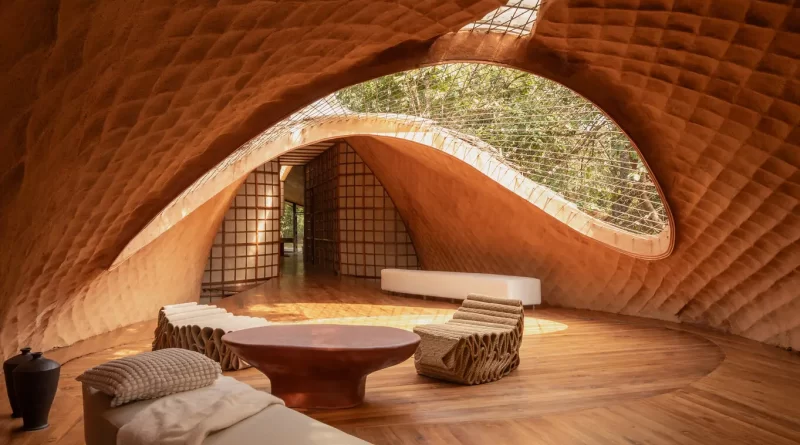
To create an unsupported bridge span anchored to the walls of the gorge, Mr. Daniel’s team devised a roof structure made up of “a combination of four hyperbolic parabolas.” Steel tendons frame the structure, supporting a thatched roof. The roof wraps around the home’s living spaces, with an oculus open to sunlight at the center of the bridge.
It was like something out of a Tolkien novel set in the tropics.


Once the couple started to grasp Mr. Daniel’s vision, they warmed to it. “We were floored by the whole idea,” Mr. Shah said. “And we were very excited at that point of time.”
But it was everything but smooth sailing from there. The project involved a lot of excavation, which was slow, messy work. Then the project team struggled to find the right kind of grass for the roof thatch. After consulting nearby residents, the group eventually settled on a local variety called kusale gavat with a long life span and treated it to make it last longer.
“Before this project, I never looked at grass as much as I did here,” Mr. Shah said.
Karjat also receives intense rainfall, which forced work on the roof to stop periodically.


“Normally, our projects take around two years,” Mr. Daniel said. “Our initial estimates went out of the park because during the monsoon season, it’s impossible to even stand in the area, forget about working there.”
Mr. Shah was in charge of procuring the materials at every stage. He said that Mr. Daniel “always maintained a kind of surprise element in the end.” Although he was perplexed and anxious at Mr. Daniel’s experiments, he realized that he had to trust him. “When you’re trying to create a piece of art, you really don’t know how it’s going to come out,” Mr. Shah said.
When the thatch was finally laid, taking eight months worth of work spread over the whole project, Mr. Daniel’s team incorporated a mud plaster layer and waterproofing to ensure that pests and rodents wouldn’t tear through it. He said he drew inspiration from the pangolin — a scaly mammal — for the final textured finish, which resembles coconut husks. On the inside, the walls and ceilings exhibit a subtle coffered pattern. They dance and form arches, uniting at the roof’s peak.


The house’s layout resembles an arrow from above. On the upper level, a triangular wood-paneled entrance leads into a foyer. Next comes the living room, with the oculus at its center. Furnished sparsely, the space features curving daybeds, and a terra-cotta teapoy developed through a collaboration between Wallmakers and the product design firm Nirmiti Collective.
There’s also the Petty chair, a rippling mass of a folded textile made of yarn woven from recycled plastic bottles and discarded fishing nets. To create it, Mr. Daniel collaborated with the Indian luxury brand Neytt, which provided carpets made of recycled bottles for recent Met Galas.
For the home’s flooring, Mr. Shah traveled to a ship-breaking yard over 400 miles away in the state of Gujarat, where he procured a large amount of salvaged seasoned wood. Despite the long journey, steep price of the wood and the rigors of treating and cutting it, he said he found joy in the process.
“The figures which came out of this wood were amazing,” he said. “It really makes my house shine.”


Two bedrooms flank the eastern end of the hallway on the upper level. On the floor below, two larger bedrooms are at opposite ends of the bridge. Floating wooden steps provide access to them from the corners of the living space. Impromptu hammocks of suspended netting hang over the stairs. Shoji-esque jute and bamboo screens serve as walls throughout the home. At the far end of the upper floor, an arrowhead-shaped kitchen and dining area features a table surrounded by Chandigarh chairs. Floor-to-ceiling windows offer views of a triangular pool and the verdant wilderness beyond.
As for Mr. Shah, he has plans to open up the home for short-term rentals and artist residencies. “But first, I want to enjoy my house for some time, since we’ve worked so hard on it.”