
A life in pictures : Ayatollah Ali Khamenei
Ayatollah Khamenei became Iran’s supreme leader in 1989, wielding ultimate religious and political authority over the state and security apparatus.
For more than three decades, Ayatollah Ali Khamenei led Iran with a steady glare and a closed fist. He was killed in U.S.-Israeli strikes on Iran on Saturday.
Ayatollah Khamenei, the Islamic Republic’s second supreme leader, hardened the revolution beyond the vision of its founder, Ayatollah Ruhollah Khomeini, who held power for a decade. He blocked reform, dismissed protests as Western “sedition” and answered unrest with arrests and executions. The ayatollah, who was 86 at his death, also strengthened the Islamic Revolutionary Guards Corps, using its intelligence arm to police the streets and silence critics.

Beyond Iran’s borders, he armed and trained militias from Gaza to Yemen, pressing Israel and rival Saudi Arabia without courting direct war. He called the United States “the Great Satan,” denounced Israel in venomous terms and aided Russia’s suicide drone attacks in Ukraine.
After the Palestinian militant group Hamas attacked Israel in 2023, he backed anti-Israel fighters in the war that followed. Yet, Iran’s advancing nuclear program, paired with Ayatollah Khamenei’s blistering rhetoric, drew crippling sanctions, deepening isolation and hardening the nation’s standing as a global pariah.
1981

Ayatollah Khamenei, center, with Ayatollah Ruhollah Khomeini, right, who led the revolution and founded the Islamic Republic of Iran.
1986

Ayatollah Khamenei praying in Tehran.
1986

At a Non-Aligned Movement summit with the Palestinian leader Yasir Arafat sitting behind him in Harare, Zimbabwe.
1989

When Ayatollah Khomeini died in 1989, Ayatollah Khamenei, center, was elevated to Iran’s supreme leader.
1989

Ayatollah Khamenei visiting Beijing.
1997

As supreme leader, Ayatollah Khamenei sat above all other branches of government. He appointed the heads of the judiciary, the state media and key security agencies and held final authority over who could run for president.
2000

Inspecting Basij volunteers. The militia’s role in the harsh repression of waves of protest has made it one of the most feared institutions of the Islamic Republic.
2000

A crowd listening to Ayatollah Khamenei speak at a mosque in Tehran.
2006

Photographs of Ayatollah Khamenei hanging in a shop in Qom, Iran.
2006

At a ceremony with Islamic Revolutionary Guards Corps members in Tehran.
2008

Leading a Friday Prayer in Tehran.
2009

People listening to a Friday Prayer speech by the ayatollah after a disputed presidential election in which Mahmoud Ahmadinejad was quickly declared the winner over a reformist, triggering widespread protests before the unrest was violently crushed.
2009

People attending Friday Prayer at Tehran University holding a poster showing Ayatollahs Khamenei and Khomeini.
2022

Ayatollah Khamenei speaking during a commemoration of the death of Ayatollah Khomeini, at a shrine in southern Tehran.
2024

Delivering a speech after casting his vote in presidential elections in Tehran.
2025

A mural showing Ayatollah Khamenei, left, and Ayatollah Khomeini in Tehran.
2025

Iran sees possessing missiles that can reach as far as Israel as critical for self-defense.
2026

A march in Tehran to commemorate the 47th anniversary of Islamic revolution.
2026

A satellite image showing extensive damage to Ayatollah Khamenei’s residence in Tehran on Saturday.
2026

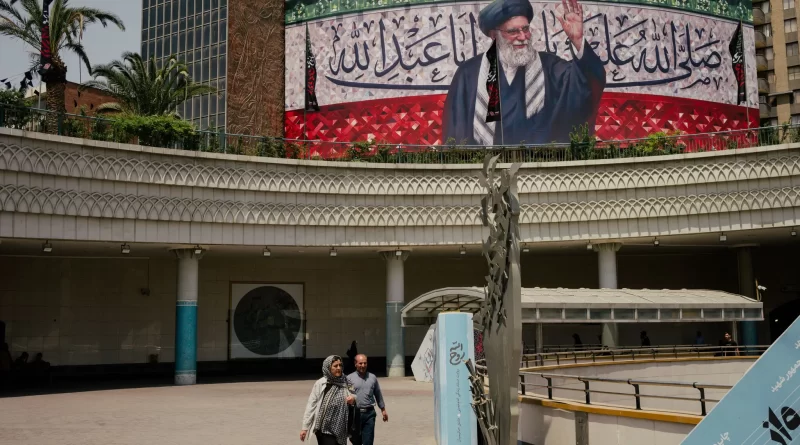
People in Tehran on Saturday as rumors of the supreme leader’s death spread.