
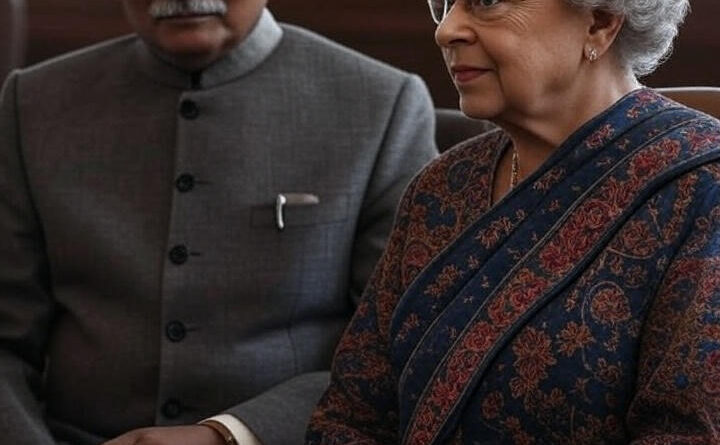
A Royal Visit to Rashtrapati Bhavan: A Glimpse into History
–G.P. Bahuguna
Whenever I glance at old books, it feels like reconnecting with a long-lost friend. This story, drawn from Major C. L. Datta’s book With Two Presidents: The Inside Story, is one such cherished encounter. I first read it in 1985 at the Gauri Pustakalaya, a municipal library within the Malviya Udyan complex in Kotdwar, Garhwal. Written in a diary-like style, the book offers a fascinating glimpse into the tenure of India’s first President, Dr. Rajendra Prasad, and later, Dr. S. Radhakrishnan, both of whom Major Datta served as Aide-de-Camp (ADC). This article focuses on a memorable episode from Dr. Rajendra Prasad’s presidency during the 1961 state visit of Queen Elizabeth II to India.
The Royal Visit
In 1961, Queen Elizabeth II, accompanied by her husband, Prince Philip, Duke of Edinburgh, made her first official visit to India. On the final day of their trip, the royal couple visited Rashtrapati Bhavan to meet President Dr. Rajendra Prasad. During the warm reception, Dr. Prasad presented the Queen with a unique sandalwood carving depicting Lord Krishna seated on a chariot, crafted by skilled Indian artisans. The Queen was visibly delighted with the gift but appeared hesitant as she offered a return gift—a simple yet elegant silver penstand. She seemed to feel it paled in comparison to the intricate Indian artwork.
Dr. Rajendra Prasad, with his characteristic grace, accepted the penstand warmly, saying, “I am deeply touched by this gift. The value of a friend’s gesture lies not in its size but in the affection it carries. I am overwhelmed by the warmth in your heart.” His words eased the moment’s awkwardness.
A Playful Exchange
Also present was Mrs. Vijayalakshmi Pandit, sister of Prime Minister Jawaharlal Nehru and a noted diplomat. In a light-hearted moment, she remarked that Dr. Prasad was writing his autobiography and had delayed its final chapter to include the Queen’s visit. Intrigued, Prince Philip asked, “How many pages will your autobiography be?” Dr. Prasad replied, “Around 1,100 pages.” With a mischievous glint, Prince Philip quipped, “Oh! So, the President of India has so much free time and so little work!”
Dr. Prasad responded with quick wit, “Your Majesty, three-quarters of it was written in jail, where Her Majesty’s father, the Emperor, had kept me. I spent six years there with nothing but time on my hands.” The remark left the Queen momentarily uneasy, but Mrs. Pandit deftly lightened the mood, saying, “The weather today is delightful, as if it, too, is celebrating the Queen’s arrival.”
Impressions of the Royal Couple
Major Datta, in his book, shares candid observations about the royal couple. He writes, “We, the personal staff of Rashtrapati Bhavan, had several opportunities to observe the Queen closely. Contrary to her photographs, she was petite, barely 5 feet 1 inch tall, and slender. Her skin was wrinkled beneath her eyes, and she wore heavy makeup for public appearances. In the lifts, she often checked her reflection, adjusted her hat, and studied her painted fingernails. She greeted crowds with a measured wave of her right hand, smiling only as much as protocol required. Prince Philip, tall and lanky with thinning hair, had a charming personality. He spoke softly and rapidly, captivating those around him.”
This episode, blending diplomacy, warmth, and wit, remains a charming footnote in the history of India-UK relations, captured vividly through Major Datta’s recollections.