
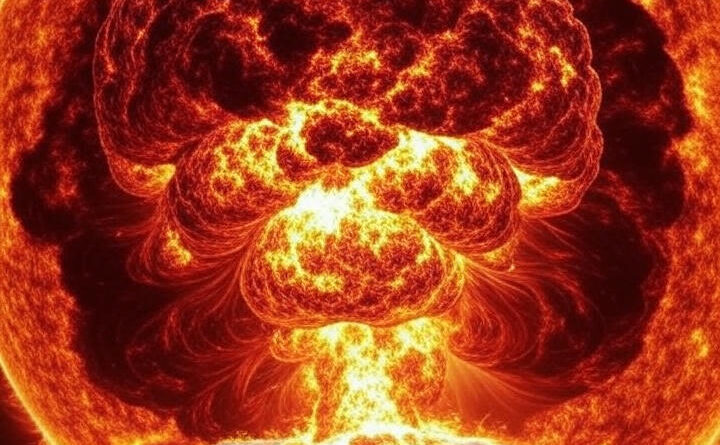
A Stunning Solar Explosion That Defies Expectations


By- Jyoti Rawat
Imagine a massive explosion on the Sun, hurling charged particles and magnetic fields into space at mind-boggling speeds. Now, picture this fiery outburst maintaining a steady temperature despite expanding rapidly across the cosmos. Sounds impossible, right? Yet, that’s exactly what scientists discovered in a solar event on July 20, 2017—a finding that’s rewriting our understanding of the Sun’s explosive tantrums and their impact on Earth.
What Are Solar Explosions?
Solar explosions, known as Coronal Mass Ejections (CMEs), are like cosmic fireworks. These eruptions blast out massive clouds of plasma—superheated, charged gas—and magnetic energy from the Sun’s outer atmosphere, called the corona. When these clouds barrel toward Earth, they can wreak havoc, disrupting satellites, GPS systems, and even power grids. Understanding how these CMEs behave as they travel through space is crucial for protecting our technology-dependent world.
CMEs are a wild mix of temperatures, ranging from chilly (about 10,000 Kelvin) to scorching hot (around 10 million Kelvin). As they expand, they exchange energy through processes like heat, motion, and electricity, which can make the plasma hotter or cooler. To predict their effects, scientists need to study their thermodynamic properties—things like temperature, density, and pressure.
A Surprising Discovery
A team of scientists, led by Dr. Vaibhav Pant and Prof. Dipankar Banerjee from the Aryabhatta Research Institute of Observational Sciences (ARIES) in Nainital, India, along with Dr. Ritesh Patel from the Southwest Research Institute in Boulder, USA, zoomed in on the core of a CME from July 2017. Using data from ground-based tools like the Mauna Loa Solar Observatory’s K-Cor coronagraph and space-based telescopes like NASA’s Solar Dynamics Observatory, they made a jaw-dropping discovery: the core of this CME stayed at a constant temperature as it stretched from 1.05 to 1.35 times the Sun’s radius.
Normally, you’d expect the core to cool down as it expands—a process called adiabatic cooling, where no heat is exchanged with the surroundings. But this CME defied the rules, behaving more like an isothermal system, where the temperature holds steady. The team also found that the core’s density dropped by a factor of 3.6 as it spread out, offering clues about how these solar storms evolve.
Why This Matters
This discovery is a game-changer. By studying how CMEs behave close to the Sun (within 3 times its radius), scientists can better predict their journey through space and their potential to disrupt life on Earth. Past studies focused on CMEs farther out, missing the rapid expansion and acceleration that happen closer to the Sun. This new insight fills a critical gap in our knowledge, helping us prepare for space weather—the conditions in space that can affect our planet.
Looking Ahead with Aditya-L1
India’s first solar mission, Aditya-L1, is set to launch a powerful tool called the Visible Emission Line Coronagraph (VELC). This instrument will capture detailed images and spectra of CMEs right in the Sun’s inner corona, shedding even more light on their behavior. With VELC’s data, scientists hope to uncover new secrets about these solar storms, making our predictions sharper and our technology safer.
Details could be found in the following links: