
Artemis II Moon Flyby Live Updates: Artemis II Astronauts Prepare to Pass Distance From Earth Record
The crew of four will become the humans who have traveled farthest from Earth at 1:56 p.m. Eastern time. Later, the astronauts will pass behind the moon.

Reporting from Johnson Space Center in Houston.
It’s time to go around the moon.
The world has tracked the journey of NASA’s Artemis II mission for five days. The four astronauts have launched into space, tested life support and other important systems of their Orion spacecraft, tangled with the vehicle’s toilet, puzzled over personal computing devices and left low-Earth orbit. They are the first humans to do so since 1972, although they will not land on the moon.
The three Americans and one Canadian aboard Artemis II are set on Monday to make even more history.
First, Reid Wiseman, Victor Glover, Christina Koch and Jeremy Hansen will become the humans who have traveled farthest from Earth. They will surpass the astronauts of Apollo 13, whose lunar mission went awry.
Later, the astronauts will pass behind the far side of the moon, seeing parts of the moon never observed with human eyes, gathering scientific data on what they spot. In the process, they will fall out of radio contact with Earth for about 41 minutes.
As the crew comes out of its scheduled communications blackout, they may have an opportunity to create a moment for a new generation as inspirational as the “Earthrise” of NASA’s Apollo 8 mission in 1968.
Here’s what else to know.
-
Distance record: The astronauts are expected to cross the 248,655-mile distance record from Earth, set by the Apollo 13 mission in 1970, at 1:56 p.m. Eastern time. They will go a bit farther as they go around the far side of the moon, ending up 252,760 miles from Earth at 7:07 p.m., before looping back toward the planet.
-
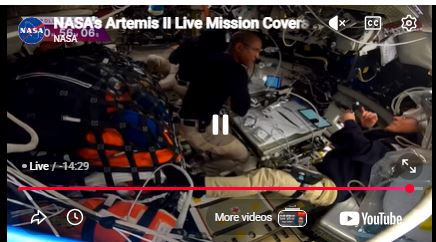
How to watch: NASA is streaming live video coverage of the mission 24 hours a day. You can view it on YouTube, X, the agency’s website and its smart TV apps. You can also view it in the video player above.
-
Radio blackout: When the astronauts go around the lunar far side, they will lose contact with Earth because the moon blocks signals with Earth. This is expected to occur at 6:44 p.m. and is no cause for alarm. (During the Apollo missions, the command module repeatedly passed behind the moon, providing some periodic respite from mission control for the astronaut who waited in lunar orbit while his two crewmates walked on the surface.) At 7:02 p.m., the crew will zip over the moon at an altitude of 4,070 miles, its closest approach.
-
Bonus eclipse: After the astronauts come around the far side, they will experience a 53-minute solar eclipse starting at 8:35 p.m. They will be able to observe the solar corona from a unique perspective, as well as unusual glimpses of Earth and other planets.
-
Current distance: The astronauts were 247,255 miles from Earth the last time this post was updated.
-
Five days: The Artemis II mission launched to orbit on the evening of April 1. After a day of testing important systems in a high Earth orbit, the crew flew away from the planet on Day 2. On Days 3 and 4 the astronauts tested other systems and spoke with family. At the end of Day 5 they entered the lunar sphere of influence, where the pull of the moon’s gravity is stronger than Earth’s.
.