
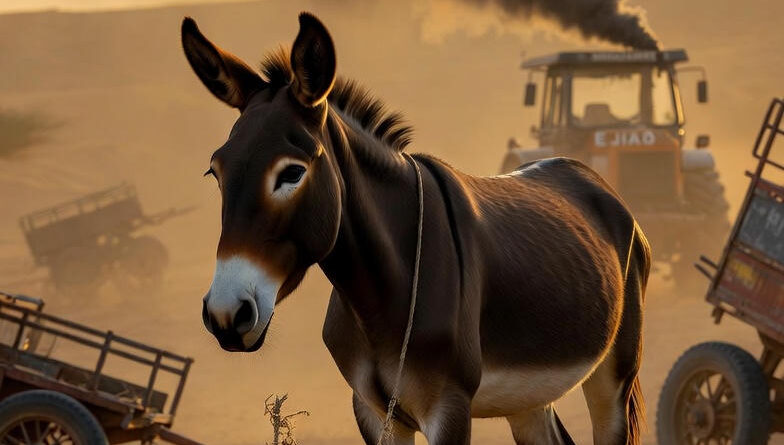
BETRAYAL OF THE LOYAL CREATURE: THE DONKEY
भारत का आखिरी गधा
एक फटी रस्सी, एक टूटा गाड़ा
और उसकी पीठ पर सात हज़ार साल का बोझ
ट्रैक्टर की धूल में खोया हुआ
ईजियाओ के लिए कटता चमड़ा
और इंसान की जुबान पर गाली बनता नाम
लेकिन आँखों में अभी भी वही बफादारी
जो कभी नहीं टूटी
———————————————————————————

– Jay Singh Rawat
The donkey is that creature of the earth whose loyalty and sense of duty have not only turned it into a symbol of foolishness but have also made it a term of abuse in human language. In return for its loyalty, it has received nothing but betrayal. This is why the donkey population is continuously declining—a matter of not only environmental and social concern but also a reflection of humanity’s ingratitude and growing disconnection from nature. Donkeys, which have been companions of human civilization for millennia, are today facing neglect, cruelty, and a rapidly shrinking population. In India, the population of this animal has fallen by as much as 90 percent.
According to the latest livestock censuses, the number of donkeys in India stood at 9,677,000 in 1992. By 2012 it had dropped to 320,000, and by 2019 it had further plummeted to just 112,000. The 20th Livestock Census (2019) records a 90 percent decline in the donkey population between 1992 and 2019. Between 2012 and 2019 alone, their numbers fell by 61 percent. The latest census in Madhya Pradesh shows only 3,052 donkeys remain there—a 94 percent decline since 1997. A 2021 comparative study by Stuart L. Norris and colleagues found that between 1997 and 2018, India witnessed a 74 percent drop in donkey and mule populations, higher even than China’s 72 percent decline.
According to the 2019 livestock census, Rajasthan has the highest remaining donkey population in India, with approximately 23,000 individuals. Yet even in Rajasthan, the population fell by 71.31 percent between 2012 and 2019. In contrast, the northeastern states of Arunachal Pradesh, Nagaland, Mizoram, and Manipur have very few donkeys; in Arunachal Pradesh the figure is below 100. In Uttarakhand, only about 50 donkeys remain. This geographical variation reflects regional factors that affect the use and survival of donkeys.
Donkeys are often labelled “foolish” or “stubborn,” a completely mistaken perception. In reality, donkeys are intelligent, adaptable, and sensitive animals. They are renowned for their ability to survive harsh conditions, carry heavy loads,076 and maintain stability on rugged terrain. Donkeys are social creatures that form strong bonds with their owners and herd companions. They exhibit complex behaviours such as problem-solving, communication, and social learning. With proper training and care, donkeys can be gentle, loyal, and obedient.
The increasing mechanisation of agriculture and transport in India is eliminating the traditional roles of donkeys. Tractors, motorcycles, and other motorised vehicles have largely replaced them because they are faster and more efficient. In rural areas where donkeys were once used to transport goods and people across rough terrain, motorised vehicles have now taken over. Another grave threat to donkey populations is the soaring demand for ejiao (gelatin made from donkey hides) in Chinese traditional medicine. Demand exploded after the popular 2011 Chinese drama Empresses in the Palace and with China’s growing prosperity and ageing population. This demand is affecting donkey populations worldwide, as poaching and export of donkey hides have surged. Had other countries taken effective steps to protect their donkeys, this global crisis would not have become so severe.
In India, donkeys used in tourism activities—such as rides and safaris—face cruelty, neglect, and abuse. Many suffer from inadequate food, water, and veterinary care, further reducing their life expectancy and breeding rates. Rising donkey prices in developing countries have placed an additional burden on poor communities, especially women and girls. In the absence of donkeys, the task of transporting goods and carrying loads often falls on these women and girls.
Donkeys are not merely useful animals; they have been an integral part of human civilization. For seven thousand years, a deep relationship has existed between donkeys and humans. In ancient times, donkeys played a vital role in transporting goods and people for artisans, merchants, and administrators. In India, they pulled caravans that connected cities and even carried saints and deities. Just a few generations ago, donkeys were an essential part of rural India’s economy and social fabric. Even today, in some remote Indian villages where motorised transport is neither feasible nor affordable, donkeys are still used to carry goods and people.
Immediate action is needed to halt the declining donkey population and ensure their welfare. Governments and non-governmental organisations must enforce strict policies to prevent cruelty and neglect. Providing veterinary care and proper shelter can increase their life expectancy. Alternative livelihood opportunities should be offered to communities dependent on donkeys, reducing economic pressure and exploitation. Awareness campaigns about the intelligence and importance of donkeys must be launched to improve their social image. Sustainable practices for donkey breeding and habitat protection should be promoted. Since ejiao is made by boiling donkey hides, a complete ban on hide exports and the promotion of alternative materials would be crucial steps forward.
The conservation of donkeys is not merely about saving one species; it is an opportunity to regenerate our humanity and our relationship with nature.
ABOUT AUTHOR -We are profoundly honored to feature the insightful writings of Shri Jay Singh Rawat —a veteran senior journalist, prolific author of several acclaimed books, incisive commentator, and profound social thinker. With decades of dedicated service to truth and society, Rawat’s voice has illuminated critical issues, from environmental crises to human-animal bonds, inspiring generations to reflect and act. His latest piece on the plight of India’s donkeys is a testament to his unwavering commitment to the voiceless. We are privilleged to have him in our editorial board as an honorary member. ~ Admin Team