
Coming Home May Be the Most Dangerous Part of Artemis II
After a successful flight around the moon, the astronauts are relying on a flawed heat shield to protect them as they re-enter Earth’s atmosphere.

The Artemis II heat shield, NASA agrees, is flawed. The heat shield is the critical layer at the bottom of a spacecraft that protects it — and the astronauts inside — from searing temperatures upon re-entering the Earth’s atmosphere. If the shield fails, the underlying metallic structure could melt, rupture and disintegrate.
And there is no backup, and no way for the astronauts to escape.
NASA officials, however, are confident that despite the known shortcomings of the heat shield, the four Artemis II astronauts will remain alive and comfortable as they arrive at Earth on Friday evening at a speed of nearly 24,000 miles per hour, concluding a 10-day trip to the moon and back.
Extensive analysis and testing of the heat shield material “got us comfortable that we can undertake this mission with lots of margin to spare,” Jared Isaacman, the NASA administrator, said in an interview in January.
However, Charlie Camarda, a former NASA astronaut and an expert on heat shields, says NASA should never have launched Artemis II. The agency does not understand well enough the chances that the heat shield might fail, he says, and the mission, a success so far, could end with the deaths of the astronauts.
“I’m going to pray that nothing happens,” he said during an interview a few days before the launch of Artemis II.
His hunch is that there is a 95 percent chance that the astronauts will return safely. But that would mean a 1-in-20 odds of a disaster.
Compare that with the roughly one-in-nine-million chance that the International Air Transport Association calculates for dying in a commercial airline accident.
The crux of the disagreement lies in how much certainty is needed when a definitive, perfect answer is impossible.
During Artemis I, a flight without astronauts that circled the moon in 2022, the capsule, known as Orion, survived re-entry. Had there been astronauts aboard, they would not have noticed anything amiss.


The Orion spacecraft of the Artemis I mission splashing down in the Pacific in 2022; Orion’s heat shield, removed after the conclusion of the mission for study.Credit…NASA; Pool photo by Mario Tama; NASA
But when the capsule was pulled out of the ocean, the heat shield — the same design as the one on the Artemis II spacecraft — was unexpectedly pockmarked, with sizable chunks missing.
A couple of years of investigations followed. NASA officials said their analysis looked at what might happen under worst-case assumptions. Those findings, along with changes in the re-entry path for the astronauts’ return to Earth during Artemis II, provide a significant safety margin, they have said.
The Artemis II crew is aware of the flight’s risks and how NASA has addressed them. “We have actually been there every single step of the way of the spacecraft being built,” Reid Wiseman, the commander of Artemis II, said in September last year.
Dr. Camarda counters that NASA still does not understand the basic physics of what happened during the Artemis I mission and thus cannot truly say what the worst-case scenario might be.
NASA officials have downplayed concerns about the heat shield.
During a news conference in January 2024, Amit Kshatriya, now the associate administrator of NASA, said the Artemis I heat shield had experienced “unexpected phenomena that we need to make sure we understand perfectly.” But, he said, it provided “very good performance from a thermal protection standpoint.”
Photographs of the Artemis I heat shield remained out of public view until they appeared in a report by the agency’s inspector general, an independent watchdog, in May 2024.

The heat shield is made of a material called Avcoat, similar to what was used during the Apollo program more than 50 years ago. By design, as it absorbs the heat of re-entry, it gradually chars and burns off, preventing the heat from reaching the rest of the capsule.
In the investigation of the Artemis I heat shield, engineers concluded that inside some portions of the heat shield, gases built up, and the pressure created cracks, causing chunks of Avcoat to break off suddenly instead of burning slowly and steadily.
For future missions, the Avcoat formula has been modified to make it more porous to allow gases trapped inside to escape.
That left a conundrum of what to do with Artemis II.
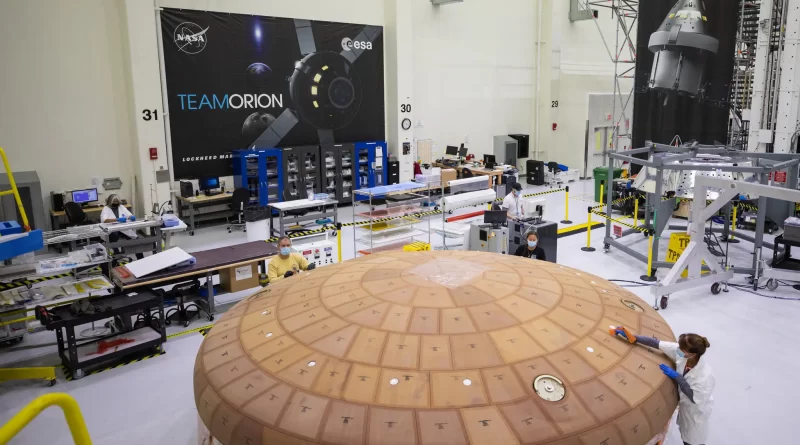
For this mission, the heat shield, using the original formula, was already finished and attached to the Orion capsule. Replacing the shield or the entire capsule would have pushed the launch farther into the future.
Instead, NASA engineers concluded that a steeper, shorter re-entry trajectory would minimize the time during which the vehicle would experience high temperatures and help keep the astronauts safe.
Dan Rasky, a heat shield engineer who retired from NASA in December, shares Dr. Camarda’s objection to this decision.
“Let me just give you an analogy,” he said. “If you’re driving down the highway and if there’s pieces of one of your tires that start coming off, do you just keep driving and just hope it’s OK? Or do you pull over and change your tire because you’re worried about a blowout?”