
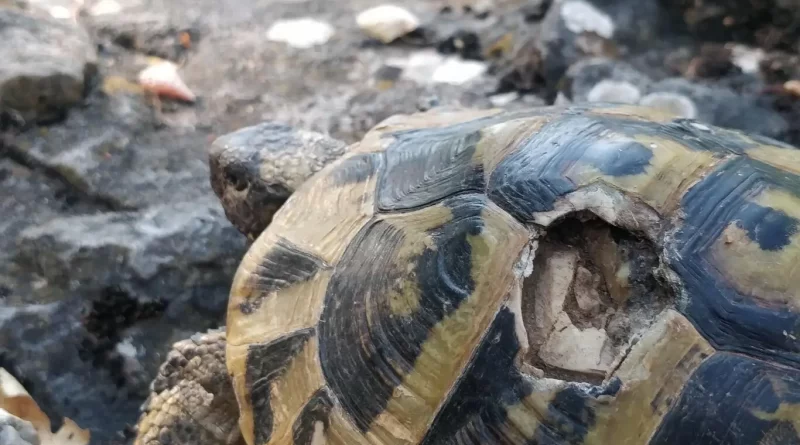
Constant Sexual Aggression Drives Female Tortoises to Walk Off Cliffs
On a remote island in North Macedonia, male Hermann’s tortoises outnumber females 19 to 1, an imbalance driving the population to extinction.
On the island of Golem Grad in North Macedonia, visitors may see a chain of tortoises mounting each other like a slow-moving, libidinous locomotive. It used to strike Dragan Arsovski, an ecologist at the Macedonian Ecological Society, as funny. Now that he knows what’s really going on, he isn’t laughing.
This uninhabited island in a country that once was part of Yugoslavia is crawling with around 1,000 Hermann’s tortoises — especially males. They pursue mates aggressively, making life unhealthy and short for the island’s scarce females. Some of those females even die by walking off the island’s cliffs. In a paper published last month in the journal Ecology Letters, researchers have found that the relentless males are driving their population to extinction.
The island, in Lake Prespa, has a forested plateau encircled by sheer cliffs. When Dr. Arsovski started studying the salad-plate-size tortoises in 2008, “it was quite a dense and seemingly prosperous population,” he said.
But for some reason, there were far more adult males than females — 19 males for every female on the plateau, at the latest count. He and his colleagues documented how the males seemed to manage their carnal instincts by mounting each other.
Then, after many years of study, Dr. Arsovski realized that the females were undersized and dying young. He also realized those once-comical copulatory trains were made up of many males pursuing just one female. When the female tired, the train would become a frenzied heap of reptiles. “She’s literally buried by males,” Dr. Arsovski said.
He and his co-authors wrote that as part of the tortoises’ courtship, they “bump, bite (sometimes to the point of blood loss), mount and finally vigorously poke fleeing females” with a sharp tail tip. Three-quarters of the island’s females had genital injuries.

Nonstop male attention seemed to be driving females to early deaths. The scientists wondered whether the stress also keeps females from reproducing; they can store sperm for several years rather than fertilizing their eggs. The researchers began transporting female tortoises to a veterinarian’s office for X-rays.
The scans revealed that most island females’ bellies were empty. Only 15 percent of females from the plateau carried any eggs. But among tortoises from a nearby mainland population, every female was pregnant, her belly packed with up to 11 eggs.
One more hint about the bleak lives of the Golem Grad females was that on multiple occasions, scientists saw them throw themselves off the cliffs.
Earlier experiments had shown that the island’s tortoises are bold navigators of their rugged native terrain and fearlessly climb off ledges. So Dr. Arsovski set up an experiment in the field: He put females in a temporary enclosure with one exit that led to a short, cushioned fall.
Female tortoises from the mainland, if they were alone, never took the exit. By contrast, many of the island females eventually walked off the simulated cliff. When scientists added five aroused males to the enclosure, though, nearly all the females ended up falling. The authors noted that while the mainland females were pushed, many of the island females “exited voluntarily.”

Male turtles, too, sometimes go over the island’s edge. But, Dr. Arsovski said, “there’s a very significantly higher proportion of females that do die like this.”
Once, he put a GPS device on one of the island’s few egg-carrying females to track where she laid them. Instead, data from the device’s accelerometer “just went berserk” one day, he said. When he returned to the island, he found her dead on the beach, her shell smashed.
The scientists predict in the new study that Golem Grad’s last female tortoise will die in 2083.
The high concentration of aggressive males “actually seems to be causing an extinction vortex,” said Jeanine Refsnider, an evolutionary ecologist at the University of Toledo in Ohio who was not involved in the study.
Dr. Refsnider had “never heard of anything like that” in a natural setting without human disturbances such as pollution or habitat loss, she said, adding, “It’s really unusual and disturbing, but it’s really fascinating.”
Something must have initially tipped this population into having too many males. The scientists say it could have been random variation. On the mainland, there are slightly more females than males.
It’s also possible that humans carried the tortoises to the island in the first place, maybe in unequal numbers. The tortoises can live for a century if conditions are right, and, mysteriously, more than a hundred of Golem Grad’s oldest males have numbers carved into their shells.
“We have no idea where they come from,” Dr. Arsovski said. “I’ve talked to so many people in this region — the oldest people I could find.”
No one knows the answer except the tortoises. In a matter of decades, they may disappear and take their secrets with them.
========================================================
Elizabeth Preston is the author of “The Creatures’ Guide to Caring: How Animal Parents Teach Us That Humans Were Born to Care,” publishing on May 5.