
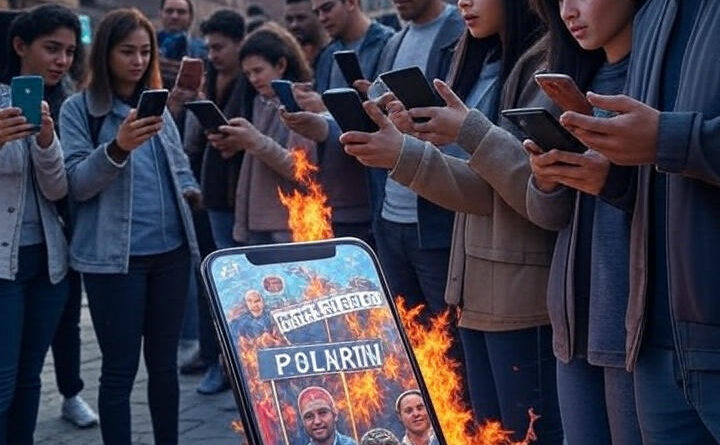
Governments Can Also Be Toppled by Social Media!
Senior journalist and author of several research books, Jaysingh Rawat, explores the transformative power of social media in his latest article, “Governments Can Also Be Toppled by Social Media!” Rawat draws parallels between historical events and the recent upheaval in Nepal, where a ban on 26 social media platforms sparked a rebellion that toppled the government. Highlighting the Nepal incident as the “first social media rebellion” in history, he traces its roots to youth frustration over corruption and unemployment, escalating into violent protests that claimed dozens of lives. Rawat connects this to the Arab Spring (2010-2012), where social media fueled revolutions in Tunisia and Egypt, and later instances like Myanmar’s coup and Brazil’s failed coup attempt, underscoring its dual role as a tool for both liberation and chaos. With 806 million internet users in India and global mobile penetration, he argues that social media’s speed and reach make every phone a citizen journalist’s tool. However, he cautions against its pitfalls—fake news, foreign interference, and polarization—citing Nepal’s rumor-driven violence. Rawat concludes that while social media empowers voices against injustice, its unchecked power poses risks, urging responsible use to balance its benefits and dangers.–ADMIN
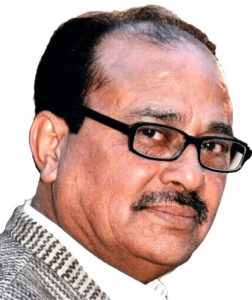
- Jaysingh Rawat
The renowned poet Akbar Allahabadi once wrote about the glory of newspaper media: “Do not draw the bow nor unsheathe the sword; when faced with a cannon, bring out the newspaper.” However, a glance at the recent events in Nepal reveals that the latest avatar of communication, ‘social media,’ has surpassed even Akbar Allahabadi’s imagination. The world has witnessed an unprecedented and fierce form of social media rebellion in Nepal, which has dismantled an entire governance system. This unchecked power of social media, present at every step, can act as a double-edged sword. The Nepal incident serves as a warning that in the digital age, power resides not just in weapons but also in screens.
The events in Nepal this September are introducing the world to a new reality. This marks the first time in history that a rebellion, sparked directly by a social media ban, has escalated to toppling a government. The Nepal government imposed a ban on 26 social media platforms (such as Facebook, WhatsApp, Instagram, and TikTok) under the pretext of curbing misinformation and ensuring accountability, affecting 14.3 million users. However, this ban became a symbol of rebellion for the youth, particularly Generation Z, against corruption, nepotism, and unemployment. Protests that began on September 8 turned violent, resulting in at least two dozen deaths due to police firing and hundreds of injuries. Protesters set fire to the parliament, Supreme Court, prosecutor’s office, and the homes of politicians.
While this may be the first such rebellion, the political influence of social media is not new. The “Arab Spring” revolution between 2010 and 2012 in the Middle East and North Africa stands as its most prominent example. In Tunisia, the self-immolation of fruit vendor Mohamed Bouazizi sparked a movement that spread like wildfire through social media. Videos and posts shared on Facebook and X organized protests, leading to the downfall of President Zine El Abidine Ben Ali’s regime. Similarly, in Egypt, millions gathered at Cairo’s Tahrir Square against Hosni Mubarak’s government, with social media providing real-time information and coordination. Researchers note that these platforms not only amplified the protests but also attracted Western media attention, creating international pressure.
However, the aftermath of the Arab Spring yielded mixed results. While democracy strengthened in some countries, chaos ensued in places like Libya and Syria, where social media provided an opportunity for foreign powers to intervene. For instance, the U.S. State Department used social media as a weapon for “regime change,” as seen in the 2014 ousting of Viktor Yanukovych’s government in Ukraine. American intelligence agencies and NGOs like the National Endowment for Democracy funded and supported protests via Facebook and X.
This year’s events in Nepal serve as the latest testament to the power of social media, often dubbed the “first social media rebellion” in history. Interestingly, despite the ban, protesters organized offline, but the absence of social media further fueled their anger. In Myanmar’s 2021 military coup, Facebook played a dual role—serving as a medium for protests while also being accused of spreading hate during the Rohingya genocide. Similarly, in Brazil, the January 8, 2023, incident saw social media organize Jair Bolsonaro’s supporters for an attack on the parliament, an unsuccessful coup attempt. The role of social media was also evident in the January 6, 2021, Capitol riots in the United States.
The tremendous speed and vast reach of social media are its greatest strengths. Today, anyone with a mobile phone in their pocket is a citizen journalist. According to TRAI, the number of active cellular mobile connections in India was 1.15 billion by the end of 2024, with a slight increase in 2025. Approximately 659 million people use smartphones, and as per TRAI data, there were 806 million active internet users in January 2025, mostly via mobile devices. A key strength of social media is its ability to spread information within minutes to areas where print and electronic media cannot reach. For instance, in August 2025, a sudden flood in the Kheer Gad stream in Dharali village, Uttarkashi district, Uttarakhand, caused devastation. With roads destroyed, traditional media took three days to reach the site, but local residents used mobile phones to instantly viralize pictures and videos, spreading the news worldwide. In contrast, during the 2013 Kedarnath disaster in Uttarakhand, when mobile technology was less advanced, it took two days for the state government to learn of the unprecedented devastation and thousands of deaths.
Social media has undeniably provided a powerful platform to raise voices against inequality, injustice, and corruption. However, it has a dark side too. It is less reliable than print media and can become a weapon for fake news and disinformation. Its misuse is evident in elections and can fall into the hands of foreign powers, threatening a nation’s security and stability. Some analysts in Nepal are calling it a “color revolution.” Studies suggest that in military and authoritarian regimes, social media fuels rebellions, while in democratic countries, it creates polarization. It can incite violence, breach privacy, and impact mental health. In Nepal, rumors after the ban further escalated violence. The unchecked power of social media can be as dangerous as it is beneficial for any nation or society. Governments, companies, and users must collaborate to ensure responsible use, such as curbing fake news and promoting transparency. Social media is a tool, and its impact depends on how we wield it.
(The views expressed in the article are personal to the author, with which the admin does not necessarily agree..Admin)