
Guinness Record Marks India’s AI Resolve
More than 250,000 citizens commit to responsible AI
-A PIB FEATURE-
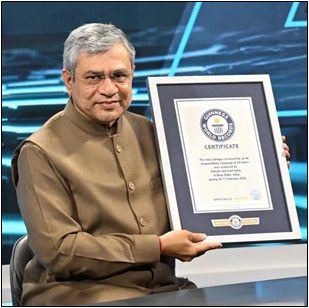
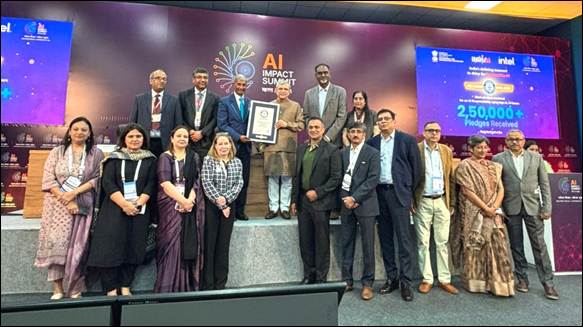
On the third day of the India AI Impact Summit 2026, a quiet sense of achievement settles over Bharat Mandapam in New Delhi. The announcement is simple, yet significant. India has secured the Guinness World Records title for the most pledges received for an AI responsibility campaign in 24 hours. A total of 250,946 valid pledges are recorded between 16 and 17 February. The figure comfortably surpasses the initial target of 5,000. It is not merely a record. It is a statement of intent from a young nation that is choosing to shape artificial intelligence with conscience.
The summit, underway from 16 to 20 February, continues to draw students, educators, innovators and policymakers from across the country and beyond. The AI Responsibility Pledge campaign, launched under the IndiaAI Mission in collaboration with Intel India, invites citizens to commit to ethical, inclusive and accountable use of AI. Participants who complete the pledge receive a digital badge and access to curated AI learning pathways. The gesture is symbolic, yet practical. It links intent with education.
Addressing the media, Union Minister for Electronics and Information Technology Ashwini Vaishnaw described it as a proud moment for the country. He underlined Prime Minister Modi’s vision of engaging young Indians in the responsible use of AI. Colleges across the country are being mobilised, faculty members are encouraged to lead informed discussions, and students are urged to view AI not as a shortcut, but as a tool for social good. He commended the more than 250,000 participants who took the pledge, noting that India’s approach is clear: AI must be embraced with responsibility at its core.
The energy in the venue reflects that clarity. India is home to the largest youth population in the world, with more than 65 percent of its people under 35. The summit taps into this demographic force with deliberate focus. The conversations are not limited to algorithms and infrastructure. They revolve around literacy, ethics and long-term capability. There is a sense that AI is no longer a distant technology. It is a life skill in the making.
That spirit is visible in the announcement of the YUVAi Global Youth Challenge winners. The challenge, conceived under the IndiaAI Mission, draws over 2,500 applications from 38 countries. Young innovators aged 13 to 21 build AI solutions anchored in the themes of People, Planet and Progress. Their ideas range across public health, agriculture, climate resilience, accessibility, smart mobility and digital trust. The top 70 teams now showcase working prototypes at the summit. They speak with policymakers and investors. They are not just participants. They are problem solvers.
This global participation signals something larger. India is not only nurturing domestic talent. It is positioning itself as a convening power in responsible AI. The YUVAi programme, launched in November 2022 by the National e Governance Division under MeitY, equips students from Classes 8 to 12 with AI and social skills. It encourages them to apply AI across eight thematic areas that matter to daily life. Agriculture, health, education, environment and justice are not abstract domains here. They are lived realities that young minds are learning to address with code and creativity.
Alongside it runs YUVA AI for All, a free national AI literacy course offered in eleven Indian languages. Available through DIKSHA, iGOT Karmayogi and FutureSkills Prime, it aims to build foundational AI proficiency among 1 crore citizens. The ambition is bold. It seeks to democratise knowledge and bridge urban rural divides. In doing so, it treats AI literacy as essential as digital literacy once was. The Guinness record now feels like a natural extension of this mass movement.
In another corner of the summit, the Atal Innovation Mission under NITI Aayog showcases how grassroots innovation is feeding into national priorities. The AI Tinkerpreneur Showcase brings together 50 student teams from Atal Tinkering Labs across India. Their projects tackle healthcare gaps, crop management, climate adaptation and accessible education. More than 12,000 teams participate in this year’s edition. After a rigorous evaluation, the top 50 stand here today. They reflect a culture of tinkering that is steadily becoming a culture of innovation.
Beyond the exhibition floor, a broader ecosystem is taking shape. The government has been steadily building frameworks to support AI education and skilling at multiple levels. The Union Budget 2026 to 27 reinforces this direction with allocations for emerging technologies. Support for the Indian Institute of Creative Technologies in Mumbai will help establish AI aligned Content Creator Labs in 15,000 schools and 500 colleges. The initiative is expected to open pathways to nearly 20 lakh jobs in fields linked to the Orange Economy, including animation, gaming and digital content.
The summit also carries news of expanded compute capacity. India will add 20,000 more Graphics Processing Units to its existing base of 38,000 in the coming weeks. Infrastructure and ethics are advancing together. The message is consistent. Scale must go hand in hand with responsibility. A skilled workforce is central to that balance.
From school classrooms to advanced research labs, pathways are being built. Centres of Excellence in healthcare, agriculture and sustainable cities are already operational. A fourth Centre of Excellence for education has been announced. 5 National Centres of Excellence for Skilling are preparing young people with industry relevant AI skills. The Skilling for AI Readiness (SOAR) initiative launched in July 2025 offers structured modules for students and educators. At the vocational level, the Craftsmen Training Scheme has introduced 31 new age courses, including artificial intelligence and industrial robotics, delivered through Industrial Training Institutes and National Skill Training Institutes across the country.
Within government itself, capacity building is underway through the AI Competency Framework for Government Officials. The framework provides structured training to help public officials acquire essential AI skills and apply them in policymaking and governance. This ensures that understanding of AI is not confined to classrooms or private industry, but extends into the public system.
Higher education and research are being supported directly under the IndiaAI Mission. Fellowships and infrastructure are being extended to 500 PhD scholars, 5,000 postgraduate students and 8,000 undergraduate students. By July 2025, more than 200 fellowships have been awarded, with 73 institutes onboarding doctoral candidates. Data and AI laboratories are being established in Tier two and Tier three cities. 31 labs have already been launched in collaboration with NIELIT and industry partners, while states and Union Territories have nominated 174 Industrial Training Institutes and polytechnics for additional labs. Access to advanced tools is no longer limited to a handful of metropolitan centres.
As the summit continues, the mood is measured but confident. The conversations are forward looking, yet grounded in execution. Policymakers listen as teenagers explain prototypes. Industry leaders scout ideas that are both scalable and ethical. The exchange feels less ceremonial and more consequential.
The Guinness recognition marks a moment. But the resolve behind it runs deeper. India is investing in infrastructure, nurturing research, strengthening skilling pipelines and inviting its youth to define the ethics of emerging technology. The record may have been set in 24 hours. The commitment it represents is generational.