
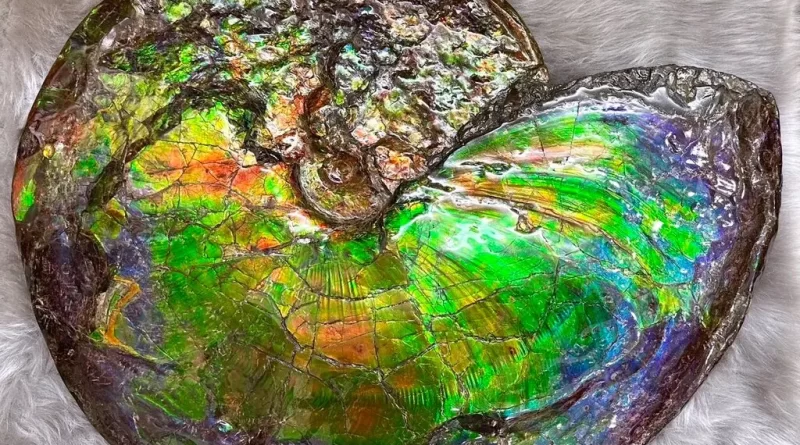
How a Sea Creature’s Fossils Show All the Colors of the Rainbow
The brilliant iridescent hues found in ammolite come from tiny air gaps in the fossils’ layers, a new study finds.

Millions of years ago, squid-like creatures called ammonites swam through ancient seas. While the animals are long gone, many of their shells fossilized, and some of them formed a rare, prized gemstone that bursts with bright iridescent colors.
The gem is known as an ammolite. While other shells have these colors, some scientists believed that the hues of ammolites seemed more intense.
“The vivid colors of ammolite are an art form created by living organisms and the Earth,” said Hiroaki Imai, a chemist at Keio University in Japan, who was first captivated by the fossils at a mineral fair in Tokyo.
A new study, published last month by Dr. Imai and colleagues in the journal Scientific Reports, showed that inside the ammolite, there are very tiny gaps, about four nanometers wide, filled with air between the plates of the mineral aragonite. These evenly spaced gaps reflect specific colors of light depending on the layer’s thickness, giving ammolite gemstones their brilliant, glowing colors.
“We were thrilled to discover that such an exquisite structure is created through the collaboration of biological and geological processes,” Dr. Imai said.
While ammonite fossils are found all over the world where oceans once existed, most of the fossils that produce the iridescent ammolite are mined along the Bearpaw Formation in Alberta.
To understand the source of the ammolite’s colors, the scientists focused on the inner layer of ammonite shells called nacre. This iridescent, pearly layer is also known as mother-of-pearl and is made up of layered plates of the mineral aragonite and organic material. Nacreous layers are found in the shells of other mollusk species, both living and dead.
Using electron microscopes, the scientists observed the microstructures of nacre specimens. They started with the nacreous layers in Canadian ammonite fossils, comparing them with the layers in ammonite fossils from Madagascar. They also studied the nacre in abalone and nautilus shells.
In each specimen, they found similar stacked aragonite plates. But the thickness of these plates and the size of the gaps between them varied
Paul Johnston, a geologist at Mount Royal University in Canada who was not involved in the new study, likened the structures of shells to tiny bricks. In modern shells, like abalone, organic material is still present. But in the fossils, that material has disappeared, leaving space between the tiny bricks.
Paler shades in other shells such as abalone could be caused by the organic material found in the gaps, the study said. But even when the scientists removed the organic material, the abalone shells did not achieve the same coloration as ammolites.
What gives the ammolites from the Bearpaw Formation such brilliant rainbow coloration is the combination of the uniform layered structure and the tiny air gaps.
“That was a very valuable contribution of this paper,” Dr. Johnston said.
An assortment of ammonites can be found along the Bearpaw Formation, and not all of them have an iridescent coloration. Some are a white, creamy color, Dr. Johnston said. For him, a question remains: Why do particular areas of the formation produce the highly iridescent shells?
“There’s some kind of geological difference that we haven’t figured out yet,” Dr. Johnston said.
Neil Landman, who is the curator emeritus of fossil invertebrates at the American Museum of Natural History but who wasn’t involved in the study, said he looks forward to pursuing similar research on why certain fossils found in Alberta produce iridescence.
He said Dr. Imai and colleagues had “set the groundwork for that next question.”
“This, for me, is like the crossover between science and art,” Dr. Landman said.
————————————————————————————————————————————
Alexa Robles-Gil is a science reporter and a member of the 2025-26 Times Fellowship class, a program for journalists early in their careers.