
IIT Madras research reveals Renewables can dominate Global Energy only by late 2040s in aggressive scenarios

– A PIB FEATURE-
A pivotal study by researchers at the Indian Institute of Technology Madras (IIT Madras) has issued a critical reality check on the global transition to net-zero. The research reveals that under current growth trajectories, renewable energy will not surpass fossil fuels in the global energy mix until the mid-2050s. Only under the most aggressive scenarios—requiring an immediate doubling of current investment levels—could renewables realistically dominate the energy sector by the late 2040s. These findings, published in the Transactions of the Indian National Academy of Engineering, emphasize that meeting COP 28 targets necessitates a roughly 73% increase in spending on power grids and energy storage to manage the shift effectively.
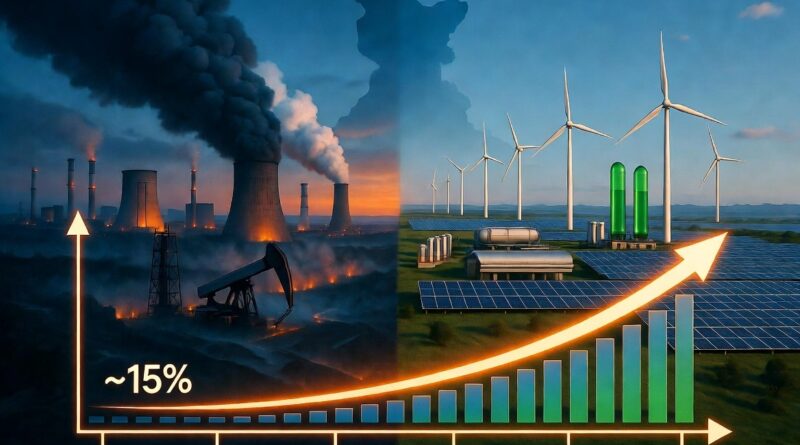
The study, co-authored by Prof. Jitendra S. Sangwai and doctoral scholar Mr. Rajat Dehury, highlights a sobering gap between climate ambitions and current actions. While global renewable capacity grew 128% over the last decade, it still accounts for only 14.56% of total primary energy consumption, with fossil fuels continuing to provide over 81% of world needs. Prof. Sangwai stresses that the transition is an economic and geopolitical imperative, noting that while technological pathways exist, the world is not yet investing at the necessary scale. The analysis also underscores India’s complex role, balancing massive infrastructure needs and economic growth with its ambitious target of reaching 485 GW of renewable capacity by 2030.
Ultimately, the researchers argue that a multi-technology approach is essential for a successful transition. Because fossil fuels are expected to play a significant role for the next two to three decades, particularly in developing economies, the path to net-zero must be complemented by Carbon Capture (CCUS), advanced energy storage like green hydrogen, and significant smart grid modernization. The study warns that without a dramatic acceleration in policy reform and infrastructure funding, the world risks missing every major climate target of the coming decades.