
In Xi’s China, Even the Mightiest General Can Fall
A combat veteran, Zhang Youxia was once seen as the most trusted man in Xi Jinping’s military. Now he has been accused of disloyalty to Mr. Xi.

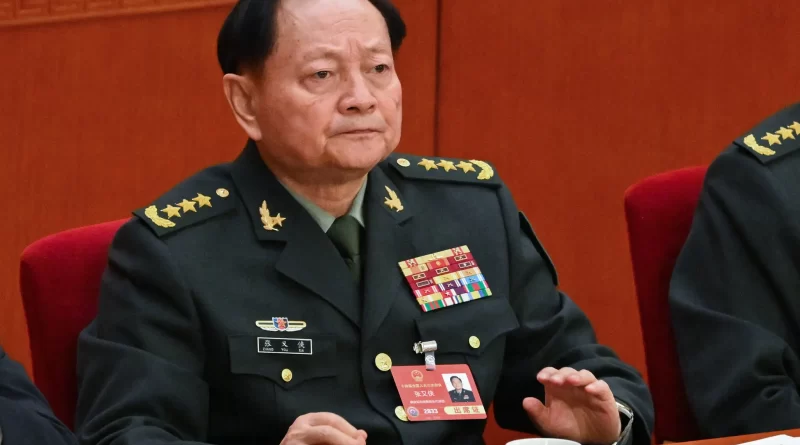
When Gen. Zhang Youxia met with U.S. officials in Beijing in 2024, he exuded the confidence of a man who was seen as the most trusted deputy in the military of China’s top leader, Xi Jinping. General Zhang did not appear worried that he had to look over his shoulder to make sure he was pleasing the leader, said Jake Sullivan, who was the U.S. national security adviser attending the meeting, which lasted at least an hour. “He spoke in an unvarnished way that was typical of a military guy, but also reflective of someone who didn’t feel like he had to be cautious.”
That image of General Zhang’s invulnerability, and closeness to Mr. Xi, shattered over the weekend, when China’s defense ministry announced that he was under investigation for unspecified breaches of laws and political discipline.
General Zhang’s downfall is of a different magnitude from the dozens of other generals who have been toppled in Mr. Xi’s unrelenting campaign against perceived corruption and disloyalty over the past three years. His fate has astonished even longtime experts who thought that they had taken full measure of Mr. Xi, China’s most powerful and imperious leader in generations.

“It’s fair to say this is a seismic event,” Mr. Sullivan said. For Mr. Xi to “take out somebody who he had such a long history with is striking and raises a lot of questions,” he said.
At 75, General Zhang was old enough that Mr. Xi could in theory have ushered him into retirement. Instead, Mr. Xi made a public pariah of him. An editorial about General Zhang in the Liberation Army Daily on Sunday hinted that he was being accused of corruption, and, perhaps more important, of disloyalty to Mr. Xi.
General Zhang and another commander who fell with him, Gen. Liu Zhenli, had “trampled on” the authority of the military chairman — that is, Mr. Xi — and had “severely undermined the party’s absolute leadership over the military,” the editorial said. Their actions had “rendered massive damage” on the military’s political soundness and combat readiness, it said.

“It reads more to suggest that they really were challenging Xi Jinping, that it was really a personal betrayal,” said Shanshan Mei, a political scientist at RAND, a research organization, who studies China’s military. “Corruption is mentioned, but to me this gist of what they are accused of is very political, betraying Xi.”
What prompted Mr. Xi to finally turn against General Zhang is now a topic of fevered speculation in Beijing and beyond. Some experts believe that Mr. Xi may have come to see General Zhang as too powerful after the general’s own rivals were toppled in previous purges. Others believe Mr. Xi concluded that systemic corruption was so deep that he needed drastic surgery to clear the way for a new generation of commanders.
Other allegations have emerged. The Wall Street Journal reported on Sunday, citing anonymous sources, that General Zhang has been accused of leaking nuclear secrets to the United States.
The timing of the investigation has drawn attention to General Zhang’s recent high-level engagements. Mr. Sullivan said their discussions of nuclear issues in 2024 — in the presence of about 20 other Chinese military officers — were strictly general. He said that he brought up nuclear weapons in the context of China’s overall military buildup, but said that General Zhang said nothing sensitive or even substantive on the topic.
“That was not one of the main topics of the discussion,” Mr. Sullivan said.
A ‘Princeling’ Like Xi
Mr. Xi and General Zhang are both “princelings,” the sons of revolutionaries who served under Mao Zedong. General Zhang’s father was a general who served alongside Mr. Xi’s father, Xi Zhongxun, in northwest China. There is no evidence that General Zhang and Mr. Xi were close as children, but their shared background might have helped to cement their bond at some point, said Joseph Torigian, the author of a biography of the older Xi.
General Zhang was a celebrated war veteran in a nation where few active commanders have endured real combat. Mr. Xi kept him in office past retirement, and made him his top vice chairman of the Central Military Commission — Mr. Xi’s eyes and ears in running the People’s Liberation Army’s forces day to day.
Now, if formal charges are leveled against General Zhang, he may face a secret trial in the military justice system. If so, he is almost certain to be convicted and imprisoned.
General Zhang’s downfall “will ultimately have a big effect on the power elite in Beijing because it removes one of their safety boundaries,” said Deng Yuwen, a former editor of a Chinese Communist Party newspaper in Beijing who now lives in the United States. “Even Zhang Youxia’s personal relationship with Xi Jinping was no guarantee of his safety, so nobody can feel safe.”

General Zhang joined the army in late 1968 and later distinguished himself as a frontline officer during China’s grinding, yearslong border war with Vietnam from 1979. Accounts from troops described him as an audacious and wily unit leader who urged soldiers to use more artillery during a series of battles for Longshan, a disputed area on the border.
“We must first grab him by his throat so that he can’t escape, advance or move, and then we strike,” General Zhang told a junior officer, Li Zhongping, according to a Chinese oral history of the war published in 1989.
After Mr. Xi became China’s leader in 2012, he quickly moved to shake up the military, which was rife with corruption and organizationally stuck in the past, ill equipped to deal with the country’s expanding naval, air and nuclear weapons ambitions. General Zhang was one of the commanders tapped by Mr. Xi to help lead his overhaul of the People’s Liberation Army, or P.L.A., culminating in a major reorganization from 2015.
“Zhang was a key enabler of Xi’s military reform agenda prior to late-2015 — before Xi became powerful enough to impose himself on the P.L.A.,” said James Char, an assistant professor at Nanyang Technological University in Singapore who studies the Chinese military.
In 2012, General Zhang, who was then the head of a military region in northeast China, joined a delegation of senior Chinese military officers who visited the United States. Drew Thompson, then a Pentagon official helping to organize the visit, said the general was strikingly confident and inquisitive.
Other Chinese officers “stood up faster and straighter when he entered a room,” Mr. Thompson in a post on Substack on Monday. He added: “He wasn’t afraid to talk to foreigners, unlike some other senior officers who were often afraid or unable to engage.”
Later that year, he was promoted to head the Chinese military’s armaments department, an office that bought weapons, a post he held until 2017.

The department had the makings of “a petri dish of corruption for all the obvious reasons: Developing and procuring expensive weapons systems makes it a nice place to collect bribes and kickbacks,” said Daniel Mattingly, a professor at Yale University who is studying Chinese military politics.
Other senior officers who worked in the department were later felled in anti-corruption investigations. Yet General Zhang had long seemed to be spared scrutiny.
Now, the purge of General Zhang could raise questions about China’s strategy toward Taiwan and the risks of war. Mr. Thompson, the former Pentagon official, saw the general as someone who “had seen combat and been humbled by it.”
“I think he could assess U.S. and Taiwan military capabilities objectively and explain to Xi Jinping what the military risks and costs of an operation to take Taiwan would be,” Mr. Thompson wrote of General Zhang. “I worry about the consequences of someone other than Zhang Youxia providing Xi Jinping with military advice.”
Chris Buckley, the chief China correspondent for The Times, reports on China and Taiwan from Taipei, focused on politics, social change and security and military issues.