
Iran War Live Updates: As Trump’s Latest Ultimatum Looms, Tehran Vows to Step Up Attacks
Iran said it would respond “crushingly” if President Trump carried out his threats to strike power plants and bridges unless Tehran reopens the Strait of Hormuz by Mr. Trump’s newly extended Tuesday deadline.

Iran said on Monday that it would retaliate forcefully if President Trump carried out his threat to strike Iranian power plants and bridges unless Tehran ends its chokehold on the Strait of Hormuz.
Both countries appeared to stand on the precipice of what could become a new phase in the month-old war, as they escalated threats and Iran and Israel launched new attacks. Tehran has sent a new 10-point peace proposal to Pakistan, which has acted as an intermediary with Washington, demonstrating that attempts to broker an end to the war are still underway. But those efforts have yielded little ahead of Mr. Trump’s Tuesday deadline, with each side making demands that the other has dismissed as unacceptable.
Mr. Trump has threatened repeatedly to bombard critical Iranian infrastructure unless Iranian forces meet his deadline to end their de facto blockade on the Strait of Hormuz, which is a conduit for a significant portion of the world’s crude oil and natural gas.
But he has also postponed that threat several times, most recently on Sunday, when he pushed back the deadline by a day, to Tuesday evening in the United States. Analysts say that without tangible progress toward peace, the repeated postponements risk eroding the power of his warnings.
An Israeli strike overnight on Monday killed Majid Khademi, the intelligence chief for the Islamic Revolutionary Guards Corps, in the latest killing of a senior Iranian leader. Iran has refused to back down, firing repeated volleys of ballistic missiles at its neighbors and snarling global shipping.
“If attacks on civilian targets are repeated, the subsequent phases of our offensive and retaliatory operations will be carried out much more crushingly and extensively,” Ebrahim Zolfaghari, an Iranian military spokesman, said on Monday.
Strikes on power plants could affect millions of civilians across Iran, in what many legal experts argue could be considered war crimes under international law. Such attacks could also add to worries about the global economy, which has been rattled by soaring energy prices since the war began in late February. Oil prices rose slightly during Asia’s business day on Monday before falling on reports of progress in indirect talks between Iran and the United States.
The impasse has left Mr. Trump contemplating extreme options for the next steps, including a ground invasion of strategically important islands in the Persian Gulf.
Here’s what else we’re covering:
-
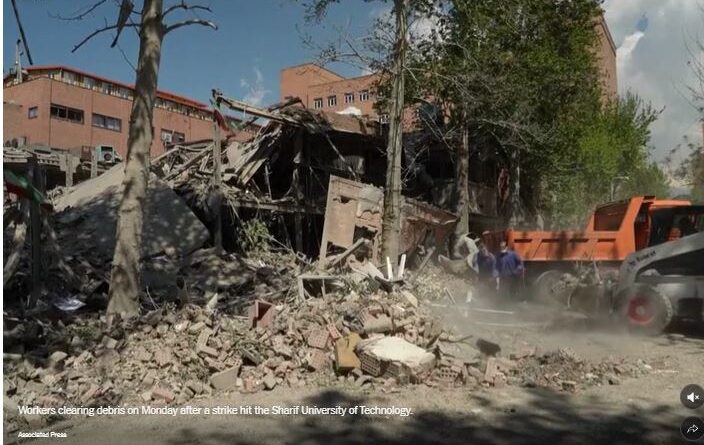
University bombed: Overnight airstrikes hit Sharif University of Technology in Tehran, Iran’s top science, engineering and math institute, prompting outraged responses from Iranians, including opponents of the regime. The university is under Western sanctions for ties to the Iranian military and agencies that develop weapons systems.
-
Rescued airmen: The two U.S. airmen who were rescued after being shot down over Iran were receiving care at Landstuhl Regional Medical Center, a military hospital in Germany, a U.S. military official said.
-
Attacks across the Middle East: Israel said it had bombed a major Iranian petrochemical complex on Monday, just days after it struck a similar site — part of an avowed goal to destroy factories that fill Iran’s coffers. Israeli paramedics retrieved the bodies of four people killed by an Iranian missile strike in Haifa, according to the Israeli authorities.
-
Warning from oil nations: Eight members of the consortium of influential oil producing nations known as OPEC Plus on Sunday expressed concern about the toll the war was taking on global oil supplies and energy infrastructure in the region. “Restoring damaged energy assets to full capacity is both costly and takes a long time,” the group said in a statement. Read more ›
-
Death tolls: The Human Rights Activists News Agency said at least 1,606 civilians, including 244 children, had been killed in Iran as of Friday. Lebanon’s health ministry on Thursday said at least 1,345 Lebanese had been killed since the latest fighting between Israel and Hezbollah began. In attacks blamed on Iran, at least 50 people have been killed in Gulf nations. In Israel, at least 20 people had been killed as of Monday. The American death toll stands at 13 service members, with hundreds of others wounded.