
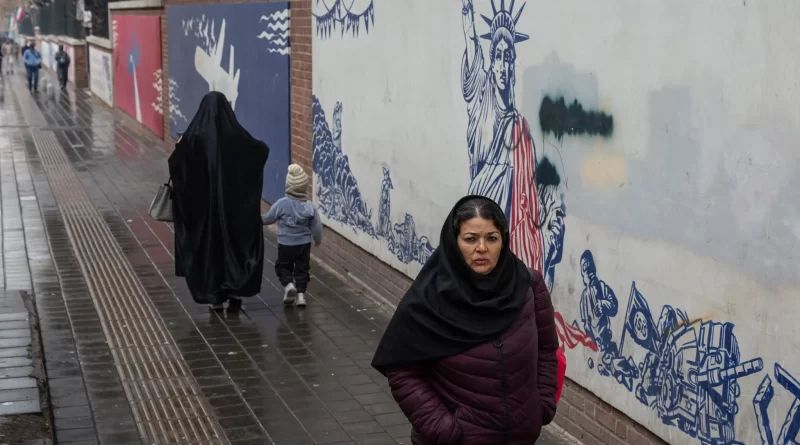
Iranians Brace for War Beneath Veneer of Normalcy
Stores are well stocked, and there have been no reports of shortages of food and other essentials, but many Iranians are in limbo as they wait to see whether U.S. forces will attack.


For days, the fate of roughly 90 million Iranians has appeared to swing between war and peace as American and Iranian officials traded threats of attack and calls for diplomacy.
With negotiators from both sides set for indirect talks in Geneva on Thursday — seen as the last chance to reach a deal that can avert war — some Iranians are packing emergency bags, buying backup generators and making plans to escape to rural areas or flee the country altogether.
Others have resigned themselves to watch and wait, believing that they have little sense of what is to come, and little means left to prepare.
And some, like Sara, a chemist in Tehran, feel too paralyzed by anxiety to act.
“I’m going crazy,” she said in a telephone interview. “I wish whatever is supposed to happen would happen so we could get out of this limbo.”
Like all Iranians who spoke to The New York Times, Sara asked to be identified by only her first name, out of fear of retaliation from authorities.
A 53-year-old mother of two, she said she was struggling to decide whether it was too soon to remove her daughter from school and begin evacuating her elderly relatives. If war were to break out, she said, the roads out of Tehran would quickly choke up with traffic.
Many Iranians already had a taste of such an arduous experience last June during the country’s 12-day war with Israel, when millions fled the capital to the Caspian Sea and the mountainous countryside outside the city. A journey that would normally take four hours took many of them almost a day to complete.

Despite this, the Iranian government has shown little in the way of contingency planning. Last week, Tehran’s mayor, Alireza Zakani, told local news outlets that metro stations and underground parking lots could be turned into shelters. The municipality, he said, had taken “minimum” steps to prepare them.
Local planning experts have warned that metro stations and parking lots need heating, ventilation, and hygienic facilities. There is no publicly available information suggesting those measures have been taken.
Mr. Zakani, who was criticized over the lack of emergency planning for the June war, has dismissed concerns about preparedness as premature. He shrugged and smirked in a televised interview with the Iranian news media last week and said authorities did not want to cause panic.
“We don’t believe there will be a war so bad that we should force an emergency situation on the public,” he said. He accused Washington of trying to sow fear in the Iranian public, which lives in a perpetual state of “no war, no peace.”
“Why should we allow them to close our city and make us anxious?” he asked.
Some Iranians say they feel abandoned to their fate.
“It’s like there is no government and we have to figure out how to survive war with the biggest army in the world,” Amir, a 42-year old businessman, said. He is too afraid to travel for work and leave behind his wife and children when war feels as if it could start any minute.
On the surface, little in Tehran has changed. Grocery stores are well stocked, residents say, and they have seen no signs of shortages of food, gasoline or water. Schools and businesses remain open, and people go about their work and daily lives.

Online, however, Iranians are sharing tips on how to prepare for the worst.
Some posts encourage people to write down emergency numbers for loved ones and designate meeting places, in case the Iranian authorities shut down the internet and telecommunications — as they did during the war in June and in the wake of antigovernment protests last month.
Last week, a prominent Iranian activist in France, Ilia Hashemi, posted a widely circulated list of suggestions for stocking up two weeks’ worth of supplies: about a gallon of water per person per day, canned and dry goods, candles, flashlights, first-aid supplies, warm clothes and power banks.
A day later, Mr. Hashemi wrote that he had been inundated with responses from angry people inside Iran saying they could not meet their needs for a single day, let alone two weeks.
Iran is also mired in a dire economic crisis.
The demonstrations were set off last December by a plunge in the value of the currency, the rial. In the weeks since, the rial has hit two more record lows, while inflation has risen 60 percent compared with last year, according to a prominent Iranian business newspaper.
Basic items like meat, poultry and eggs are now out of reach for many families, and some residents say loved ones are having to choose between paying the rent or buying food.
“It’s not even possible to make preparations and plan for things,” said Sahand, a Tehran resident. “Families don’t have the money to go stock up on food and medicine. All they think about is where to go and hide.”
Most people, Sahand added, “have just given up. They think there is nothing they can do.”

Beyond basic survival, some Iranians are also concerned about how to keep communicating.
In addition to filling an emergency backpack with her passport, water, medicine and dried fruit, Maryam, a 54-year-old artist in Tehran, also purchased high-end virtual private network services, hoping she could use them to bypass an internet blackout.
Like many Iranians interviewed, Maryam has been glued to daily news about diplomatic negotiations and the looming threat of war.
“Everyone I’ve spoken with these days is very confused,” she said. Many Iranians say they cannot understand President Trump’s wavering position on the scope or timing of an attack — or even whether it could happen at all.
As potential strikes loomed, Iran’s Revolutionary Guards conducted military drills on the country’s southern coast on Tuesday, according to state media.
There are divergent views among critics of the Iranian government on the possibility of U.S. strikes. Some say they are eager for them to happen, as a form of revenge for the thousands killed in the bloody security force crackdown last month. Others are wary that war would ravage the country without toppling the state.
And Iranians are still voicing their defiance. For four days, protests have erupted across university campuses in at least three cities — Tehran, Mashhad and Isfahan — with students chanting for an end to Iran’s clerical rule and burning the state flag, according to videos verified by The Times.
Reza, a marketing specialist and conservative who supports Iran’s clerical rulers, said he was frustrated to see the authorities cracking down on university protests instead of announcing more emergency plans.
“When we are under the shadow of the most powerful military in the world, the government’s responsibility is to consider the worst-case scenarios,” he wrote in a text message.
Sahar, 38, who works at a start-up in Tehran, said she was terrified by the idea that the country could be wrestled over by two forces who have little concern for the fate of regular Iranians.
“It’s like two men arguing over a house,” she said, “and in the end they burn it down while we’re still inside.”
( With courtsey from The New York Times)
====================================================================
Sanam Mahoozi and Sanjana Varghese contributed reporting.
Farnaz Fassihi is the United Nations bureau chief for The Times, leading coverage of the organization. She also covers Iran and has written about conflict in the Middle East for 15 years.