
New Supreme Leader Issues Defiant Statement Amid Growing Disruption to Global Supplies
Iranian state media said Mojtaba Khamenei vowed his country would keep blocking the Strait of Hormuz, a key oil route, and avenge “the blood of the martyrs.” Israel pounded central Beirut, the Lebanese capital, expanding its attacks against Hezbollah.

Mojtaba Khamenei, Iran’s new supreme leader, struck a defiant tone on Thursday in his first known public comments since succeeding his slain father, vowing to keep blocking the Strait of Hormuz, a vital oil route, and to avenge “the blood of the martyrs.”
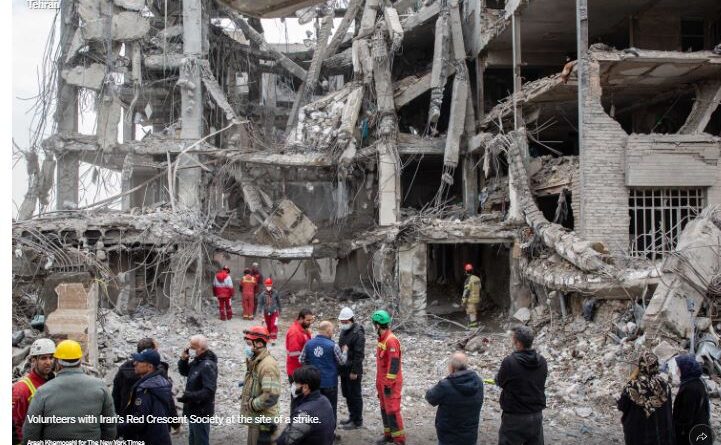
Hours later, Israel said it had launched a new wave of strikes in Beirut, targeting what its military said was infrastructure belonging to Hezbollah, the Iran-backed militant group. The strike on central Beirut sent a thick plume of dust and smoke rising above a residential area filled with high-end bars and restaurants.
For Lebanese residents displaced by Israel’s evacuation orders and relentless bombardment, the latest strikes, far from the southern suburbs of Beirut where Hezbollah holds sway, were the latest sign that the conflict was expanding. It also crystallized a growing suspicion that even the once-safest corners of the city may no longer be off-limits in the rapidly escalating war between Hezbollah and Israel.
The strikes came after the military issued sweeping evacuation order for central Beirut, the first such warning for an area within city limits since the U.S.-Israeli war with Iran began last month. Earlier on Thursday, Israeli airstrikes hit several cars along the seaside corniche in Beirut’s Ramlet al-Baida neighborhood, covering the sidewalk in bloodied sand and setting off panic in the neighborhood.
“I don’t feel like there is a safe place for us to go anymore,” said Hussain Mansour, 32, a Lebanon resident who standing by the site of a strike in the seaside community Ramlet al-Baida. “Where? Where should we go?”
Israel’s expanding attacks on parts of Lebanon erupted after Hezbollah, an Iran-backed militant group, began striking parts of Israel in solidarity with Hamas, another Iran proxy in Gaza. The United States and Israel began striking Iranian targets on Feb. 38, killing the supreme leader, Ayatollah Ali Khamenei, who was then succeed by his son Mujtaba.
In written statements carried by Iranian state media on Thursday, the younger Mr. Khamenei said that Iran would pursue “an effective and regret-inducing defense” and that “the lever of blocking the Strait of Hormuz must also continue to be used.” About 2,000 people have been killed since the start of the U.S.-Israeli assault, mostly in Iran.
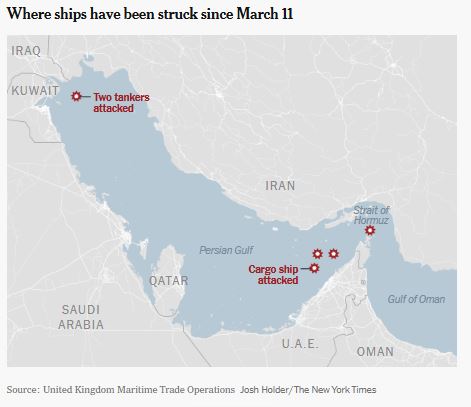
His comments were likely to add further instability to oil markets. Iran has threatened attacks on shipments through the Strait of Hormuz, which is normally a conduit for one-fifth of the world’s oil. Iraq and Oman closed oil terminals on Thursday after two tankers were attacked and left burning off Iraq’s coast.
Oil prices have surged despite pledges by the United States and other major economies to calm markets to release emergency reserves. On Thursday, President Trump shrugged off the rising oil prices, arguing that preventing Tehran from acquiring nuclear weapons was more important and claiming the United States would profit.
“The United States is the largest Oil Producer in the World, by far, so when oil prices go up, we make a lot of money,” he wrote on social media, adding that “of far greater interest and importance to me, as President, is stoping an evil Empire, Iran, from having Nuclear Weapons.”
Qatar said on Thursday that it had stopped a missile attack, while Saudi Arabia said it had destroyed two drones that were heading toward the kingdom’s huge Shaybah oil field.
Here’s what else we are covering:
-
Death toll: Iran’s representative to the United Nations, Amir Saeed Iravani, told the Security Council on Wednesday that more than 1,348 civilians had been killed. Dozens have also died in Iranian drone and missile attacks on Gulf countries and Israel. In Lebanon, the Israeli bombardment has killed more than 680 people and displaced over 800,000, according to Lebanese officials.
-
Tanker attacks: Iran’s Revolutionary Guards Corps claimed responsibility for attacking one of the two tankers off Iraq’s coast, a Marshall Islands-flagged ship that Iraqi officials said was owned by an American company. In a statement cited by Iranian state media, the Guards said the ship had “disobeyed and ignored” warnings. Chris Wright, the U.S. energy secretary, told CNBC on Thursday that the U.S. Navy could begin escorting ships through the strait by the end of the month.
-
Banks threatened: Major financial institutions, including Citi and HSBC, temporarily closed offices in the Persian Gulf after Iran said it would target U.S. and Israeli banks in the region. Iran’s Islamic Revolutionary Guards Corps made the threat after an airstrike hit a building in Tehran linked to Bank Sepah, an institution founded in 1922 as Iran’s first modern domestic bank. Read more ›
-
Khamenei: Mr. Khamenei, the new Iranian leader, has not appeared on video or in public since he was appointed on Monday to replace his father, Ayatollah Ali Khamenei, who was killed in Israeli airstrikes at the start of the U.S.-Israeli bombing campaign. Mr. Khamenei, 56, a hard-line cleric seen as close to Iran’s top military force, was injured in the initial strikes, according to Iranian and Israeli officials. The full circumstances and extent of his injuries is unclear.
-

A billboard in Tehran depicts Ayatollah Mojtaba Khamenei taking an Iranian flag from his father, Ayatollah Ali Khamenei.Credit…Arash Khamooshi for The New York Times Mojtaba Khamenei, the newly appointed supreme leader of Iran, issued a defiant statement on Thursday, directing the military to continue blocking a vital oil shipping route and calling for Iran’s neighbors to close U.S. military bases used to attack Iran.
The statement, Ayatollah Khamenei’s first since being chosen to succeed his father Ali Khamenei, who was killed during U.S.-Israeli airstrikes on Feb. 28, was an early indication of how the new supreme leader would approach the war, as well as how he would rule the country. The crisis has spread far beyond Iran’s borders and threatened regional stability and the world economy.
“Certainly, the lever of closing the Strait of Hormuz must continue to be used,” he said. Iran has warned that ships that pass through the strait, a vital oil shipping route on its southern coast, are at risk of attack, effectively halting transit through the waterway and sending the price of oil spiraling upward in recent days.
Ayatollah Khamenei also promised to avenge the death of Iranians killed by U.S. and Israeli air strikes.
“We will not refrain from avenging the blood of your martyrs,” Ayatollah Khamenei said in a section addressed to the Iranian nation, according to text of the statement published by Iranian state media.
He referred specifically to a strike on a girls’ elementary school in Minab in southern Iran, which an ongoing U.S. military investigation has determined the United States was responsible for. Iranian officials have said the death toll was at least 175 people, most of them children.
In addition, he said, Iran has studied the possibility of “opening other fronts in areas where the enemy has little experience and would be highly vulnerable,” though it was unclear what exactly he was referring to.
Ayatollah Khamenei also appeared to issue a warning to Iran’s neighbors in the Middle East to sharply curtail their military cooperation with the United States. In response to U.S. and Israeli attacks, Iran’s military has launched missile and drone strikes across the Persian Gulf region, targeting U.S. military bases and American interests, though it has also hit civilian infrastructure.
“I recommend that they shut down those bases as soon as possible, because by now they must have realized that America’s claim of establishing security and peace has been nothing more than a lie,” he said, referring to Iran’s neighbors.
Hamidreza Azizi, a visiting fellow at the German Institute for International and Security Affairs and an expert on Iranian security issues, said Ayatollah Khamenei’s statement was even more defiant in tone than his father’s utterances, particularly in how explicit he was about military strategy.
“He gets right to the point,” Mr. Azizi said. “It tells a lot, I think, about the direction of the country.”
Mr. Azizi raised the possibility that the statement had been written for Ayatollah Khamenei by other powerful figures in Iran and delivered in his name, but “What matters is that this is the reflection of the tone of the system,” he said.
“Whoever is making decisions is not going to show any sign of compromise or appeasement.”