
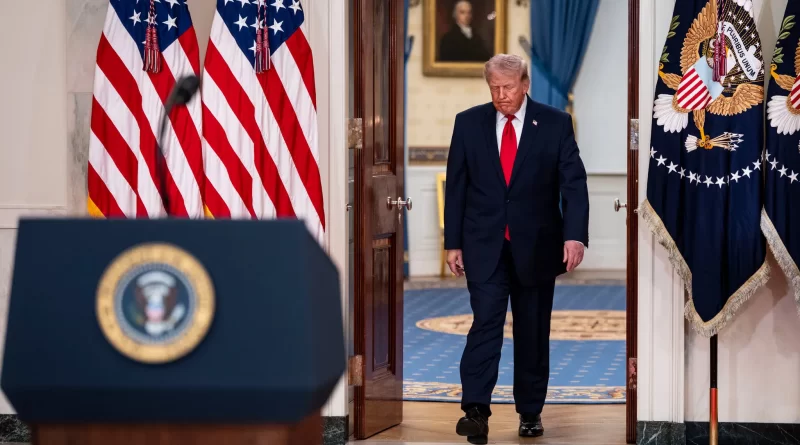
On Iran, Trump Keeps World Off Balance With Ever-Changing Threats
Global leaders are struggling in their efforts to find a way to end the American-Israeli war on Iran, and they are spooked about what President Trump might do next.

Reporting from London
The world is on edge.
One minute, President Trump says the war in Iran is nearly over. The next he says it will continue for weeks. He brags that Iran has been “eviscerated,” but then vows that the fighting will go on. A huge bombardment, he says, might begin in five days, or 10 days, or on Tuesday at precisely 8 p.m. Eastern.
If the president means what he says, the world could be about 24 hours from a devastating escalation in the war. But like the producer of a television cliffhanger, Mr. Trump seems determined to keep everyone off balance.
On that, at least, he is succeeding.
In capitals around the world, presidents and prime ministers have spent almost six weeks seeking a way to prevent the U.S.-Israeli war against Iran from spiraling out of control. Diplomats from more than 40 countries gathered for a video call on Thursday that concluded with few concrete proposals. Leaders across Europe, Asia and beyond are exasperated, angry and more than a little spooked about what could be around the corner.

In an emergency cabinet meeting on Monday, President Lee Jae Myung of South Korea warned, “The scars of war are expected to persist for a long time.” In an Easter message at a church the day before, Mr. Lee had lamented, “The order of peace and prosperity that has sustained the world is weakening.”
In Japan, which is deeply reliant on oil imports from the Middle East, Prime Minister Sanae Takaichi said on Monday that she would seek direct talks with the Iranian government as soon as Wednesday. In France, President Emmanuel Macron complained last week about Mr. Trump’s constantly changing commentary, saying that serious people “don’t say every day the opposite of what we said the day before.”
Andreas Babler, vice chancellor of Austria, criticized Mr. Trump’s war conduct in a social media post on Saturday as he defended Vienna’s decision to maintain neutrality by denying American warplanes the use of Austrian airspace.
“We are not part of Trump’s chaotic policy,” Mr. Babler wrote, “and must not yield an inch here.”
Mr. Trump and his aides have long boasted that unpredictability is a strength on the world stage. During his first term, Mr. Trump threatened to unleash “fire and fury like the world has never seen” on North Korea but later declared that he “fell in love” with its dictator, Kim Jong-un, whom he called “a smart guy.”
Even knowing Mr. Trump’s erratic history, his handling of the war in Iran has rattled his counterparts with a series of contradictory, up-is-down statements about how the war might end.
On Wednesday, in a speech to the nation, Mr. Trump effectively declared Iran defeated. “Their navy is gone, their air force is gone,” he said, adding, “Their missiles are just about used up or beaten.” Iran has “no antiaircraft equipment,” he claimed, with a radar system that is “100 percent annihilated.”
Two days later, Iran shot down two American military planes.
In his Wednesday speech, Mr. Trump seemed unconcerned about the closure of the Strait of Hormuz, saying, “When this conflict is over, the strait will open up naturally. It will just open up naturally.”

But on Sunday, in a profanity-laced, 44-word social media post, Mr. Trump promised to bomb Iran’s power plants and bridges — attacks which would in most cases constitute war crimes under international law — unless the “crazy bastards” open “the Fuckin’ Strait” to international shipping by Tuesday.
“You’ll be living in Hell — JUST WATCH!” Mr. Trump wrote.
The threats did not sit well with some leaders. António Costa, president of the European Council, which sets the European Union’s political direction, issued an unusually clear discouragement to the United States over Iran.
“Any targeting of civilian infrastructure, namely energy facilities, is illegal and unacceptable,” Mr. Costa wrote on social media. “Escalation will not achieve a ceasefire and peace.”
Hours after his threat, Mr. Trump suggested that negotiations with Iran were ongoing, telling Axios, “If they don’t make a deal, I am blowing up everything over there.” In an interview with The Wall Street Journal, Mr. Trump said that he would bomb “every power plant and every other plant they have in the whole country” if Tehran refused to open the strait.
Iran responded by vowing retaliatory operations that would be “carried out much more crushingly and extensively,” according to a statement published by the semiofficial Mehr News Agency.
On Monday morning, reports emerged that officials in Pakistan had sent the United States and Iran a proposal for a 45-day cease-fire and a reopening of the Strait of Hormuz. There was no immediate response from either country.
The uncertainty makes it difficult for global leaders to plan what to do once the fighting stops.
In the meeting of diplomats on Thursday, which was convened by Britain, envoys discussed how to mitigate the economic shocks from the disruption to energy shipments through the strait.

In a statement after the closed-door meeting, the British foreign secretary, Yvette Cooper, declared that Iran must not prevail in trying to “hold the global economy hostage in the Strait of Hormuz.” But many global leaders have explicitly ruled out becoming militarily involved in the war. Ms. Cooper’s statement offered no practical steps beyond “diplomatic pressure” and “coordinated economic and political measures” to free up international shipping again.
Using the often ambiguous language of diplomats, her statement promised only “to take forward further discussions.”
In the days following, Prime Minister Keir Starmer of Britain spoke with the leaders of Germany, Italy, Kuwait, Ukraine, the European Union and NATO. Readouts from the British government of all those conversations concluded in a similar way.
“The prime minister and crown prince welcomed the meeting convened by the foreign secretary yesterday on a viable plan to reopen the strait,” said a news release about the call between Mr. Starmer and the crown prince of Kuwait. “They agreed to continue to work together on this and stay in close contact over the coming weeks.” ( COURTESY FROM THE NEW YORK TIMES)
===================================================================
Reporting was contributed by Javier C. Hernández from Tokyo, Choe Sang-Hun from Seoul, Jeanna Smialek from Brussels, and Jim Tankersley from Berlin.
Michael D. Shear is the chief U.K. correspondent for The New York Times, covering British politics and culture and diplomacy around the world.