
On Safer Tracks: How Kavach and AI Are Strengthening Railway Safety in India
Key Takeaways
|
-A PIB FEATURE-
Every train journey carries a deeply human promise: that families will reunite, workers will return home, and students will arrive safely. Behind that promise, Indian Railways is undergoing a major transformation to meet present and future transportation challenges. With increasing train traffic and plans to enhance the speed potential of the network, the focus is on maximizing the capacity of existing assets, including rolling stock, tracks, traction power, and signaling systems, while ensuring safety remains uncompromised.
Driving this safety revolution is Kavach, India’s indigenously developed Automatic Train Protection (ATP) system. Combined with advanced AI-enabled monitoring and predictive tools, Kavach is helping the Railways build a safety ecosystem that grows stronger, faster, and more reliable every year. The results are clear: consequential train accidents have declined sharply, from 135 in 2014–15 to 31 in 2024–25, and further to 11 in 2025–26 (up to November). These improvements reflect a sustained focus on accident prevention, modern technology investment, and a commitment to ensuring every journey is as safe as it is essential.
This safety transformation is reinforced by sustained financial investment. Indian Railways has steadily increased its spending on safety from ₹39,200 crore in 2013–14 to ₹87,336 crore in 2022–23, ₹1,01,662 crore in 2023–24, ₹1,14,022 crore in 2024–25, and ₹1,17,693 crore in 2025–26, underscoring a long-term commitment to strengthening safety infrastructure across the rail network.
What is Kavach?
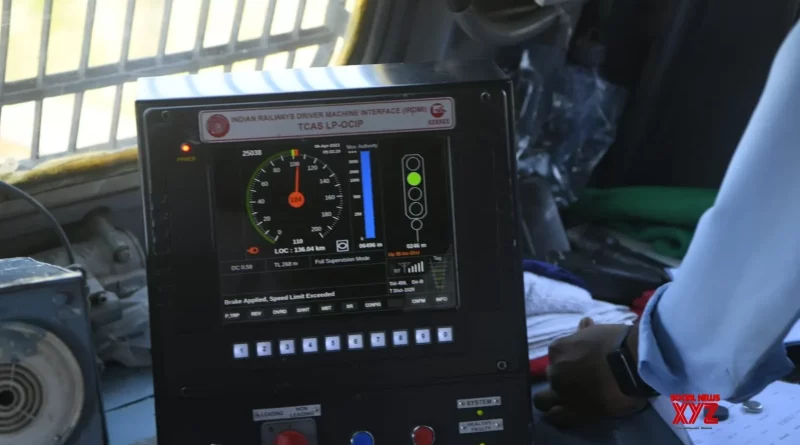
Kavach is an automated situational awareness system that provides train protection and accident prevention capabilities. It safeguards against dangerous incidents caused by human error, operational limitations, and equipment failures by adding a critical layer of safety to train operations. The system assists Loco Pilots through a real-time in-cab display of signaling information such as movement authority, target speed, target distance, and signal aspects, which are essential for safe operations beyond 120 kmph.
Developed by Indian Railways through the Research Designs & Standards Organization (RDSO), Kavach protects trains against Signal Passing at Danger (SPAD), excessive speed, and collisions. By providing this additional safety layer, it plays a vital role in operations across India’s high-speed and high-density rail network.
Why do we need Kavach?
Earlier, train operations on Indian Railways relied primarily on trackside signaling and manual control. Although modern interlocking systems improved safety, train driving continued to depend heavily on the Loco Pilot’s ability to observe line-side signals and regulate speed. This human-dependent system had inherent limitations, as missed or misinterpreted signals had led to serious accidents.
Conventional signaling systems also lacked in-cab information on permitted speed, distance to go, precise train location, and track gradients. Signal visibility was often affected by track curvature and adverse weather, while higher safety margins required greater spacing between trains, reducing network capacity. Operating in block sections without advance information further increased operational risk.
These challenges, along with Signal Passing at Danger (SPAD), reduced reaction time at high speeds, limited situational awareness, and frequent fog and low-visibility conditions, especially in Northern India, reinforced the need for Automatic Train Protection (ATP) systems.
ATP systems were developed to continuously monitor train location, speed, and movement authority, and to automatically intervene to prevent unsafe operations. With increasing traffic density and higher operating speeds, their deployment became essential for maintaining safety and reliability across the rail network. In this context, Kavach, certified to Safety Integrity Level 4 (SIL-4), one of the highest global safety standards in railway signaling, addresses these gaps by providing continuous real-time situational awareness and automated enforcement of safety parameters. By integrating onboard intelligence with trackside systems and automatic intervention, Kavach significantly enhances the safety, reliability, and robustness of train operations on Indian Railways.
| Advantages of Kavach |
|
|
|
|
|
|
Kavach-Working Principle
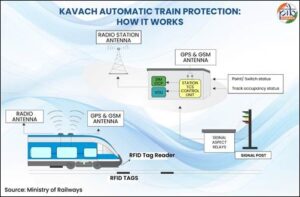
Kavach operates through continuous real-time communication between trackside systems and locomotives using secure Ultra High Frequency (UHF) radio antenna and track-mounted Radio Frequency Identification (RFID) tags. These tags provide precise train location, while wayside (stationary) units collect live data from station interlocking systems, including signal aspects, point positions, track occupancy, and route status.
Using this information, along with train position, speed, and track profile (such as gradients and speed limits), the wayside system calculates the Movement Authority, the safe distance a train is permitted to travel, and transmits it to the onboard Kavach unit. The onboard system continuously monitors train speed, displays critical information to the Loco Pilot, and generates braking curves for different operating conditions.
If the train approaches a danger signal, exceeds permitted speed, or enters a conflicting route, Kavach automatically applies brakes, preventing Signal Passing at Danger (SPAD) and potential collisions. In block sections, if two trains are detected moving toward each other, the system issues an automatic Stop-on-Sight (SoS) command to both.
All critical operational events are transmitted to a central monitoring system, ensuring network-wide visibility, while secure communication protocols and authentication mechanisms safeguard system integrity.
KAVACH-Safety Features
Supported by this operating framework, Kavach provides built-in safety functions that prevent accidents, improve driver awareness, and enforce operational discipline through automated interventions and real-time supervision. Its key safety features include:
- Detection and prevention of Signal Passing at Danger (SPAD) – automatically stops the train before the signal.
- Cab signaling with display of movement authority, target distance, speed, and signal aspects.
- Continuous real-time updates to the locomotive.
- Speed restrictions enforced at turnouts.
- Compliance with permanent speed restrictions.
- Compliance with temporary speed restrictions (under trial).
- Automatic horn activation when approaching Level Crossing Gates.
- Roll Back / Roll Forward protection – prevents unintended backward or forward movement of the train, especially on gradients or during halts.
- Prevention of all types of train collisions: head-on, rear-end, and side-on.
- Emergency Stop (SoS) messages in critical situations.
- Computation of train length for operational safety.
- Validation of shunting limits.
- Centralized live monitoring of train movements through the Network Management System (NMS).
Evolution of Kavach
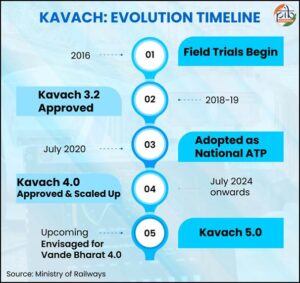
The development and deployment of KAVACH have been undertaken in a phased and systematic manner. Initial field trials on passenger trains commenced in February 2016. Based on operational experience and the Independent Safety Assessment carried out by an Independent Safety Assessor (ISA), three firms were approved during 2018–19 for the supply of KAVACH Version 3.2.
With over 1,465 route kilometres on South Central Railway and the experience gained therefrom, the system has continued to evolve through successive improvements and upgrades. These developments culminated in a revised specification, enabling enhanced functionality and suitability for wider application across the Indian Railways network.
Subsequently, KAVACH was adopted as the National Automatic Train Protection (ATP) system in July 2020. Implementation involves infrastructure, onboard, and communication-related activities, including provision of trackside, station-based, and locomotive-borne equipment, along with necessary telecommunication and optical fibre infrastructure to support reliable system operation.
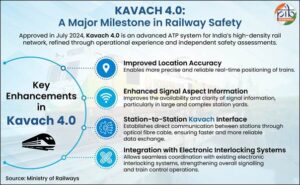
Continuous improvements based on operational experience and independent safety assessments led to the approval of Kavach Version 4.0 in July 2024. It is a significant milestone in railway safety and is designed to meet the requirements of India’s diverse and high-density rail network. Version 4.0 represents a significant technological leap.
These systematic upgrades make Kavach 4.0 more robust, responsive, and suitable for large-scale deployment across India’s diverse and high-density rail network. The system has also been certified to meet global safety standards by the Independent Safety Assessor (ISA).
The upcoming launch of KAVACH 5.0, an advanced safety and signaling system designed for suburban sections, has been announced in April 2025. It is expected to significantly reduce inter-train headway, enabling a higher frequency of train operations while maintaining safe and efficient movement. Vande Bharat 4.0 is envisaged to incorporate Kavach 5.0, the next evolution of India’s indigenously developed Automatic Train Protection (ATP) system, as part of its advanced safety and technology framework.
Strategy and Progress of Kavach
Nearly 96% of railway traffic is carried on the High-Density Network (HDN) and Highly Used Network (HUN) routes. To ensure safe transportation of this traffic, Kavach implementation is being undertaken in a focused manner based on priorities defined by the Railway Board:
- First Priority: High-Density Routes, including the New Delhi–Mumbai and New Delhi–Howrah sections, cleared for 160 kmph with Automatic Block Signaling (ABS) and Centralized Traffic Control (CTC), where trains operate closer to each other, and the risk of human error is higher.
- Second Priority: Highly Used Network routes with ABS and CTC.
- Third Priority: Other passenger high-density routes with ABS.
- Fourth Priority: All remaining routes.
After extensive trials, Kavach Version 4.0 was initially commissioned on 738 route kilometres, including the Palwal–Mathura–Nagda section (633 route kilometres) on the Delhi–Mumbai route and the Howrah–Bardhaman section (105 route kilometres) on the Delhi–Howrah route. Kavach implementation has since been taken up in the balance sections of both the Delhi–Mumbai and Delhi–Howrah corridors.
As part of the ongoing expansion, Kavach Version 4.0 was commissioned on Gujarat’s first section between Bajwa (Vadodara) and Ahmedabad, covering 96 route kilometres, marking its entry into new operational territories.
In January 2026, Indian Railways achieved a major milestone by installing the Kavach Version 4.0 safety system on 472.3 route kilometres in a single day in a single month, the highest ever so far. The newly covered routes include Vadodara–Virar (344 km) on Western Railway, Tuglakabad Junction Cabin–Palwal (35 km) on Northern Railway, and Manpur–Sarmatanr (93.3 km) on East Central Railway. With this expansion, Kavach Version 4.0 now covers 1,306.3 route kilometres across five Indian Railways Zones, strengthening safety on major corridors such as the Delhi–Mumbai and Delhi–Howrah routes. Additional sanctioned works cover 2,667 route kilometres, with execution underway.
The system has been successfully tested through automatic braking trials. Further expansion is underway, including Vadodara–Nagda and Virar–Mumbai Central, and speed upgrades up to 160 kmph are planned under Mission Raftar.
Overall, Kavach has now been implemented on more than 2,200 route kilometres, reflecting a steady and accelerating expansion of India’s indigenous Automatic Train Protection system across the national rail network.
AI & Technology-led Signaling and Telecom Measures for Railway Safety
To further enhance operational safety, improve communication reliability, and strengthen passenger information systems, Indian Railways is leveraging a range of artificial intelligence, telecom, and digital technologies across the railway network. Alongside Kavach, these initiatives complement conventional safety systems by enabling real-time monitoring, predictive maintenance, automated alerts, reducing dependence on manual intervention, improving system responsiveness, and strengthening accident prevention and infrastructure resilience.
- AI-enabled Intrusion Detection System (IDS)
An AI-enabled Intrusion Detection System based on Distributed Acoustic Sensing (DAS) technology has been developed to detect the presence of elephants and other wild animals on railway tracks in vulnerable corridors. The system generates real-time alerts regarding animal movement and transmits warnings to Loco Pilots, Station Masters, and Control Rooms, enabling preventive action and reducing the risk of collisions.
- Operational over 141 route kilometres on the Northeast Frontier Railway.
- Tenders awarded for an additional 981 route kilometres.
To further prevent the movement of wild animals, especially elephants, near railway tracks, innovative Honey Bee buzzer devices have been installed at level crossings. The sound created by these devices acts as a repellent to move elephants away from railway tracks. Additionally, thermal vision cameras are being piloted to detect the presence of wild animals on straight tracks during night or poor visibility conditions, providing timely alerts to loco pilots.
v Video Surveillance System (VSS)
To strengthen station-level security, Video Surveillance Systems (VSS) have been commissioned at 1,731 railway stations. These systems are equipped with AI-based Video Analytics (VA) for automated event detection such as intrusion and loitering, along with Facial Recognition Software (FRS) for real-time identification and monitoring, supporting proactive safety management.
v AI-driven Predictive Maintenance and Inspection
- AI-based predictive maintenance of signaling systems is being piloted at select stations to develop standardized failure prediction logics and alerts mechanism.
- Online Monitoring of Rolling Stock System (OMRS) and Wheel Impact Load Detectors (WILD) adopted for early detection of rolling stock defects and improved asset health monitoring.
- Memorandum of Understanding (MoU) signed between Indian Railways and Dedicated Freight Corridor Corporation of India Limited (DFCCIL) for Wayside Machine Vision-based Inspection System (MVIS) – AI and machine-learning driven, detects hanging/missing components in moving trains.
- MoU signed between Indian Railways and Delhi Metro Rail Corporation (DMRC) for Automatic Wheel Profile Measurement System (AWPMS) – enables automatic, non-contact, real-time measurement of wheel geometry and wear, enhancing operational safety and maintenance efficiency.
v Digital Radio Communication
Safe train operations depend on reliable voice communication between the Loco Pilot and Guard. The procurement of Digital 5W Very High Frequency (VHF) Walkie-Talkie sets has been standardized, replacing conventional analogue systems.
v Tunnel Communication Systems
For long tunnel sections, Tunnel Communication Systems have been implemented, including on the Udhampur–Srinagar–Baramulla Rail Link (USBRL) project. These systems ensure uninterrupted radio communication between trains and operation control centres, enhancing tunnel safety.
v Optical Fibre Cable (OFC) Network
To support modern signaling, telecom, and data communication, the OFC network has been expanded. As of October 2025, 619 route kilometres of OFC were laid, taking cumulative coverage to approximately 67,233 route kilometres.
v Passenger Information and Guidance System
Coach Guidance System (CGS) installed at 1,064 stations displays coach positions to help passengers locate coaches. Train Indication Board (TIB) at 1,449 stations displays train arrival/departure details, including train number, name, timing, and platform.
v Electrical/Electronic Interlocking
Electrical/Electronic Interlocking Systems with centralized operation of points and signals have been provided at 6,660 stations as of December 2025. These systems significantly reduce accidents caused by human failure.
v Vigilance Control Devices (VCD)
All locomotives are equipped with Vigilance Control Devices to improve the alertness of Loco Pilots.
v Fog Safety Measures
- Retro-reflective sigma boards are provided on signal masts, located two OHE masts prior to the signals in electrified territories, to alert crews about the signal ahead when visibility is low due to foggy weather.
- A GPS-based Fog Safety Device (FSD) is provided to Loco Pilots in fog-affected areas, enabling them to know the distance to approaching landmarks such as signals and level crossing gates.
v Track and Rail Health Monitoring
- Ultrasonic Flaw Detection (USFD) testing of rails is carried out regularly to detect internal defects and ensure the timely removal of defective rails.
- Monitoring of track geometry is undertaken using Oscillation Monitoring Systems (OMS) and Track Recording Cars (TRC) to identify defects, assess ride quality, and predict maintenance requirements.
v Digital Track Asset Management
· A web-based online monitoring system of track assets, including a track database and decision support system, has been adopted to enable rationalized maintenance planning and optimize resource deployment.
Conclusion:
With the combined deployment of Kavach 4.0, the upcoming Kavach 5.0, and AI-driven monitoring systems, Indian Railways is actively building a modern, integrated, and predictive safety architecture. These technologies are strengthening operational reliability, protecting passengers and staff, safeguarding infrastructure, enhancing suburban capacity, and improving wildlife safety.
From the first field trials in 2016 to large-scale nationwide deployment today, this journey reflects a sustained commitment to safety, indigenous innovation, and continuous improvement. As implementation continues, Indian Railways is steadily moving toward becoming one of the safest, most technologically advanced, and most future-ready rail networks in the world.