
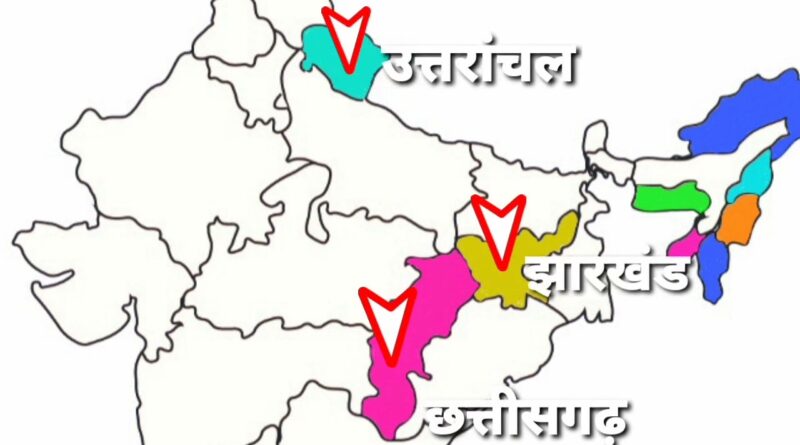
THE DAWN OF NEW HORIZONS: THE CREATION OF CHHATTISGARH, UTTARAKHAND, AND JHARKHAND

By- JAY SINGH RAWAT
In the annals of Indian federalism, the year 2000 stands as a watershed moment. On November 1, Chhattisgarh emerged as India’s 26th state, carved from the mineral-rich eastern flanks of Madhya Pradesh. Eight days later, on November 9, Uttarakhand (initially christened Uttaranchal) became the 27th state, hived off from the rugged hills of Uttar Pradesh. Finally, on November 15, Jharkhand took shape as the 28th state, separated from the tribal heartlands of southern Bihar. These formations were not mere administrative tweaks but the culmination of decades-long struggles for identity, equity, and self-governance. Driven by shared grievances of economic exploitation, cultural marginalization, and administrative apathy, they reshaped India’s political landscape.
Roots of Aspiration: Historical Demands and Movements
The demands for these states echoed a broader sub-regional renaissance in post-independence India, moving beyond the linguistic reorganizations of 1956 to embrace cultural, economic, and geographical imperatives. All three regions, nestled in the Hindi heartland, suffered from the “curse of plenty”—abundant natural resources like minerals, forests, and hydropower siphoned off without commensurate local development—coupled with neglect from distant state capitals. This fueled movements that blended indigenous pride, environmental activism, and calls for political autonomy, gaining traction in the 1970s and 1980s amid economic liberalization and rising regionalism.
Chhattisgarh: From Resource Periphery to Sovereign Entity
Chhattisgarh’s story is one of quiet resolve amid opulent neglect. Encompassing 16 districts of eastern Madhya Pradesh, the region boasted vast coal, iron ore, and bauxite reserves but languished with poor infrastructure and underutilized agricultural potential. Demands for separation surfaced as early as the 1920s, but the modern movement ignited in the 1980s, propelled by the Chhattisgarh Rajya Nirman Manch—a coalition uniting farmers, tribals, and intellectuals under leaders like Devendra Bahadur Singh and Chandulal Chadrakar. The Manch’s campaigns highlighted cultural distinctiveness, including dialects like Chhattisgarhi and festivals such as Bastar Dussehra, while decrying the siphoning of royalties to Bhopal.
The push culminated in the Madhya Pradesh Reorganisation Bill, introduced in Parliament in August 2000 and swiftly passed amid cross-party support. On November 1, Chhattisgarh was born, with Congress leader Ajit Jogi sworn in as its first Chief Minister. The state’s formation addressed long-standing inequities, fostering targeted policies for tribal welfare and industrial growth.
Uttarakhand: The Hill People’s Long March
Uttarakhand’s quest for statehood was a saga of endurance, spanning nearly two centuries. The first whispers of autonomy emerged in the early 19th century after British annexation of the Kumaon and Garhwal hills in 1815, with reformer Harish Chandra Joshi advocating for special rights. Post-independence, the Communist Party of India (CPI), led by P.C. Joshi—a Kumaoni himself—pioneered the cause in the 1950s, proposing an autonomous hill council amid widespread discontent over Uttar Pradesh’s plains-centric policies.
The 1970s Chipko Andolan, where villagers like Gaura Devi and Sunderlal Bahuguna hugged trees to protest deforestation, galvanized global attention to the region’s ecological fragility and economic woes, including mass migration due to job scarcity. The Uttarakhand Kranti Dal (UKD), founded in 1979 by Bipin Chandra Tripathi, Indramani Badoni, and Kashi Singh Airy, became the movement’s torchbearer, organizing rallies and delegations to Delhi. Tensions peaked in the 1990s with violent anti-reservation agitations against Mulayam Singh Yadav’s policies, including police firings in Muzaffarnagar and Rampur Tiraha that claimed over 40 lives, further igniting demands.
The Uttar Pradesh Reorganisation Bill, passed in August 2000, sealed the deal. On November 9, Uttaranchal was inaugurated (renamed Uttarakhand in 2007), with Nityanand Swami as interim Chief Minister. This victory not only preserved the Pahari ethos but also spurred eco-tourism and hydropower initiatives.
Jharkhand: Tribal Echoes of Resistance
Jharkhand’s formation was the most protracted and tribally rooted, tracing to 1914 when Adivasi leaders decried land alienation in the Chotanagpur plateau. The Jharkhand Party, founded by Jaipal Singh Munda in 1938, articulated demands for a “Vananchal” (forest state) to safeguard indigenous cultures against exploitative mining by outsiders. Post-1956, the States Reorganisation Commission acknowledged these aspirations but deferred action, leaving the region as Bihar’s underdeveloped appendage.
The 1970s-80s saw resurgence through the Jharkhand Mukti Morcha (JMM), led by Shibu Soren, whose agitations against displacement from dams and factories drew thousands. Birsa Munda’s 19th-century legacy of anti-colonial revolt inspired this “ul-gulan” (people’s revolution). By the 1990s, the movement allied with national politics, pressuring Lalu Prasad Yadav’s Bihar government.
The Bihar Reorganisation Act of 2000 paved the way, with Jharkhand’s birth on November 15. Babulal Marandi, a BJP stalwart, became the first Chief Minister, ushering in tribal quotas and resource-sharing pacts.
The Legislative Catalyst: Vajpayee’s Bold Stroke
These births were synchronized through three pivotal acts—the Madhya Pradesh, Uttar Pradesh, and Bihar Reorganisation Acts—debated and enacted in Parliament from August 21-28, 2000. Vajpayee’s NDA, balancing electoral promises in these regions with federal inclusivity, overcame initial congressional skepticism to secure presidential assent. Asset division, boundary delineations, and interim governance were meticulously negotiated, reflecting India’s maturing democracy.
Legacy and Challenges: A Mixed Canvas
Two decades on, these states have deepened federalism by empowering local voices, boosting GDPs through sector-specific growth—agriculture in Chhattisgarh, tourism in Uttarakhand, and mining in Jharkhand—and setting precedents for Telangana’s 2014 bifurcation. Yet, teething pains persist: Jharkhand and Chhattisgarh grapple with Naxalite insurgencies and corruption scandals, while Uttarakhand battles disasters like the 2013 Kedarnath floods. Political instability, marked by frequent chief ministerial changes, underscores the fragility of nascent democracies.
In essence, the trinity of 2000 symbolizes India’s adaptive union—one that honors diversity without fracturing unity. As these states mature, their stories remind us that true progress lies in amplifying the marginalized, one region at a time.
—————————————————————————————————–
( About author : The author, after working as a full-time working journalist for more than four decades, now engages in freelance journalism. As an author, 9 of his books have been published so far; the latest book “UTTARAKHAND KA NAWEEN RAJNEETIK ITIHAS” has been printed and will soon be available at book stalls and libraries. The author is also an honorary member of the editorial board of this news portal. The views expressed in this article are his personal — Admin)