
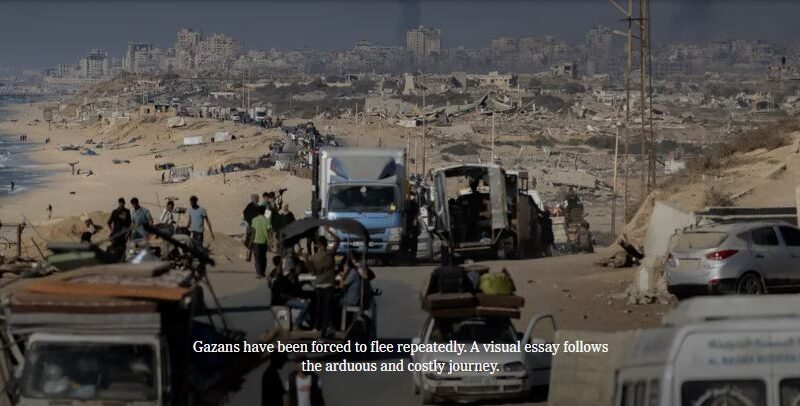
The Perilous Path to Escape Gaza City
Gazans have had to leave their lives in search of refuge multiple times throughout the war. As thousands were forced to flee again this week, a Times photographer joined them heading south.


On the coastal road heading south from Gaza City, thousands of people have begun an arduous journey to what they hope will be relative safety. Israel has told them to flee as it prepares to take over the city.

It is a dangerous journey through stifling heat and battered landscapes. Those who own a car or can afford a taxi are at an advantage. They cram into beat-up vehicles, some of which are missing windows or windshields.

The cars are piled high with mattresses, suitcases and buckets. But many more people flee the city on foot, taking only what they can carry.
As they walk down the coastal road, some stop to watch the pillars of smoke rising from the city behind them. The booms of Israeli airstrikes are never far away.

Israel has been preparing for weeks to mount a full-scale assault on Gaza City. Since the beginning of September, roughly 250,000 people have fled the city, according to an estimate from the Israeli military. Last week, the military issued an evacuation order telling all residents to seek refuge in southern Gaza. Nearly one million people have been sheltering in Gaza City, according to the United Nations. In August, a U.N.-backed panel of food security experts said the city was experiencing famine.
Many people in Gaza City have been displaced multiple times during the war, which began after the Hamas-led attack on Israel on Oct. 7, 2023, which saw about 1,200 people killed and 250 taken hostage. Israel responded by waging an unrelenting campaign that, over the last 22 months, has left tens of thousands dead in Gaza, destroyed its infrastructure and caused famine in parts of the territory.
But now, people in Gaza City must flee again.
After they left the city, Omar al-Far, 37, and his family built their tent next to a landfill. Mountains of trash loom over them. “You think of going back home to look for stuff, but that could be a fatal mistake,” he said. “And you don’t even know if your house is still standing.”
Mr. Al-Far worries about insects, rodents and disease. But he said he could not afford to rent a tiny plot of land somewhere else. “The rents are unbelievably high,” he said. “We have no money to pay.” Other people, he said, had packed as if they expected to never go back to Gaza City.
“When you leave your home, you will probably not return,” Mr. al-Far said. “You need to take any pieces of metal from your home so you can use them later to build a tent.”

Everything about fleeing costs money: transportation, plastic to build a tent, the rent for land to build it on, and even a few minutes of access to an electrical outlet. Many of those sheltering in Gaza City had previously fled from elsewhere. As the eastern part of the city came under Israeli control in recent weeks, people moved to the coastal west side, in some cases having to pitch their tents right up to the shoreline.

Since the evacuation order, Israeli airstrikes have also hit western areas of Gaza City, and people there have begun to flee down the coastal road. Last week, the military began targeting high-rise buildings in the city that it said were used by Hamas, but the group denied that. Gazans said people lived in these towers. And some said they were struck by the way the collapse of the buildings had remade the skyline.

Israel has portrayed Gaza City as a Hamas stronghold. The military says its expanded assault on the city has not yet formally begun, but last week,it said that it is in control of at least 40 percent of Gaza City. For weeks, that has left many in Gaza unsure of what the future holds and how best to plan for it.

Some parts of Gaza City have already felt the full force of the Israeli military. One neighborhood, Zeitoun, has been turned into a barren wasteland in just a few weeks, according to an analysis of satellite images by The New York Times. Many, if not most, of its buildings have been destroyed, and the tent encampments where displaced people once lived are gone. Around the city, prominent landmarks have been reduced to rubble.

Health officials do not report death tolls by locality, so it is not clear how many people in Gaza City have died so far. But Gazan health officials have said the war has killed more than 64,000 people, including both civilians and combatants.

Mr. al-Far said the future looked grim. But he said he still dreamed of a time when he could send his children back to their school, “if it still exists,” and “we can live a very simple life.”
“I wish this war would come to an end so I could return to the rubble of my house,” he said. “Or at least my neighborhood.”

————————————————————————————————
Liam Stack is a Times reporter who covers the culture and politics of the New York City region.