
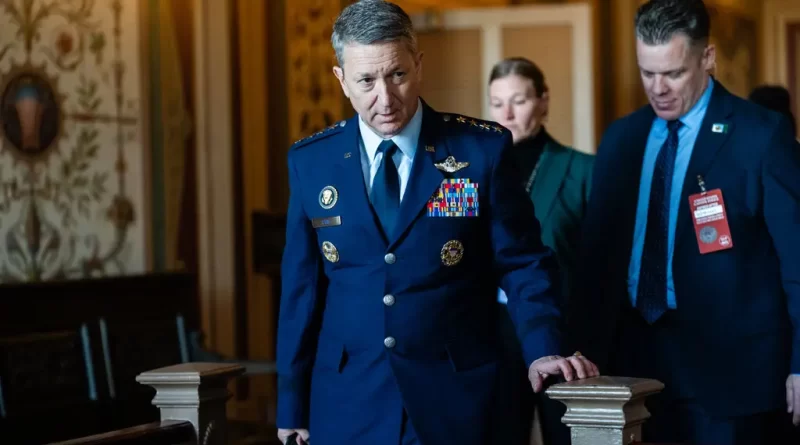
Trump Says Top General Predicts Easy Victory Over Iran; He Says Otherwise in Private
The remarks differ from what Gen. Dan Caine, the chairman of the Joint Chiefs of Staff, is said to have told the president in high-level White House meetings.

Reporting from Washington
President Trump said on Monday that Gen. Dan Caine, the chairman of the Joint Chiefs of Staff, believed that any eventual military action ordered against Iran would be “something easily won.” But that is not what General Caine has told Mr. Trump and other senior advisers in recent high-level White House meetings on Iran, people briefed on internal administration deliberations said.
Instead, General Caine has said that the United States has amassed forces in the Middle East to carry out a small or medium strike, but that there would be a potentially high risk of American casualties and that such an operation would have a negative effect on U.S. weapon stockpiles. General Caine has also underscored that the operations under consideration in Iran would be much more difficult than the successful capture last month of President Nicolás Maduro of Venezuela.
The apparent disconnect underscores the balancing act that General Caine, the president’s top military adviser, is carrying out: presenting the commander in chief with an array of military options, along with their potential risks and consequences, without giving his opinion about his own choice.
A spokesman for the military’s Joint Staff declined to comment on Mr. Trump’s remarks.
Mr. Trump’s comment, in a social media post, appeared to be prompted by reports in The New York Times and other publications about military options he is weighing if Iran does not give up its nuclear program.
The Times reported on Sunday that Mr. Trump had told advisers that if diplomacy or any initial targeted U.S. attack did not lead Iran to give in to his demands that it abandon its nuclear program, he would consider a much bigger attack in coming months intended to drive that country’s leaders from power, according to people briefed on internal administration deliberations.
Though no final decisions have been made, The Times reported, Mr. Trump has been leaning toward conducting an initial strike in coming days intended to demonstrate to Iran’s leaders that they must be willing to agree to give up the ability to make a nuclear weapon.
Targets under consideration include the headquarters of Iran’s Islamic Revolutionary Guard Corps, the country’s nuclear sites and assets of its ballistic missile program. Should those steps fail to convince Tehran to meet his demands, Mr. Trump told advisers, he would leave open the possibility of a military assault later this year intended to help topple Ayatollah Ali Khamenei, Iran’s supreme leader.
“General Caine, like all of us, would like not to see War but, if a decision is made on going against Iran at a Military level, it is his opinion that it will be something easily won,” Mr. Trump said in his post.
“He knows Iran well in that he was in charge of Midnight Hammer, the attack on the Iranian Nuclear Development,” Mr. Trump said, referring to American B-2 bomber strikes last June on three Iranian nuclear facilities.
“Razin Caine is a Great Fighter, and represents the Most Powerful Military anywhere in the World,” Mr. Trump said, using General Caine’s nickname. “He has not spoken of not doing Iran, or even the fake limited strikes that I have been reading about, he only knows one thing, how to WIN and, if he is told to do so, he will be leading the pack.”
In fact, during the recent meetings, including one last Wednesday in the White House Situation Room, General Caine discussed what the military could do from an operational standpoint but declined, as he regularly does, to advocate a certain policy position.
Negotiators from the United States and Iran are scheduled to meet in Geneva on Thursday for what appears to be last-ditch negotiations to avoid a military conflict.
“I am the one that makes the decision,” Mr. Trump said on Monday. “I would rather have a Deal than not but, if we don’t make a Deal, it will be a very bad day for that Country.”
Julian E. Barnes, Tyler Pager and David E. Sanger contributed reporting.
( With courtsey from The New York Times- Admin)
====================
Eric Schmitt is a national security correspondent for The Times. He has reported on U.S. military affairs and counterterrorism for more than three decades.