
Trump Says U.S. and Iran Held ‘Very Good’ Talks on Ending Conflict
President Trump said Monday that the United States and Iran were negotiating a “total resolution of our hostilities in the Middle East,” and that he would postpone any American attacks on Iranian power plants by five days.
Iran, at least publicly, rejected any progress in ending the U.S.-Israeli war on the country, now in its fourth week. American, Israeli and Iranian officials have frequently given clashing statements throughout the war as they seek to advance their competing agendas and motives.
Mr. Trump himself has often issued contradictory pronouncements about his plans for the next steps in the conflict, sometimes on the same day. On Saturday, Mr. Trump had threatened to bomb Iran’s power plants after 48 hours unless Iran agreed to fully reopen the Strait of Hormuz, a critical oil shipping route in the Persian Gulf.
Iran’s foreign ministry suggested there were no talks with the United States although it noted that there had been “regional initiatives” aimed at reducing tensions. The ministry argued Mr. Trump’s statements were part of an effort “to reduce energy prices and to buy time for implementing his military plans,” according to Iran’s Mizan news agency.
Analysts and officials say there is no clear offramp for the American-Israeli air war with Iran, which began on Feb 28. and has ignited a wider regional conflict. Despite Mr. Trump’s calls for the ouster of the Islamic Republic and his vow to help Iranians overthrow their leaders, the Iranian government remains in place, as is much of its nuclear program.
The foreign minister of Oman, which has frequently mediated between the United States and Iran, said on social media shortly before Mr. Trump’s announcement that Oman was working to establish “safe passage arrangements for the Strait of Hormuz.”
“Whatever your view of Iran, this war is not of their making,” the minister, Badr al-Busaidi, said. “This is already causing widespread economic problems and I fear they promise to get much worse if the war continues.”
The war’s global fallout has seen the price of oil and gas shoot up by over 50 percent since late February — a crisis that is now worse than the oil shocks in 1973 and 1979 combined, according to the head of the International Energy Agency. Iran has largely blocked most Western and Arab oil vessels from transiting the Strait of Hormuz, through which one-fifth of the world’s oil normally crosses.
Mr. Trump’s announcement that talks with Iran were in the offing immediately reduced the price of oil — which has skyrocketed amid the Iranian blockade of the Strait of Hormuz — by about 10 percent. But it was unclear how long that optimism could last without tangible progress in ending the war.
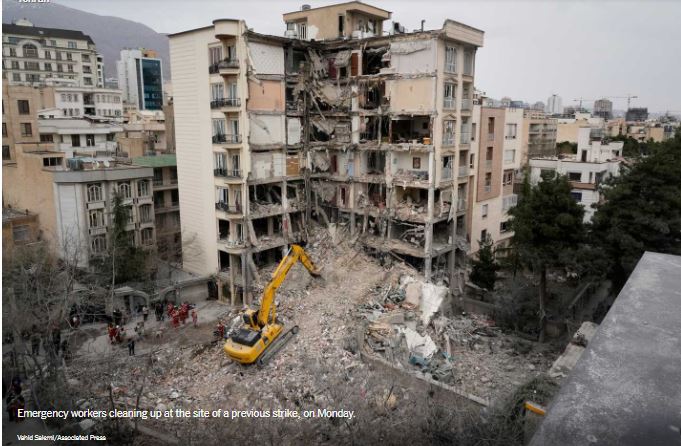
More than 2,000 people have been killed since the U.S.-Israeli attack on Iran that ignited the conflict more than three weeks ago, most of them in Iran and Lebanon, where Israel has fought a second front with Hezbollah, the Iran-backed militant group.
U.S. officials have sought to allay concerns that the war was spiraling out of control. Adm. Brad. Cooper, who runs the military’s Central Command, said in a televised interview on Monday that the U.S. was “largely ahead of or on plan for our main military objectives” for the conflict.
Here’s what else to follow today:
-
Israeli air defenses: Israel’s military faced scrutiny on Sunday about Iranian missiles that hit Dimona, a city eight miles away from Israel’s main nuclear facility, and the nearby city of Arad on Saturday night. More than 10 people were seriously injured and dozens more hurt in the strikes, renewing concerns that Israel might be holding back on using its most sophisticated air defenses to avoid depleting them.
-
Attacks in Lebanon: Israel’s military chief said on Sunday that its campaign against Hezbollah, the Iranian-backed armed group in Lebanon, had “only just begun,” adding that Israeli forces were preparing to push deeper into that country. Israel Katz, Israel’s defense minister, ordered the military to step up the demolition of bridges and houses in Lebanon, deepening fears that Israel is preparing for a long-term occupation in the country’s south.
-
Death tolls: Iran’s U.N. ambassador said that at least 1,348 civilians had been killed in the country since the start of the war — a toll that has not been updated for over a week. On Friday, a Washington-based group, the Human Rights Activists News Agency, reported that at least 1,398 civilians had been killed. More than 1,000 people in Lebanon have been killed, the authorities there said on Thursday. At least 15 people have been killed in Iranian attacks on Israel, officials have said. The American death toll stood at 13 service members.