
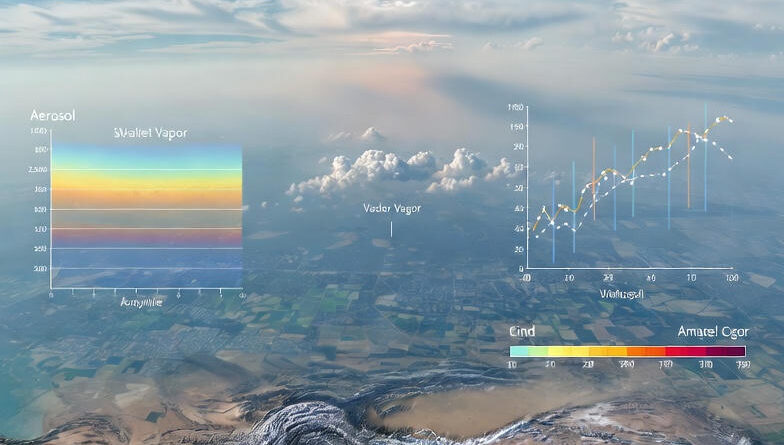
Water vapor heats the atmosphere much more than aerosols do: new study
New research has revealed the combined role of aerosols and water vapour in shaping the implications of climate change, suggesting that for reliable climate implications and future projections, both aerosols and water vapor should be considered, as their interactions can significantly impact regional atmospheric dynamics and the Indian summer monsoon.
The radiative effects of aerosols and water vapour are crucial for understanding as well as predicting the Earth’s radiation balance and hence climate dynamics, and play a pivotal role in the Earth’s radiation balance, influencing global temperatures, weather patterns and climate stability. These radiative effects provide insights on how aerosols, water vapour clouds, greenhouse gases influence the Earth’s radiation balance by scattering and absorbing the incoming solar radiation and outgoing terrestrial radiation.
The Indo-Gangetic Plain (IGP) region is considered a global hotspot of aerosol loading, with high spatio-temporal variability in aerosols and water vapor content, making accurate quantification of their climatic response quite challenging and uncertain. To refine climate projections and assess the implications of atmospheric composition changes on regional climate dynamics in and around IGP, it is important to analyse the relationship between aerosol loading and WVRE.

Figure 1: Location of observational sites over the Indo-Gangetic Plain region (top left corner), radiative forcing estimates due to aerosols (a) and water vapour, coupled with (b) and without aerosols (c), as well as heating rate (d) in Kanpur for four intervals of single scattering albedo values (top right corner). Extinction Ångström exponent (EAE) vs EAE difference binned by PWV (in cm) for Kanpur (bottom left corner) and scatter plot for EAE440–870 vs. AAE440–870, shows the different aerosol types over Kanpur (bottom right corner).
A study by Aryabhatta Research Institute of Observational Sciences (ARIES), Nainital along with Indian Institute of Astrophysics (IIA), Bengaluru, both autonomous research institute under the Department of Science and Technology (DST), Government of India, and international collaborators, University of Western Macedonia, Kozani, Greece and Soka University, Tokyo, Japan assessed the dependence of water vapour radiative forcing on aerosol loading over the Indo-Gangetic Plain (IGP) region.
The researchers led by Dr. Umesh Chandra Dumka from ARIES and Dr. Shantikumar S. Ningombam from IIA along with Dimitris G. Kaskaoutis, R.E.P. Sotiropoulou, and E. Tagaris from University of Western Macedonia and Dr. Pradeep Khatri from Soka University leveraged data from six AERONET (Aerosol Robotic Network, an international network of ground-based Sun Photometers which measure the aerosol properties) sites across the IGP and employed radiative transfer simulations using the SBDART (Santa Barbara DISORT Atmospheric Radiative Transfer) model.
Analysing the relationship between aerosol loading and water vapor radiative effects (WVRE) over the densely populated and highly polluted Indo-Gangetic Plain (IGP) region with the help of this data they found that water vapor has a greater impact on atmospheric heating than aerosols.

Fig 2: Climatology of aerosol properties and precipitable water vapour.
Their research published in Atmospheric Research Journal found that the radiative effects of water vapor are strongly influenced by the presence of aerosols and that aerosol-water vapor interactions highly modulate the radiation budget in the atmosphere, with the WVRE being much more intense in aerosol-free atmospheres compared to aerosol-laden conditions.
These effects are stronger over both the Earth’s surface and, in the atmosphere, when the air is clean (i.e., with fewer aerosols). When aerosols are present, the water vapor effect becomes more noticeable at the top of the atmosphere highlighting a significant interrelation between aerosols and water vapour.
The study also found that water vapor heats the atmosphere much more than aerosols do. This highlights the major role of water vapor in influencing the climate over the Indo-Gangetic Plains. The results reveal a strong dependence on both solar position and atmospheric variables related to aerosol absorption, thereby unravelling the combined role of aerosols and water vapour in shaping climate implications.
Publication link: https://doi.org/10.1016/j.atmosres.2025.108343