
Western Disturbance and Monsoon Collision: The Resulting Water Catastrophe and a Warning for the Future

By- Jay Singh Rawat
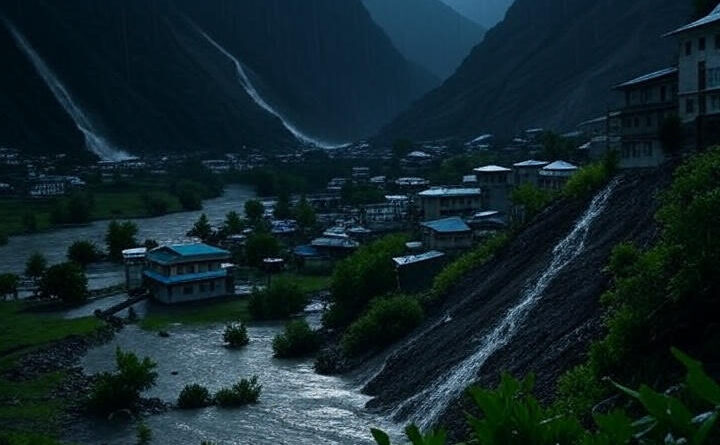
The monsoon of 2025 emerged as an unprecedented disaster for India. The Western Himalayan region—Himachal Pradesh, Uttarakhand, Jammu and Kashmir, and Ladakh—witnessed record-breaking rainfall, floods, landslides, and cloudbursts, causing widespread devastation. In August, Ladakh recorded 930% more rainfall than usual, while northern India saw an average increase of over 1200%. These disasters claimed at least 72 lives and caused an estimated economic loss exceeding $1.2 billion.
The root cause of this water catastrophe was the collision between Western Disturbances and monsoon winds from the Bay of Bengal. Typically active during winter, Western Disturbances have been triggered during the monsoon season (June–August) due to climate change, severely disrupting the seasonal cycle. This article analyzes the scientific basis of this collision, its historical context, future risks, and potential solutions, supported by scientific studies and expert insights.
Western Disturbance and Monsoon Collision: How and Why? Western Disturbances are low-pressure systems originating from the Mediterranean, moving eastward with the subtropical jet stream to bring rain to northern India in winter. Normally, during the monsoon season, the jet stream shifts northward, limiting Western Disturbances to a maximum of two per month. However, in 2025, the situation reversed, with 15 Western Disturbances recorded from June to August—five each in June, July, and August. This unusual surge, driven by climate change, enabled the collision with the monsoon.
The monsoon brings moisture-laden winds from the Bay of Bengal, forming a low-pressure trough (monsoon trough). When Western Disturbances interact with this trough, the convergence of the two systems intensifies moisture condensation, resulting in sudden heavy rainfall, cloudbursts (over 100 mm per hour), and rapid flooding. For instance, the 930% excess rainfall in Ladakh and the cloudburst in Dharali village, Himachal, in August 2025 were direct outcomes of this interaction. The Himalayan altitude (orographic effect) further amplifies this process. The India Meteorological Department (IMD) report of August 28, 2025, identified this collision as the primary cause of severe flooding in northern India.
Why Is This Collision Increasing?
The answer lies in climate change. The northward shift of the jet stream is delayed, allowing Western Disturbances to persist during monsoon months. Unusual warming in the Arctic and West Asia has destabilized the jet stream, bringing Western Disturbances closer to India. Kieran Hunt from the University of Reading told Down to Earth that the 2025 spike in Western Disturbances signals a growing trend of “monsoonal Western Disturbances.” Professor Raghu Murtugudde from IIT Bombay noted that these systems are driven by heat increases in West Asia.
Climate Change: The Root of Disrupted Seasonal Cycles
Climate change is the underlying cause of this collision. Global warming has increased the atmosphere’s moisture-holding capacity—per the Clausius-Clapeyron equation, a 1°C temperature rise boosts moisture by about 7%. This excess moisture makes Western Disturbance-monsoon collisions more destructive. Arctic warming has made the polar jet stream wavier, affecting the subtropical jet stream and reducing winter Western Disturbances while increasing their frequency during the monsoon. In the Himalayas, glacier melting has expanded lake sizes by 40%, heightening the risk of glacial lake outburst floods (GLOFs).
Scientific studies confirm this. Down to Earth (2025) linked the 15 Western Disturbances to climate change. Weather and Climate Dynamics (2024) validated seasonal shifts in Western Disturbances over 70 years. Nature connected changes in Himalayan monsoon duration to warming, while the American Geophysical Union’s journal tied rising Western Disturbance intensity to climate change. The Indian Institute of Tropical Meteorology also published a detailed review, and CMIP-6 models predict a 5.3% increase in monsoon rainfall per Kelvin of warming.
Historical Context: Has This Happened Before? The collision of Western Disturbances and monsoons is not new, but its frequency and intensity have surged in recent decades:
- 2013 Kedarnath Disaster: In June 2013, a Western Disturbance-monsoon collision in Uttarakhand caused 400% excess rainfall, affecting thousands.
- 2023 Himachal-Uttarakhand Floods: Earth and Space Science (2024) reported 223 mm of single-day rainfall in Himachal in July 2023 due to this interaction.
- 1950–2000 Data: Weather and Climate Dynamics (2024) showed Western Disturbances were rare (0–3 per season) in the monsoon before 2000, but their numbers have since risen.
These examples indicate that such collisions occurred earlier, but climate change has made them more frequent and devastating. The 2025 events represent the peak of this trend.
Future Risks: Rising Frequency and Intensity
Scientific models and studies warn of grave future risks. The Intergovernmental Panel on Climate Change (IPCC) and the World Meteorological Organization (WMO) predict that by 2100, monsoon rainfall in India could increase by about 20%, though irregularly. In the Himalayas, the extreme rainfall index (R95p) could double, and GLOF risks will multiply. Some models suggest a 12% decrease in Western Disturbance frequency, but their intensity, especially during the monsoon, will rise. The WMO estimates a 70% chance of exceeding 1.5°C warming between 2025–2029, worsening Himalayan disasters.
The Himalayas, known as Asia’s “water tower,” are increasingly vulnerable. Glacier melting threatens the water supply, agriculture, and livelihoods of over 2 billion people. The irregular convergence of Western Disturbances and monsoons will lead to both floods and droughts, as seen in 2025.
Path to Solutions Addressing this crisis requires concrete steps:
- Adaptation: AI-based weather forecasting, glacial lake outburst monitoring with the Himalayan Forest Research Institute, flood barriers, and forest conservation.
- Mitigation: Reducing greenhouse gas emissions, expanding renewable energy, and adhering to the Paris Agreement.
- Policies: Strict curbs on illegal construction and mining in the Himalayas, and involving local communities in disaster management. The World Wildlife Fund’s glacier conservation projects are a significant step forward.
The 2025 water catastrophe resulted from the collision of Western Disturbances and monsoons, rooted in climate change. International journals (IPCC, WMO, Nature, American Geophysical Union) and experts (Kieran Hunt, Raghu Murtugudde) warn that this trend will become more lethal. Without timely adaptation and mitigation, floods, landslides, and GLOFs in the Himalayan region will escalate, endangering the livelihoods of 2 billion people. This is a wake-up call—there is still time to act, or nature’s wrath will grow more severe.
(About the Author: Jaysingh Rawat is a senior journalist with 47 years of active experience in full-time and freelance journalism. He has authored eight books, two of which have been published by the National Book Trust (NBT) of the Government of India.-ADMIN)