
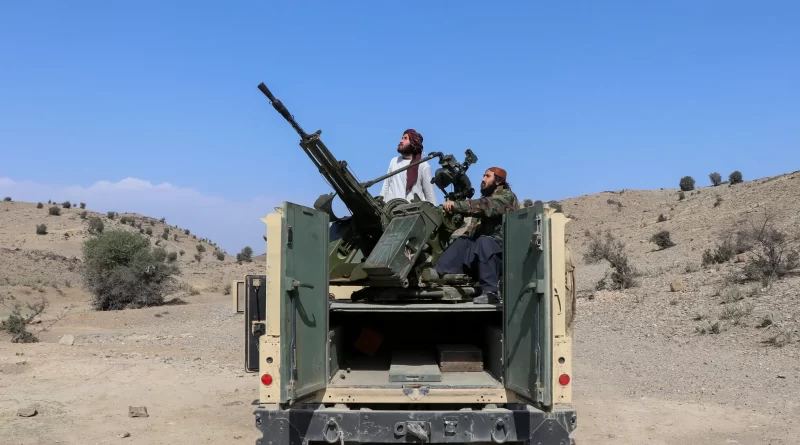
What to Know About the Clashes Between Pakistan and Afghanistan
Pakistan Strikes Afghanistan in ‘Open War’
The renewed violence between the neighboring countries stems from Pakistan’s accusations that Afghanistan’s Taliban government has harbored a militant group.


Francesca RegaladoLynsey Chutel and Elian Peltier
Elian Peltier reported from Islamabad, Pakistan.
Afghanistan and Pakistan are clashing openly again over a militant group that has attacked Pakistani security forces and civilians across their shared border.
Pakistan launched airstrikes across Afghanistan on Friday that hit military installations in Kabul, the capital, and Kandahar, the southern city that is home to the supreme leader of the ruling Taliban, Sheikh Haibatullah Akhundzada.
Where Pakistan struck in Afghanistan’s two largest cities
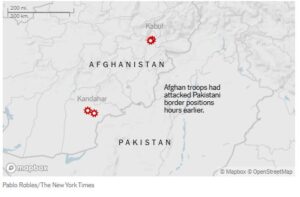
Months of tension and border skirmishes preceded the airstrikes on Friday. Hours before the strikes, Afghan troops attacked Pakistani border positions in what Afghanistan said was retaliation for Pakistani strikes earlier in the week.
How significant are the latest attacks?
The attacks on Afghanistan’s two largest cities were the heaviest launched by Pakistan since it agreed to a cease-fire with the Taliban government in October, after weeks of fighting that killed dozens of people and injured hundreds.
In the past, Pakistan said it had attacked militants’ positions but not government forces. This time, it targeted Afghanistan’s military infrastructure, aiming to deal a direct blow to the Taliban administration.
The New York Times could not immediately confirm a death toll in either country from the latest attacks. Pakistan and Afghanistan released claims on Friday about the number of deaths from the day’s fighting at the border region. The Pakistani military spokesman, Lt. Gen. Ahmed Sharif Chaudhry, said that at least 274 people had been killed there. Zabiullah Mujahid, the Taliban government spokesman, said that 55 Pakistani soldiers had been killed.
Ammunition depots in Kabul and Kandahar were also bombed. Satellite images reviewed by The Times confirmed the strike. The province of Paktia, near Afghanistan’s border with Pakistan, was also hit by the airstrikes.
An ammunition depot in Kabul was struck.


Why are they fighting?
Pakistan has accused the Taliban government in Afghanistan of harboring the militant group Tehreek-e-Taliban Pakistan, also known as the Pakistani Taliban. Pakistan says the Taliban has allowed the group to train and launch attacks from within Afghanistan.
The militant group has relentlessly attacked Pakistani security forces in recent years, including with a suicide bombing in November that killed a dozen people at a courthouse in Islamabad, Pakistan’s capital.
The Taliban has denied hosting militant groups, even as attacks by Pakistani Taliban fighters have surged since it took power in Afghanistan in 2021. Some Afghan officials have privately acknowledged the Pakistani Taliban’s presence in their country.
Were the Taliban and Pakistan always enemies?
No. Pakistan helped create the Afghan Taliban in the early 1990s, and many Taliban leaders hid in Pakistan during the U.S. occupation of Afghanistan. Throughout the two-decade American-led war in Afghanistan, U.S. officials pressed Pakistan to clamp down on Afghan Taliban militants inside its borders.
“You can’t keep snakes in your backyard and expect them only to bite your neighbors,” Hillary Clinton, then the U.S. secretary of state, told Pakistani government officials in 2011.
The Taliban returned to power in Afghanistan in 2021 as U.S. forces hastily withdrew from the country. Pakistan initially welcomed the new leaders. But as attacks by the Pakistani Taliban have surged, the Taliban government’s relations with Pakistan have soured.
Pakistan accuses the Afghan Taliban of supporting the group, while the Afghan Taliban has repeatedly said that they have nothing to do with Pakistan’s domestic security problems.
The two entities are distinct, though the Afghan Taliban share deep ties with the Pakistani Taliban, which supplied fighters during the Afghan militants’ war against U.S. and NATO forces.
Safiullah Padshah contributed reporting from Kabul, Afghanistan, and Zia ur-Rehman contributed reporting from Islamabad, Pakistan.
=========================================================================
Francesca Regalado is a Times reporter covering breaking news.
Lynsey Chutel is a Times reporter based in London who covers breaking news in Africa, the Middle East and Europe.
Elian Peltier is The Times’s bureau chief for Pakistan and Afghanistan, based in Islamabad.