
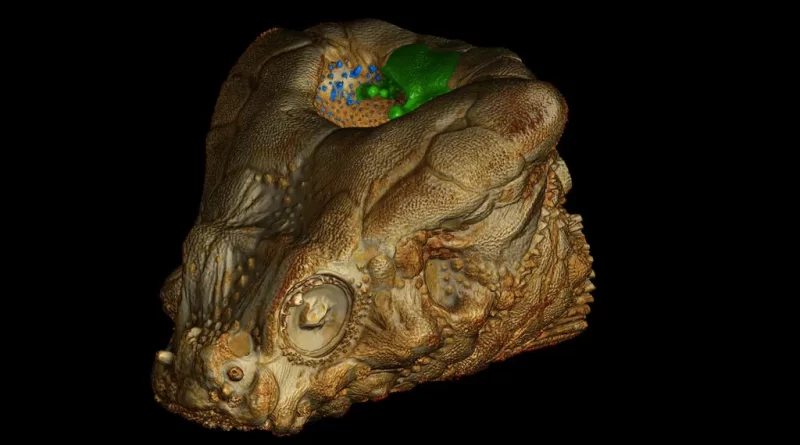
Why This Fish Actually Needs a Hole in the Head
A cavity in the middle of the rockhead poacher’s skull might be used like a maraca to produce sound, new research suggests.

Ten years ago, Kory Evans, an evolutionary biologist, was staring at an unusual fish in a lab. The fish, a rockhead poacher, was tiny and chunky, he said, and looked “so different from all the other guys around it.”
But the feature that made it stand out the most was the “big old hole” in the middle of its head, he said. For over a century, the poacher’s head cavity had puzzled scientists.
Daniel Geldof, an undergraduate at the University of Washington at the time, made a comment in passing to Dr. Evans about how the fish could be using the pit to produce sound.
Last year, Mr. Geldof presented his master’s thesis to advisers at Louisiana State University that was the culmination of years of research and hours of laborious scanning. It explains that the rockhead poacher uses the hole in its head as a percussion instrument, like a drum, or a maraca. As its ribs hit the cavity, a buzzing sound emerges.
“I clearly underestimated how much he was going to test this hypothesis,” said Dr. Evans, who is now a researcher at Rice University.
“It makes total sense,” said Kassandra Ford, an evolutionary biologist at the University of Minnesota who was not involved in the study. She considered Mr. Geldof’s methods a “creative way” of figuring out the “really funky and unique behaviors in this particular species of fish.”
Many fishes make some kind of noise. Toadfish have giant swim bladders that vibrate to produce mating calls. Catfish rub their bones together to make a croak-like sound.
Now here is the rockhead poacher, with its own anatomical approach to acoustic outbursts.
“This one is just kind of extraordinary in that he’s quite loud for his size and is doing crazy things, and, of course, has a wild head hole,” Mr. Geldof said.


The rockhead poacher, a member of the Agonidae family, is found in shallow intertidal parts of the northeastern Pacific Ocean. It has an armored body and is no bigger than a human finger. Scientists initially thought that the head cavity was camouflage, that made the fish look like a rock with a crevice. But the inside of the pit had unique tiny structures, suggesting a more complex purpose. Such as sound production.
“People have been ruminating on this idea for years,” Dr. Ford said.
To solve the mystery, Mr. Geldof used a micro-CT scanner to study the fish’s anatomy. He found that the fish’s ribs are connected to the fish’s strongest muscles through tendons, and are flattened against the pit, suggesting the animal may be using them as “drumsticks.”
In the intertidal zone, getting sound to travel can be challenging. Sounds are often muffled, and the environment can be a complicated and chaotic one to navigate. Between the crashing waves, moving rocks and clicking crabs, rockhead poachers are “living in a rock concert 24/7,” Mr. Geldof said.
To communicate, or find other fishes, rockhead poachers are likely to need to call to each other. Because the fish sits on the bottom of the tide pool, the buzz-like sound the fish produces may vibrate against the ground, helping the sound travel.
For a small fish in a noisy environment, “evolving this crazy sound production system is actually a very clever workaround,” Dr. Evans said.
Since Mr. Geldof’s passing remark 10 years ago, Dr. Evans has been following the mystery. “It’s really satisfying to see Dan actually pull this off,” he said.
For Mr. Geldof, his time spent studying the rockhead might make him the person who has studied it the most. “I’m not the first person to notice that this animal is weird, and I’m not the first person to study it, but I certainly have been able to go into more detail than anyone before me,” he said.
To show people the type of fish he studies, he has a 3-D printed model of the fish’s micro-CT scan that he carries with him. He has taken it with him on first dates.
“I adore these things. They’re wonderful animals,” Mr. Geldof said. “This is probably almost certainly not the last you will see of the rockhead poacher.”
———————————————————————————————————
Alexa Robles-Gil is a science reporter and a member of the 2025-26 Times Fellowship class, a program for journalists early in their careers.