
Iran War Live Updates: Iran-Backed Houthis Enter War With Missile Attack on Israel
A U.S. official said that earlier an Iranian strike at a military base in Saudi Arabia injured around two dozen U.S. troops, one of the most serious breaches of American defenses since the war began.

The Houthis, an Iranian-backed militant group in Yemen, announced on Saturday that they had launched a ballistic missile attack on Israel, appearing to open another front in the spiraling war in the Middle East.
With the war entering its second month, President Trump has said “very strong talks” are underway with Iran on a diplomatic offramp to the war, which has drawn in much of the Middle East. But a series of strikes on Friday and Saturday underscored how the conflict shows little sign of ebbing.
A U.S. official said on Saturday that around two dozen U.S. service members had been wounded in an earlier Iranian strike on a military base in Saudi Arabia, and the fighting only continued to expand across the region.
The attack on the base — which seriously injured two of the soldiers and damaged two military planes, according to U.S. officials — was one of the most serious breaches of U.S. defenses since the war began in late February. Strikes in the Persian Gulf also damaged a civilian airport in Kuwait, an Omani port, and cities in Israel and Iran.
There were no reports of casualties in the Houthis’ attack on Israel. But the group, which control much of Yemen, could further rattle global markets already strained by the Iranian blockade of the Strait of Hormuz. During the war in Gaza, the Houthis disrupted international shipping by menacing passing vessels in the Red Sea.
Yahya Saree, a Houthi military spokesman, said that the attacks from Yemen would continue “until the aggression ends” — a reference to both the American-Israeli war with Iran and Israel’s campaign against Hezbollah, another Iran-backed group in Lebanon.
Iran and its network of armed groups across the region have shown little sign of giving ground in the face of the U.S.-Israeli air campaign. American diplomatic efforts to compel Iran to make major concessions on its nuclear program in exchange for ending the war have yet to succeed.
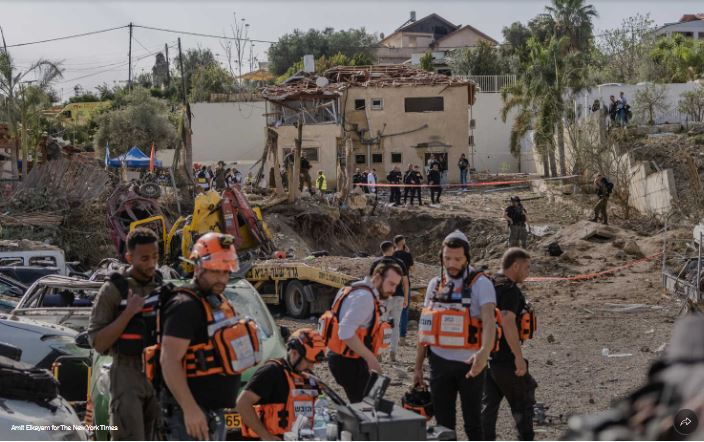
The Israeli military said Saturday that it had begun a new round of bombardment in the Iranian capital of Tehran. Israel also reported more waves of incoming Iranian missiles, which killed at least one person in Tel Aviv, according to Israel’s emergency service.
Elsewhere in the region, drones struck Kuwait International Airport, damaging its radar, and the key port of Salalah in Oman. Both Bahrain and the United Arab Emirates said its forces were intercepting drones and missiles from Iran. Saudi Arabia’s defense ministry said its forces had intercepted drones and a missile, without saying where they had come from.
Secretary of State Marco Rubio insisted on Friday that the war would conclude within weeks, not months, and that the United States did not need ground troops to win it. The Pentagon last held a news conference on March 19.
Mr. Trump has said that talks with Iran were progressing well, while Iranian officials have described the recent contacts as minimal. Pakistan said it would host Egyptian, Turkish and Saudi officials starting on Sunday to discuss the war. It did not say whether U.S. or Iranian officials would attend.
Here’s what else we’re covering:
-
Strikes in Iran: The U.S.-Israeli coalition bombarded Iran’s industrial infrastructure on Friday, with attacks on two major steel production complexes that are vital to the country’s economy. American and Israeli officials have vowed to target the country’s military industrial base to prevent it from quickly rearming after the war. Israel’s military also said it had attacked nuclear sites in central Iran.
-
Food supply: The effects of the war on fertilizer supplies are worsening by the day, and price increases for farmers are threatening to lead to food insecurity in some parts of the world.
-
Death tolls: The Human Rights Activists News Agency has reported that more than 1,492 civilians have been killed in Iran, out of more than 3,300 total deaths. More than 1,110 people in Lebanon have been killed, the health ministry there said on Thursday. More than 50 people have been killed in Gulf countries, while in Israel at least 16 were killed in Iranian attacks, officials said. The American death toll stands at 13 service members.