
Iran War Live Updates: Tehran Sends Mixed Signals on Talks After U.S. Seizes Ship

An Iranian official vowed retaliation for the U.S. attack on an Iran-flagged vessel near the Strait of Hormuz. But Iran’s president said the war “benefits no one,” as an American delegation prepared for more peace talks.

Iran on Monday sharpened its threats to retaliate after the United States attacked and seized an Iranian cargo ship near the Strait of Hormuz, putting pressure on the fragile cease-fire set to expire this week.
Iranian officials have been sending mixed messages about the possibility of more peace talks with the United States in Pakistan. President Trump said American negotiators would arrive in the country in the evening. It is still unclear whether an Iranian delegation will attend.
Iran’s foreign ministry spokesman said Monday that there were “no plans” in place for the next round of talks. But Masoud Pezeshkian, the Iranian president, said that while Iran must stand firm “against injustice and excessive demands,” continuing the war “benefits no one.”
The zigzagging echoed similar comments from Iranian officials in the run-up to the first round of talks, which took place over a week ago and ended without an agreement to end the war. At the time, Iran had cast doubt on the negotiations even taking place just hours before its delegation arrived.
If they go forward, the meetings will be the second formal round of talks since the two-week truce went into effect on April 8. A White House official said Vice President JD Vance was expected to lead the delegation.
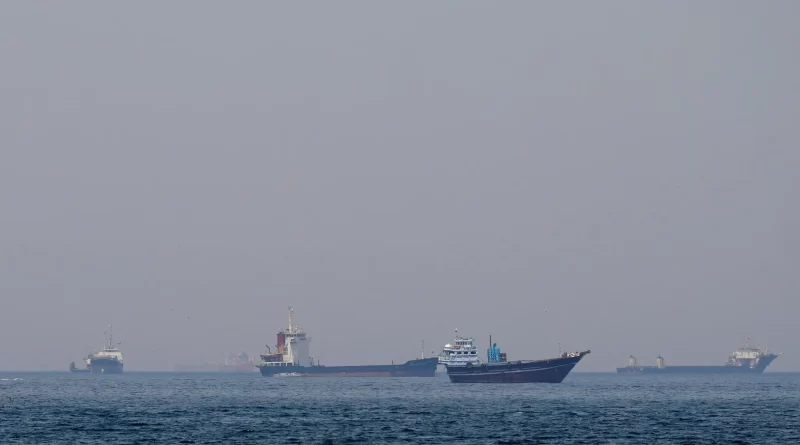
The cease-fire was being tested in the Strait of Hormuz, a vital waterway for oil and gas that Iran has blocked, rattling global energy markets. The United States has countered by blockading Iranian ports.
A U.S. Navy destroyer fired on the Iranian cargo ship on Sunday after it defied that blockade, Mr. Trump said. Marines were searching the ship as officials weighed whether to tow it to Oman, a U.S. official said. Iran’s armed forces called it “piracy” and warned that they would soon retaliate, according to Tasnim, a semiofficial Iranian news agency.
The price of Brent crude, the global benchmark for oil, climbed more than 6 percent on Monday, to around $96 a barrel after the attack. Oil prices are up by about 33 percent since the war began on Feb. 28.
Here’s what else we are covering:
-
Pakistan: Pakistan appeared to be preparing to host new U.S.-Iran peace talks, despite the uncertainty about Iran’s attendance. Officials said they would deploy 10,000 extra security personnel in Islamabad, the capital.
-
Energy prices: The U.S. energy secretary, Chris Wright, acknowledged on Sunday that gasoline prices in the United States had probably peaked but could remain elevated for months, undermining an earlier claim by Mr. Trump.
-
Lebanon: Joseph Aoun, the Lebanese president, said that he had appointed Simon Karam, a former ambassador to the United States, to lead talks with Israel aimed at ending the war and achieving a complete Israeli withdrawal from southern Lebanon. Israel wants the disarming of Hezbollah, the Iran-backed armed group.

Reporting from London

Only three ships crossed the Strait of Hormuz on Monday as traffic in the crucial waterway slowed to a near halt, according to data from Kpler, a firm that tracks maritime traffic.
On Saturday, 24 ships crossed the strait after Iran had declared the passage open to commercial vessels at the start of a cease-fire between Israel and Lebanon. But within 24 hours, Iran reversed course and said it had returned the strait “to its previous state.”
Only one made it through on Sunday, according to Kpler figures, which refer to ships carrying crude oil and chemicals, but not cruise ships or container ships. Kpler uses satellites and transponders to track the movement of ships.
The United Kingdom Maritime Trade Operations center, which is administered by Britain’s Royal Navy, said that two incidents vessels had been hit, according to a notice published on Saturday. In one instance, gun ships operated by Iran’s Islamic Revolutionary Guards Corps fired at a tanker without radio warning, the British organization said. In the second incident, a container ship was hit by “an unknown projectile” that damaged some of the containers. Those ships, and several others, then reversed course.
At least 20 vessels have been attacked in recent weeks, according to the International Maritime Organization, a United Nations agency.
And most shipping companies said the situation was too precarious to try to navigate ships through the strait.
On Monday, the three ships that crossed the strait were the Nova Crest, which sailed under a Barbadian flag, the Starway (Liberia) and the Axon 1 (Gambia), according to Kpler.
A two-week cease-fire between the United States and Iran, which is scheduled to expire on Wednesday in the Gulf, remained precarious on Monday. A U.S. Navy destroyer fired on an Iran-flagged vessel that was trying to evade a blockade on Sunday. President Trump said a U.S. delegation would head to Pakistan for more peace talks, but the spokesman for Iran’s foreign ministry said there were “no plans” in place for the next round of peace talks there. ( With Courtsey from the New York Times.)