Trump and Xi Play Up Stability Without Resolving Major Tensions
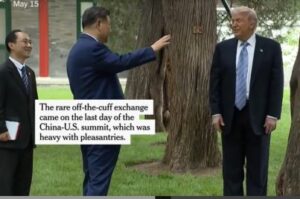
As President Trump left Beijing, there was no indication that he and Xi Jinping had resolved any major points of contention on trade, the war in Iran or other issues during their talks.

President Trump and China’s leader, Xi Jinping, emphasized stability on Friday as they concluded a high-stakes summit in Beijing, though without announcing any clear resolutions on trade, Taiwan, the war in Iran or other major points of contention.
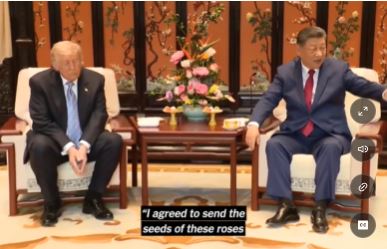
Sitting beside Mr. Xi during a meeting at Zhongnanhai, the walled headquarters for China’s ruling Communist Party, Mr. Trump said that the Chinese leader had “become really a friend” and that they felt similarly about the war.
“We’ve settled a lot of different problems that other people wouldn’t have been able to settle,” Mr. Trump said, without elaborating.
Mr. Xi said he had chosen to receive Mr. Trump at Zhongnanhai to reciprocate for his 2017 visit to Mar-a-Lago in Florida. In the comments he made publicly, he avoided wading into specific issues, in contrast to a blunt warning over Taiwan he issued on Thursday.
Mr. Xi described the visit as a “historic and symbolic” milestone. “We have established a new bilateral relationship, based on constructive strategic stability,” he said.
A few hours after the Zhongnanhai meeting, Mr. Trump boarded Air Force One for a flight back to the United States.
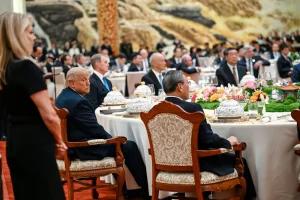
The Trump-Xi summit, the first U.S. presidential visit to China in nearly a decade, was a test of whether the détente between the two nations would continue. It was heavy on public praise and pleasantries. At a lavish state banquet on Thursday evening, Mr. Trump invited Mr. Xi to visit the White House in September.
The White House described a Trump-Xi meeting on Thursday as a “good meeting” and sought to underscore Mr. Trump’s priorities, saying that both sides agreed that the Strait of Hormuz must remain open and that “Iran can never have a nuclear weapon.” Mr. Trump also told a reporter on Friday that he and Mr. Xi had made “fantastic trade deals.”
But tensions were never far from the surface.
In formal talks behind closed doors on Thursday, Mr. Xi told Mr. Trump that the issue of Taiwan, a self-governing island that China claims as its territory, could lead to conflict and “an extremely dangerous situation” if it were handled poorly, according to Xinhua, China’s official news agency.
Mr. Xi also made a reference to avoiding the “Thucydides Trap” — a concept that suggests that an established power tends to be threatened by a rising one, leading to a clash.
Mr. Trump and Mr. Xi last met in October in South Korea, where they agreed to pause a trade war. Before that, China had threatened sweeping new export restrictions on rare earths as retaliation for heavy U.S. tariffs on Chinese goods. Mr. Xi agreed in South Korea to postpone those measures for a year. This week’s visit ended without any visible progress on the export restrictions, and it remained unclear on Friday whether China would agree to an extension.
Here’s what else we’re covering:
-
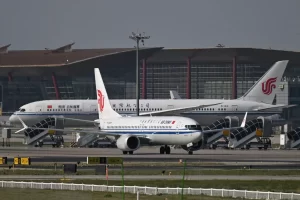
Boeing Order: President Trump said on Thursday that China had agreed to order 200 Boeing jets, potentially lifting the fortunes of the American jet manufacturer in one of the world’s largest aviation markets. But Beijing officials were noncommittal after he left on Friday.In an interview with Fox News, Mr. Trump hailed on Thursday what he termed as successes from the first day of meetings with Xi Jinping, China’s top leader. He said Mr. Xi told him that an order would be placed for the American planes.
-
Artificial Intelligence: The United States and China will discuss guardrails on artificial intelligence, including establishing a protocol for keeping powerful A.I. models out of the hands of nonstate actors, Treasury Secretary Scott Bessent said on Thursday.Mr. Bessent, who was speaking from Beijing in an interview with CNBC, did not give more details, including when these discussions would take place. But Xi Jinping, China’s leader, and President Trump had been expected to discuss A.I. during their summit in the Chinese capital.
-
Reaction: A New York Times reporter visited four Chinese cities and talked to residents who described a mixture of amusement and anger, blaming U.S. tensions for a slowing economy and rising fuel prices.Residents in four Chinese cities described a mixture of amusement and anger, blaming U.S. tensions for a slowing economy and rising fuel prices.