
NEW STUDY PAVES WAY FOR SOLVING THE MYSTERIOUSLY HIGH TEMPERATURE OF SOLAR CORONA
A novel way to detect hidden turbulence in the Sun’s outer atmosphere or corona could help scientists gain new insights into the long-standing mystery of why the corona is much hotter than the Sun’s visible surface.
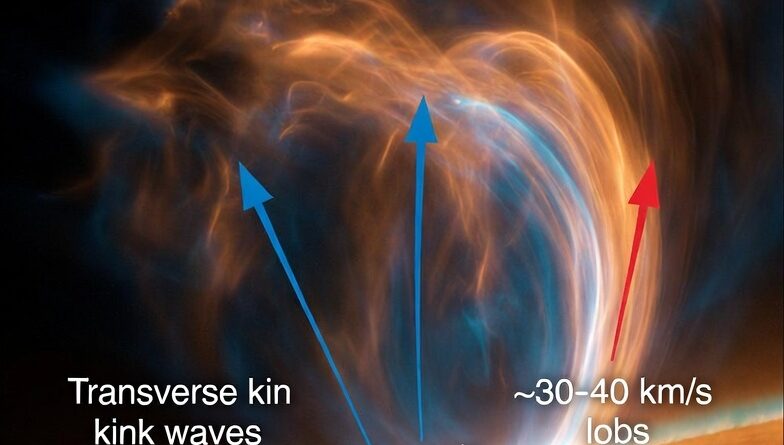
The Sun’s outer atmosphere, the corona, is filled with magnetic structures that constantly sway as waves travel along them. Among the most common of these are propagating transverse magnetohydrodynamic (MHD) waves, often described as Alfvénic or kink waves. These waves make coronal structures oscillate sideways as they move outward along these magnetic structures.
Spectroscopically, such waves are known to produce alternating red and blue Doppler shifts, signatures of plasma moving toward and away from the observer due to transverse motions perpendicular to the magnetic field. However, whether these propagating transverse waves can also modify the shape of coronal spectral lines, producing measurable asymmetries in otherwise Gaussian profiles, has not yet been clearly established observationally.
Previous observations of the corona and transition region have revealed ubiquitous blueward asymmetries in spectral lines. These have largely been interpreted as signatures of upward flows, jets, or mass motions along magnetic field lines. In contrast, transverse waves are often considered nearly incompressible and therefore not expected to produce strong line profile asymmetries. As a result, their potential contribution to spectral asymmetries has received far less attention.
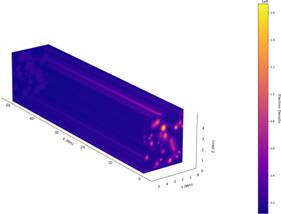
In a recent study by Aryabhatta Research Institute of Observational Sciences, (ARIES) Nainital, an autonomous institute of the Department of Science and Technology (DST), and Indian Institute of Technology (IIT) Delhi, advanced three-dimensional MHD simulations combined with forward modeling were used to investigate this question. The researchers Ms. Ambika Saxena, PhD student at ARIES and Prof. Vaibhav Pant from the Department of Physics, IIT, Delhi, performed simulations of an open-field coronal region containing density inhomogeneities across its transverse cross-section. Transverse waves were driven at the lower boundary and allowed to propagate upward along the structured magnetic field. Using forward modeling, they then computed how the plasma emission would appear in a commonly observed coronal spectral line, Fe XIII 10749 Å.
The simulations in the study published in The Astrophysical Journal, revealed a consistent pattern. As transverse waves propagate along a structured magnetic plume, the plasma within the structure does not move uniformly. The cross-section of the plume contains density variations, and as the wave evolves, it generates increasingly fine-scale structure through phase mixing. This process leads to the development of turbulence, producing small-scale velocity and density structuring within the magnetic structure.
Because the solar corona is optically thin, emission from many parts of the structure overlaps along the line of sight. Different regions move with different velocities at the same time. When this emission is combined, the resulting spectral line is no longer perfectly symmetric. Instead, it develops alternating blue and red wing asymmetries that switch in time and height as the wave travels.
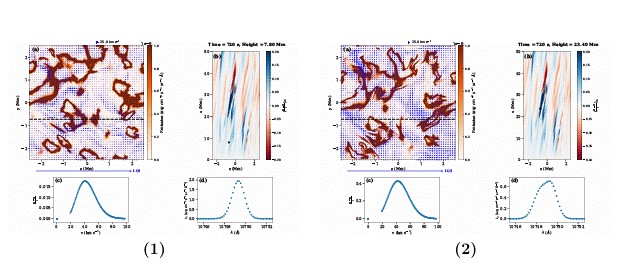
Figure 2: Evolution of spectral asymmetry with radial height. Panels (1) and (2) show snapshots at two different heights in the simulated corona. The maps illustrate how plasma moving at different speeds contributes to the observed signal. These patterns reflect the complex motions generated by the propagating wave.
Importantly, these asymmetries arise naturally from the combined effects of transverse wave dynamics, cross-sectional inhomogeneities, and the development of wave-driven turbulence. The simulated asymmetries can reach up to about 20 percent of the line peak intensity, with apparent secondary velocities of 30 to 40 km s⁻¹. Moreover, the alternating red–blue pattern itself propagates outward at speeds consistent with the wave.
These results demonstrate that propagating transverse MHD waves alone can generate systematic alternating spectral asymmetries. With the high spatial and spectral resolution now available from facilities such as DKIST, observations of this phenomenon may soon become possible, offering a new diagnostic of wave-driven dynamics in the solar corona.
==============================================================
Publication link: https://iopscience.iop.org/article/10.3847/1538-4357/ae2482