
Exploring the Universe with a World of Antennas
With 263 antennas spread across the U.S. and Mexico, the Next Generation Very Large Array, would join a new wave of radio astronomy.

A new telescope — the Next Generation Very Large Array, or ngVLA — is sprouting in New Mexico. If funded, it will consist of 263 radio antennas spread through New Mexico, Texas, Arizona and northern Mexico, with additional sites across the United States.
Astronomers hope to use the ngVLA to peer into the inner regions of star systems that are forming planets like our own and to study the chemical conditions that, in our own corner of the cosmos, preceded life. It will also help them hunt for supermassive black holes, study how stars form and galaxies evolve, and find dense, pulsating stars that can be used to test Einstein’s theory of gravity.
There’s “just essentially an endless list of science that people can do,” said David Wilner, an astrophysicist at the Center for Astrophysics, Harvard & Smithsonian, and a chair of the ngVLA Science Advisory Council.
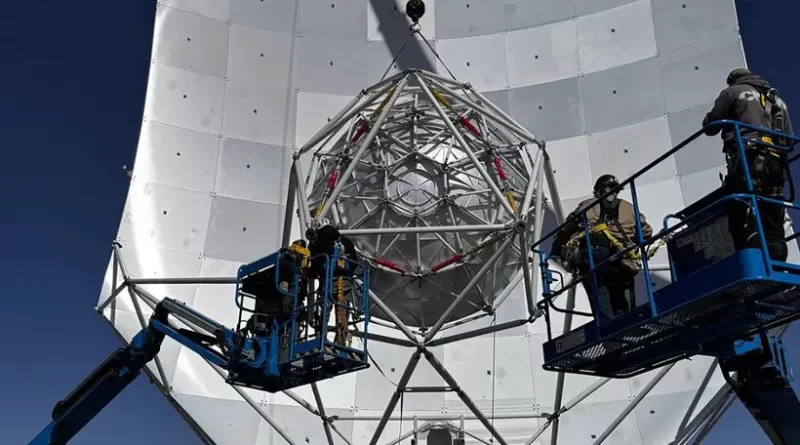
On Monday, the National Radio Astronomy Observatory announced that a prototype antenna of the ngVLA, which astronomers identified as a main target in their 10-year plan for the cosmos, had captured its first cosmic light with observations of radio waves from the sun, the aftermath of a supernova and a distant supermassive black hole.
First light from the ngVLA prototype is one milestone in a global effort to usher in a new era of radio array telescopes. These are collections of antennas — often attached to giant white dishes — that point at the sky to reveal aspects of the universe that can’t be seen by eye.
Astronomers study the universe with instruments that detect different wavelengths, or colors, of light. Optical telescopes are ideal for looking at stars; infrared is useful for peering through cosmic dust. Radio telescopes are particularly suited for studying the gas from which stars and planets form. But because radio wavelengths are longer than other types of light, they require larger instruments to properly resolve from the sky.
“If you want to, say, match the resolution of the Hubble Space Telescope at radio wavelengths, then you need a telescope that’s, like, tens of kilometers across,” Dr. Wilner said. “You just can’t build a single dish antenna that big.”
Instead, astronomers opt for collections of smaller antennas scattered across a large area, and they carefully combine the data from each to achieve the resolution of one giant dish. The spacing of the dishes changes the resolution of the telescope. Twenty-eight 82-foot dishes compose the existing Very Large Array in New Mexico. Another telescope, the Very Long Baseline Array, has 10 antennas of the same size. But because its dishes are spread across the United States, the Very Long Baseline Array has about 240 times the resolution of the Very Large Array at the same wavelengths.
The smoothness of the dish’s surface dictates which wavelengths the telescope can see. According to Tony Beasley, director of the National Radio Astronomy Observatory, smaller dishes generally have smoother, more precise surfaces. The Atacama Large Millimeter/submillimeter Array, in northern Chile, consists of 66 dishes — the largest of which are about 40 feet across — that are ideal for capturing radio signals of much shorter wavelengths.
By contrast, the Low Frequency Array in Europe forgoes the traditional dish design. Instead, it uses some 20,000 dipole antennas — similar to those used for TV broadcasting — to collect some of the longest wavelengths of light in the universe.
The ngVLA is expected to replace both the Very Large Array and the Very Long Baseline Array with new dishes that are smaller, but more precise. “As a field, we had built bigger antennas that had less precise surfaces, and smaller antennas that had more precise surfaces,” Dr. Beasley said. “We needed a Goldilocks antenna,” he added, referring to the new ngVLA prototype.
More radio arrays are in the works. Hundreds of researchers are involved in planning the Next Generation Event Horizon Telescope, which would add several new antennas to the instrument that in 2019 produced the first picture of a black hole. A radio array in South Africa, made of 197 dishes, is currently under construction, as is a sibling array in Western Australia consisting of more than 130,000 dipole antennas that resemble Christmas trees.
The arrays in South Africa and Australia will be able to take data from parts of the sky that radio telescopes in the north can’t see, according to Naomi McClure-Griffiths, the chief scientist of the Square Kilometer Array Observatory, which oversees the projects.
The advent of next-generation radio arrays offer astronomers another vantage point — alongside observations in optical, infrared and other wavelengths — from which to decipher the cosmos. “When we put it together with all of the other colors,” Dr. McClure-Griffiths said, “we get a complete picture of the universe.”
===========================================
Katrina Miller is a science reporter for The Times based in Chicago. She earned a Ph.D. in physics from the University of Chicago.