
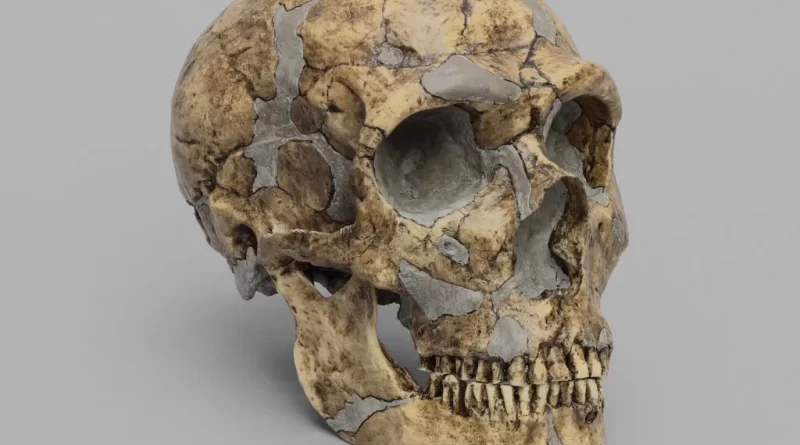
What Happened to the Neanderthals?

Scientists now know that they shared many of the sophisticated abilities of Homo sapiens. So why are we the only humans left standing?

For most of our evolutionary history, humankind was made up of many human kinds. Take the last 100,000 years or so. The oft-caricatured, big-browed Neanderthals roamed across Europe and into western Asia. The mysterious, towering Denisovans hunted and gathered in Asia. The diminutive, hobbit-like Homo floresiensis dwelled on an Indonesian island. The last of Homo erectus had just died out in Java. Our species, Homo sapiens, was merely another variation on the type.
It’s tempting to assume the monolithic human world we live in now is the normal one. But for many scientists who study the ancient past, the present is the puzzle.
“This is a strange time,” said Chris Stringer, a paleoanthropologist at the Natural History Museum in London. “Why are we the last ones left, and what happened to all the others?”
For decades, humanity’s narrative of its own origins was intertwined with presumptions of biological exceptionalism. Human evolution was often portrayed as a march toward the big brains, adept tool use and social complexity of modern day people.
In that story, the other hominins — human ancestors and evolutionary cousins — were primitive discards. They deservedly died out. We were the happy ending.
“Everything else was brutish,” said Eleanor Scerri, an archaeological scientist at the Max Planck Institute of Geoanthropology, reflecting on the ideas that dominated discussions of human evolution in the 1980s, when as a child she first became hooked on the field. “That was very much in vogue: ‘And we survived, because we were the greatest.’”
Over the course of Dr. Scerri’s career, however, the story about human origins has been rewritten and revised, as new lines of evidence have emerged. That includes the narrowing of the cognitive gap between Homo sapiens and our close cousins, with evidence that they also had sophisticated abilities — to make art, bury their dead and wield fire. Still, there are now more than eight billion humans on the planet, of only one type.
Amid the daunting saga that is human evolution, the Neanderthals, so recent and closely studied, are in many ways the accessible celebrities of the story. Their fate seems to offer a toehold on the big questions about how we came to be the last species standing. What happened to the Neanderthals, then?
One glib answer is that they are still here, lurking in the DNA of present-day people in tiny amounts. Ancient DNA studies revealed that Neanderthals and Denisovans, and possibly others, didn’t so much as die out as become absorbed, through mating, into who we are today.
But if it were possible to ask Neanderthals, they probably wouldn’t see themselves present on the planet. So why are modern humans alone now? How much of our success stems from unique abilities? How much of our advantage was just luck? Can the past teach us anything about how to think about the existential risks of the present and the future?
Are we triumphant survivors — or just next on the evolutionary chopping block?

Were Neanderthals just like us?
Picture a day in the Pleistocene. A group of humans kindle a fire to cook, striking a flint against pyrite. They hunt big game. They also gather plants to eat and, perhaps, use as medicine. They draw on the walls of caves. They care for sick and disabled compatriots, even performing something like a root canal to relieve a throbbing toothache.
But “they” aren’t Homo sapiens — they are Neanderthals.
The process of human evolution was long seen as akin to climbing a ladder, with more primitive species on the lower rungs.
But archaeological discoveries have turned human evolution into more of a tangled bush, filled with hominin species that aren’t clearly more or less advanced than one another. The fossil record now includes hominin species who overlapped in time, interbred with each other — and most likely possessed incipient versions of some of our abilities.
When Neanderthals were discovered in the 19th century, scientists’ “assumption was they were halfway to chimps,” said John Hawks, a paleoanthropologist at the University of Wisconsin-Madison. “And today we understand they are 95 percent of the way to modern humans.”
Notions of human uniqueness have also crumbled repeatedly — and not just for our closest relatives. In 2010, Zeray Alemseged, a paleoanthropologist at the University of Chicago, made a discovery that challenged the dominant view that stone tools were a special innovation of our genus, Homo. He found evidence of animal bones that had been cut by stone tools associated with Australopithecus afarensis, the pre-human species made famous by the fossil Lucy, discovered in the Afar region of Ethiopia. The finding pushed back the use of stone tools by 800,000 years to 3.4 million years ago.
“It was very, very controversial,” Dr. Alemseged recalled.

Other evidence continues to emerge showing the resonance between Neanderthal and Homo sapiens abilities. Dr. Stringer points to the 176,500-year-old Bruniquel Cave in France, where archaeologists discovered mysterious ring structures built from broken stalagmites, with evidence that fires had topped them.
“A group of Neanderthals went deep into this cave, carried with them all the materials they needed in terms of lighting and fuel,” Dr. Stringer said. The people who made these structures would have had to plan, communicate and work together. “That, on its own, is a window into the complexity of the mind,” he said.
Despite this growing list of similarities, some experts think that the pendulum has now swung too sharply to a “Neanderthals, they’re just like us” interpretation of the fossil record. Paleoanthropologists like to pose a thought experiment: If a Neanderthal were riding on the New York subway, some suggest, people wouldn’t blink.
Even if our cultures were similar, was it a sign Neanderthals and other species were copying our behaviors and technology? How much were they also influencing us?
Putting human abilities on a continuum makes the mystery of our present-day solo existence even more profound. If we shared so much with these closely related creatures, why us, and not them?
Ancient DNA changes the story
The Neanderthal genome landed in 2010, containing a bombshell: “They” didn’t evolve directly into us, nor did they die out completely.
Instead, Neanderthals were absorbed into modern human populations and are among our ancestors — making up about 2 percent of the DNA of present-day people with non-African ancestry. Denisovans, too, mated with humans. And a growing raft of studies suggests that the Homo sapiens genome contains “ghost lineages” from unknown ancestors.
The scant evidence on these prehistoric couplings leaves pretty much everything else up to the imagination. Geneticists can pinpoint the interactions in time — for example, a 7,000-year span beginning more than 50,000 years ago, when Neanderthals and modern humans had babies together — but how frequent were these interactions? Were they voluntary? Was there violence?
A recent Science study found evidence that couplings followed a distinct pattern: Neanderthal males with modern human females. But the salacious details remain murky. “It’s striking, the things we still don’t know,” said Joshua Akey, a geneticist at Princeton University, who said often the first thing he’s been asked when he’s given a talk is how many times modern humans mated with Neanderthals. The answer to that question would tell us if those couplings were “an interesting side note to human history or whether it was something fundamentally important to who we are,” he said.
One interpretation of the evidence is that Neanderthals are still with us, though they clearly aren’t on the ground anymore.

To look for clues about why, scientists are now using biotech tools to explore the function of individual Neanderthal genes. For example, they’re experimenting with putting the Neanderthal or Denisovan version of genes into mice or cells in a dish to see if they grow or behave differently. Those studies will continue to flesh out the function of Neanderthal genes in coming years, and so far have found the genes play a role in immunity, circadian rhythms and anatomy.
But many scientists think DNA is just one part of a dynamic and complicated story that includes population dynamics and climate. The number of humans, of any kind, on the landscape would have been relatively sparse, and the environment could be harsh. Sometimes Neanderthals seemed to succeed, sometimes humans did — and sometimes small populations of both species died out, leaving no modern descendants.
There could be a “luck of the draw” element, Dr. Scerri said, where Homo sapiens, a tropical African species with a bigger population, simply had the edge against species living in areas of the world “more constrained by the brutality of the Ice Age.”
“It’s probably just chance — when the climate was nice enough, they could make it there,” Dr. Hawks said. “They kept trying, again and again, and to me that’s the bottom line of humans, that throughout the Pleistocene, we just kept coming.”
The unknowable
In terms of sheer numbers, Neanderthals were smaller than Homo sapiens populations.
The hunter-gatherer life was never an easy one. Abrupt swings in the climate, competition with Homo sapiens and other factors could have left small, isolated groups of Neanderthals living on the edge. The one thing we do know: Some Neanderthals became human ancestors, living on in the DNA of present-day people.
But as a group, they’re gone.
A growing number of archaeologists think the answer to why we outlasted them isn’t as simple as some new stone tool. Instead, studies explore a web of interacting factors less easy to read in the fossil record — resilience against disease, the pace of cultural development, social intelligence, the ability to build political alliances.
Many specifics of the ancient past will remain obscure; the data is scant compared with the depth of human curiosity. Each new find spurs more questions than it answers.
But some scientists argue it has never been more urgent to grapple with our deep history, as existential risk rears on multiple fronts. Human origins aren’t esoteric; a long view may also help to think about the future trajectory of our existence.
“It’s important to recognize that our species, Homo sapiens, has not been on the earth very long — so our survival is not guaranteed,” said Michael Petraglia, who directs the Australian Research Council’s Centre of Excellence for Transforming Human Origins Research.
Looking across seven million years of human evolution, it’s not even a done deal that Homo sapiens — though remarkably adept at colonizing the planet and using technology — will turn out to be a success. Homo erectus was around for more than one million years; Neanderthals for 400,000. Scientists are still debating the emergence of Homo sapiens, but many think we’re only about 300,000 years into our existence.
“I’m not so impressed by Homo sapiens; we think we’re so successful, we’re so amazing,” Dr. Petraglia said. “From a contextual standpoint, we’re nothing.”
==============================================================
Carolyn Y. Johnson is a reporter covering science and medicine for The Times.