
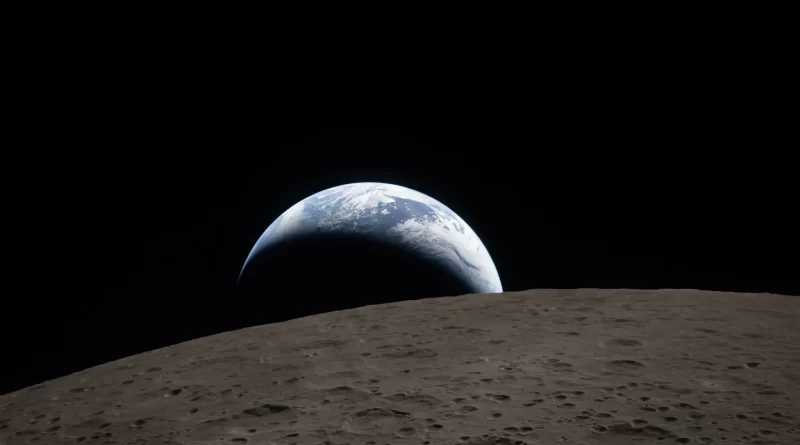
First Photos From NASA Moon Flyby Show Setting Earth and Eclipse

The White House and NASA released imagery captured by the cameras of the four astronauts of the Artemis II mission.

Katrina Miller reported on the first half of the Artemis II mission from Johnson Space Center in Houston.
Minutes before the astronauts of the NASA Artemis II mission headed into a radio blackout, cut off from contact with Earth for 40 minutes while swooping around the moon’s far side, all they could do was watch.
There it was: The swirly blue crescent of our planet, with all of humanity — every single one of us, you, me, everyone we know — in tow. It dipped ever lower on the horizon of a lifeless, pockmarked moon, a poignant farewell to the members of the crew as they plunged into silence.
This was Earthset, captured in a picture released by the White House and NASA Tuesday morning. It is a view that rivals the iconic Earthrise captured by the astronauts of Apollo 8 in 1968, when they conducted the very first human journey around the moon.
“We will always choose Earth,” Christina Koch, a mission specialist on Artemis II, said once the crew members regained communications. “We will always choose each other.”

As the astronauts emerged from the other side of the moon, they experienced yet another breathtaking sight: a solar eclipse, from a vantage never witnessed by any human being.
The sun slipped behind the moon, revealing wispy strings of its atmosphere and creating a halo of light around the lunar rim. The view, captured in a second picture released by the White House, was augmented by a surrounding field of stars and planets, including Saturn and Venus.
Victor Glover, the Artemis II pilot, said it was difficult to capture with a camera, but the face of the moon was softly lit by the glow of Earth, enough to make out lunar hills and valleys.
“Humans probably have not evolved to see what we’re seeing,” Mr. Glover said, in awe. “It is truly hard to describe. It is amazing.”