
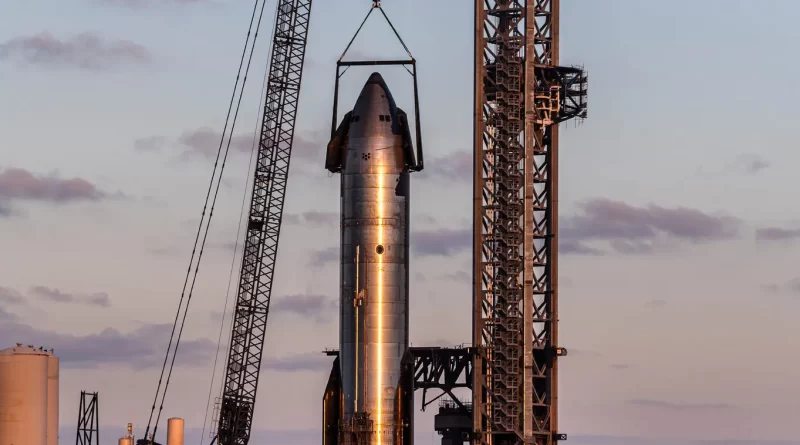
U.S. Is Losing Race to Return to Moon, Critics Say, Pointing at SpaceX

The company’s Starship rocket, which has suffered a series of recent test explosions, is still years away from being ready for the mission, former NASA executives say.

Reporting from Washington
Among these are his promises for fully autonomous self-driving cars or tunnels under Los Angeles to solve traffic congestion. Now some federal government officials worry that his pledges for landing astronauts on the moon will suffer similar delays.
That is why one of the largest federal contracts Mr. Musk has ever secured is now under intense scrutiny: a multibillion agreement with NASA for this crewed mission to the moon, the first in more than five decades.
The plan to invite private companies to develop a lunar lander for NASA was kicked off with much fanfare during President Trump’s first term, with a target of completing the mission by last year.
Other parts of the NASA moon mission are nearly ready, after their own delays and cost overruns, and are set to be subject to a full-scale flight around the moon with astronauts next year. But SpaceX’s lunar lander project is now so far behind schedule that there are increasing doubts the United States will beat China, which has its own plan with a targeted landing date of 2030, back to the moon.
The concerns, which have reached the White House, follow the falling out between Mr. Musk and President Trump, which led to a call by Mr. Trump and others inside the administration to at least initially look for SpaceX contracts to pare back or cancel.
But seven current and former senior NASA officials, in recent public statements and interviews with The New York Times, said their questions about SpaceX and its new Starship rocket had nothing to do with the public spat between the president and his biggest campaign donor.
Rather, they are nervous that Mr. Musk has once again overpromised on what he could achieve by now.
The 15-story-tall Starship has not yet carried any astronauts or commercial cargo. It has exploded during three of its four recent tests, sending a spectacular but potentially dangerous plume of debris over the Caribbean on two of those aborted trips to space. And its current version can carry only a fraction of its promised payload of at least 100 tons into low-Earth orbit.
Making matters worse, they say, Mr. Musk’s plan to carry two astronauts to the surface of the moon relies on a never-attempted refueling in space that the former NASA engineers say is so risky and behind schedule that it could be years before it is ready for the moon mission, meaning China is likely to get an astronaut there before the United States.
“This is not anything against SpaceX — they have done incredible things,” said Douglas Loverro, who served as the head of NASA’s human spaceflight division early in Mr. Trump’s first term. “But the further you move from known technology, the longer it takes to go ahead and get something done.”
Mr. Musk has missed a number of his own announced deadlines for the lunar project. For example, he predicted, and NASA announced, that SpaceX would attempt its first ship-to-ship fuel transfer test early this year, but that has now been delayed until at least 2026.
Mr. Musk, in remarks this month, expressed confidence that the Starship project continued to make progress.
“Unless we have some very major setbacks, SpaceX will demonstrate full reusability next year, catching both the booster and the ship, and being able to deliver over 100 tons to a useful orbit,” Mr. Musk said during a podcast, referring to three of SpaceX’s goals.

NASA is currently targeting 2027 for its mission, Artemis III. That will rely on a separate Space Launch System rocket, built by contractors other than SpaceX, to carry a spacecraft called Orion to get the astronauts to lunar orbit. The astronauts will then be transferred to SpaceX’s Starship for the moon landing — a sequence that is much more complicated than earlier NASA moon missions.
But privately, NASA officials are already acknowledging that the mission date is likely to slip to 2028. Mr. Loverro and other former NASA officials predicted that Starship, given its current challenges, would not be ready for its part of the moon mission until perhaps 2032.
Part of the problem, former NASA officials acknowledge, is they chose an excessively complicated lunar landing plan, starting during Mr. Trump’s first term. Trump administration officials back then did not take up a proposal to construct a lander based on existing, proven technology, said Mr. Loverro, who helped devise the alternative lander proposal starting in late 2019 when he joined NASA.
The White House liked the commercial approach. It shifted NASA toward the goal of buying space travel as a service, instead of the agency directly overseeing the work plan. That was less expensive and had a fixed price, avoiding the possibility of federal cost overruns, Mr. Loverro and a second former NASA official then involved in the deliberations said. (With courtesy from The New York Times–Admin)